
Fashion Retail & E-commerce, Fashion Trends & Future, Sustainable Fashion, resources
Why Fabric Construction Matters More Than Most Brands Realise

Why Fabric Construction Matters More Than Most Brands Realise
Looking Beyond Surface-Level Design
Fashion consumers have become far more aware of garment quality over the last decade. While branding, graphics, and aesthetics still influence buying decisions, more customers now pay attention to how clothing feels, behaves, and lasts over time. Fabric softness, shape retention, shrinkage, fading, and durability increasingly shape how people judge whether a garment feels genuinely premium.
This shift reflects broader changes within fashion itself. Growing criticism of disposable fast fashion has encouraged many consumers to think more carefully about longevity and material quality. Shoppers who once focused mainly on visual appeal now question whether garments justify their price in terms of construction, performance, and design.
As a result, brands have begun paying closer attention to the hidden manufacturing details that influence how garments are perceived. Fibre composition, weave density, stitching quality, and finishing treatments all affect how clothing performs after repeated wear. Customers may not always describe these elements in technical terms, but they recognise the difference instinctively.
Premium apparel brands have understood this relationship for years. Strong construction helps garments maintain softness, stability, and structure long after purchase. Poor construction often reveals itself quickly through twisting seams, stretched collars, rough textures, or distorted fits.
Garment quality extends far beyond surface-level aesthetics. Fabric behaviour often determines whether clothing continues feeling premium once the initial visual impression fades.
Why Fabric Construction Shapes Garment Quality

Why Fabric Construction Matters More Than Most Brands Realise
Fabric construction directly influences how garments fit, move, age, and recover during long-term wear. Small structural differences can dramatically affect whether clothing feels refined or disposable, even when garments appear visually similar at first glance.
Weave density plays a major role in perceived quality. Tighter constructions generally create smoother, more stable surfaces that hold their shape more effectively over time. Looser constructions may initially feel softer or lighter, but they often distort more easily and lose structure faster after repeated washing.
Stitch consistency also affects garment stability. Uneven seams, inconsistent tension, or poor alignment can gradually create twisted hems, stretched necklines, and distorted side seams. Customers may not identify the technical cause, but they immediately notice when garments stop fitting properly.
Many premium brands favour side-seamed construction because it improves fit consistency and helps garments maintain shape more reliably. Tubular garments reduce manufacturing complexity, but side seams usually provide better structural control, particularly in fashion-oriented fits.
Drape creates another important quality signal. Well-constructed fabrics move naturally on the body because manufacturers carefully balance yarn quality, fabric density, and finishing treatments. Poor drape can make garments feel stiff, unstable, or awkward, regardless of branding or styling.
Shrinkage behaviour also separates premium construction from lower-quality manufacturing. Pre-shrinking and fabric stabilisation treatments help garments retain their intended fit after washing. Without these processes, fabrics often shrink unevenly or lose shape rapidly.
Consumers frequently associate garment quality with GSM alone, yet fabric weight rarely tells the full story. Heavy fabrics can still feel rough, unstable, or poorly engineered if manufacturers use lower-quality yarns or inconsistent construction methods. Conversely, lightweight garments often feel exceptionally refined when brands prioritise superior fibres and tighter manufacturing standards.
Collar construction highlights this difference clearly. Weak ribbing and inconsistent stitching frequently cause necklines to warp or stretch after limited wear. Strong collar retention immediately improves perceived quality because the neckline visually frames the garment.
Recovery behaviour matters as well. Premium fabrics generally return to shape more effectively after movement and stretching, while lower-quality garments often become misshapen over time. This distinction strongly influences long-term wearability.
Modern consumers increasingly recognise these differences, even when they cannot explain them in technical terms. Customers simply describe garments as feeling “cheap,” “rough,” or “thin” because construction flaws immediately affect the overall wearing experience.
The Difference Between Cheap and Premium Cotton
Why Fabric Construction Matters More Than Most Brands Realise
Cotton quality varies far more dramatically than many consumers realise. Two garments labelled “100% cotton” can behave entirely differently depending on fibre length, spinning method, yarn preparation, and finishing quality.
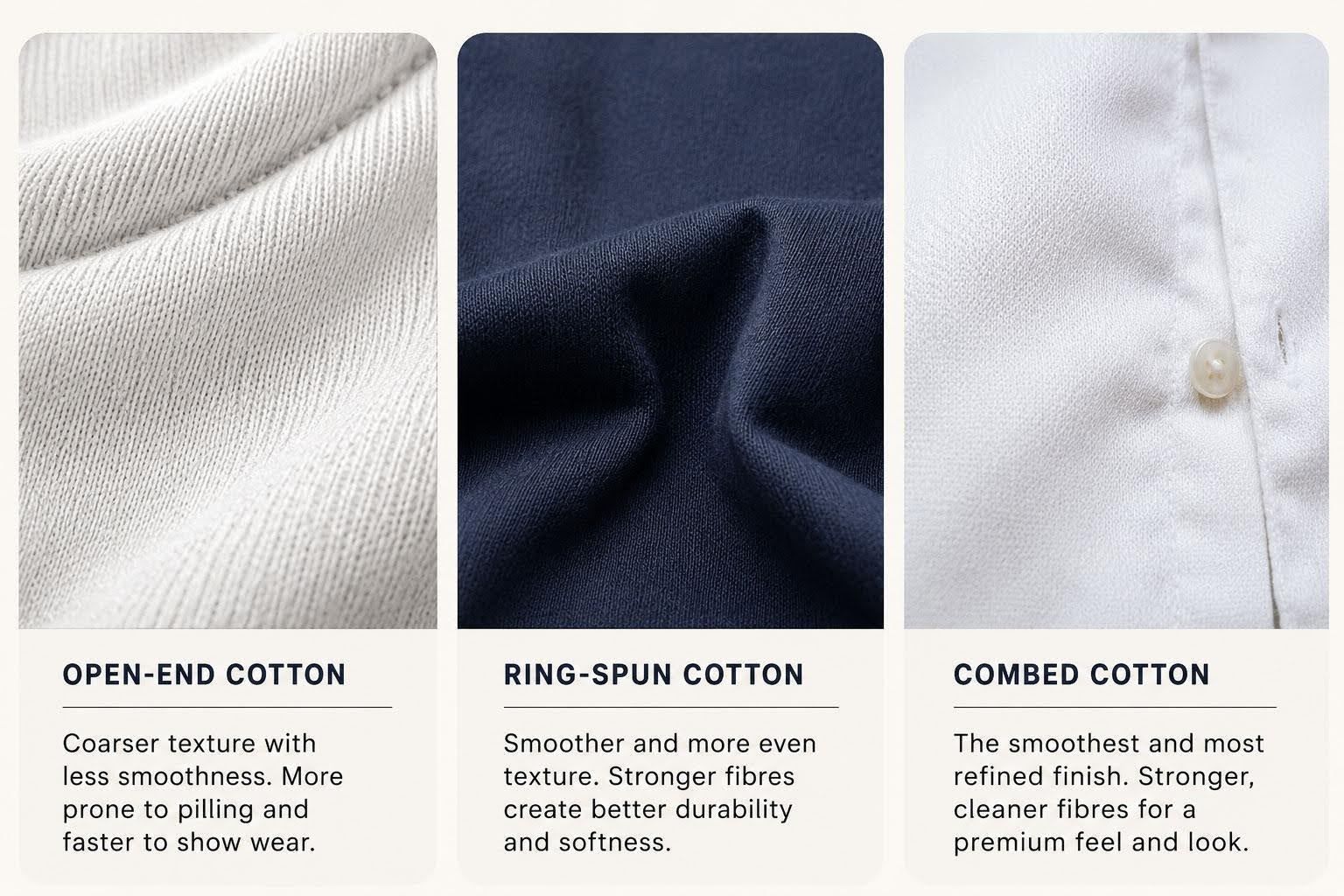
Open-end cotton, commonly used in lower-cost garments, typically produces rougher, less consistent yarns because manufacturers spin shorter fibres at higher speeds during production. This approach reduces costs efficiently, but fabrics often pill more aggressively and lose softness faster over time.
Ring-spun cotton creates a smoother, more refined surface because the spinning process twists the fibres more evenly. Longer fibres remain more consistently aligned, producing softer textures and improved durability. Many premium garments rely on ring-spun construction because it improves both comfort and fabric stability.
Combed cotton undergoes additional refinement before spinning begins. Manufacturers remove shorter fibres and impurities during processing, leaving behind cleaner and stronger fibres. The additional refinement process produces softer fabrics with greater consistency and durability. Combed ring-spun cotton combines fibre refinement with an improved yarn structure, significantly enhancing perceived garment quality.
Fibre smoothness also influences how fabrics age visually. Rougher yarn structures can create uneven fading, patchy textures, or excessive pilling after repeated washing. Higher-quality cotton constructions generally wear more evenly and maintain a cleaner appearance over time.
Organic cotton has also become increasingly important within premium fashion markets. While organic certification primarily relates to agricultural standards rather than softness directly, many brands using organic cotton also prioritise stronger overall construction quality. Consumers often associate organic garments with better durability, softness, and longevity because the production standards surrounding them tend to be higher overall.
Premium cotton fabrics also retain softness differently over time. Lower-quality garments may initially feel acceptable due to finishing treatments, but repeated washing often quickly exposes underlying fibre inconsistencies. Higher-quality fibres generally maintain softness longer because the yarn structure itself remains stronger and more stable.
Apparel specialists working closely with garment decoration and textile finishing increasingly recognise how strongly fibre consistency affects long-term garment performance. In its article “What’s the Best Fabric for DTG Printing?”, The T-Shirt Bakery also highlights how smoother cotton surfaces and stable fabric structures typically produce better long-term softness, consistency, and overall garment durability.
Durability also depends heavily on fibre integrity. Longer staple fibres create stronger yarns because fewer loose fibre ends protrude from the fabric surface. Reduced fibre breakage improves overall garment lifespan and minimises visible deterioration.
Cotton quality influences far more than comfort alone. Fibre consistency, yarn structure, and fabric refinement all contribute to how premium garments feel, wear, and age throughout their lifespan.
Why Finishing Treatments Matter

Why Fabric Construction Matters More Than Most Brands Realise
Finishing treatments often shape garment quality just as strongly as fibre composition or fabric construction. Many of the characteristics consumers associate with premium apparel — softness, smoothness, colour richness, stability, and comfort — develop during the finishing stage rather than during weaving or knitting alone.
Enzyme washing plays a major role in this process. Manufacturers use enzyme treatments to remove loose surface fibres and soften the fabric texture without damaging structural integrity. Enzyme treatments create a cleaner surface with a smoother hand feel while also reducing excessive fuzziness and pilling. Premium garments frequently feel more refined because finishing treatments improve surface consistency before products ever reach retail shelves.
Silicone finishing also contributes to softness and drape. Manufacturers apply silicone-based softeners to improve smoothness and flexibility, helping fabrics move more naturally on the body. Well-balanced silicone finishing can create a noticeably more luxurious feel, particularly on premium jersey garments. Excessive treatment, however, can create artificial slickness that fades quickly after washing, which is why finishing quality matters as much as the treatment itself.
Pre-shrinking treatments improve garment stability by reducing unexpected shrinkage during consumer washing cycles. Without proper stabilisation, fabrics can distort unevenly and rapidly lose fit consistency. Strong pre-treatment processes help garments retain their intended silhouette and structure over time, particularly in premium apparel categories where consumers expect long-term shape retention.
Dyeing methods also significantly influence how garments are perceived. Reactive dyes generally create stronger fibre bonding, producing richer colour consistency and improved wash durability compared with lower-cost dyeing processes. Garment dyeing introduces an entirely different aesthetic, often producing softer textures and more natural colour variation that many contemporary brands intentionally pursue.
These hidden manufacturing stages strongly influence how garments age. Premium finishing treatments help fabrics maintain softness, preserve colour consistency, and reduce long-term surface deterioration. Poor finishing standards often reveal themselves quickly through rough textures, uneven fading, stiffness, or instability after repeated washing.
Fashion consumers rarely discuss finishing chemistry directly, yet they respond strongly to its results. Customers notice when garments continue feeling soft months later. They recognise when fabrics maintain colour depth and structural integrity after repeated wear. These experiences shape perceived quality far more than many brands realise.
Finishing treatments also affect how garments interact with decoration and production processes. Smoother, more stable surfaces generally produce more consistent results across printing and embellishment methods because fabrics behave more predictably during manufacturing.
Premium apparel depends not only on fabric selection but also on how manufacturers refine and stabilise garments after construction. Finishing quality often determines whether products ultimately feel elevated or disposable.
Sustainability Is Pushing Brands Toward Better Construction

Why Fabric Construction Matters More Than Most Brands Realise
Sustainability conversations in fashion have gradually shifted away from purely material-focused discussions toward broader questions about garment lifespans and long-term wearability. Consumers increasingly recognise that durability forms an important part of responsible production. Clothing that lasts for years of regular use generally generates less waste than garments designed for short-term consumption.
This shift has encouraged many brands to focus more carefully on construction quality. Stronger stitching, higher-quality fibres, better fabric stability, and improved finishing treatments all help garments remain usable for longer. Longevity now functions as both a sustainability goal and a quality signal.
The growing slow-fashion movement clearly reflects this change. Many consumers no longer want wardrobes built entirely around rapid turnover and short-lived trend cycles. Instead, buyers increasingly invest in garments that retain fit, softness, and structural integrity over time. Premium construction standards support both sustainability messaging and customer satisfaction simultaneously.
Organic cotton growth has reinforced this movement as well. Brands operating in the ethical fashion space often prioritise higher overall garment quality because sustainability-conscious consumers tend to scrutinise products more closely. Poorly constructed garments undermine environmental messaging quickly if products deteriorate after limited wear.
Consumer awareness has accelerated significantly through social media and online retail reviews. Buyers openly discuss transparency, durability, shrinkage behaviour, and fabric quality when evaluating brands. As a result, construction flaws have become far more visible to the public than they once were.
Reuters has reported growing pressure on fashion brands to improve garment longevity and reduce waste as consumers become increasingly critical of disposable fashion and short-term product lifecycles.
Industry forecasts also reflect the growing commercial importance of sustainable fashion. According to the IMARC Group Sustainable Fashion Market Report, the global sustainable fashion market is likely to grow from $9.22 billion in 2024 to $64.4 billion by 2033. This expansion highlights how strongly consumer priorities continue shifting toward longevity, material awareness, and responsible production standards.
Brands responding successfully to this shift generally approach sustainability through product quality rather than marketing language alone. Durable garments naturally reduce replacement frequency, lower waste output, and encourage more conscious consumption patterns. Construction quality becomes central to the credibility of sustainability.
Fashion businesses increasingly recognise that consumers judge sustainability claims against the garment’s physical performance. Products that lose shape quickly, fade excessively, or deteriorate after minimal wear struggle to support long-term brand trust regardless of environmental messaging.
Why Construction Also Affects Print Performance

Why Fabric Construction Matters More Than Most Brands Realise
Garment construction also influences production outcomes, particularly within decorated apparel categories. While graphics and branding remain visually dominant, the quality of the underlying garment often determines whether the decoration retains its refined look after repeated wear.
Tighter fabric constructions generally produce cleaner and more consistent print surfaces because smoother fabrics allow greater detail definition and colour consistency. Looser or unstable constructions can create uneven surfaces that distort decoration visually over time.
Smoother cotton fibres also improve print clarity because consistent yarn surfaces absorb ink more evenly. Rougher fabrics frequently produce less precise detail and more inconsistent ageing after washing. Premium garments tend to maintain decorated surfaces more effectively throughout the garment’s lifespan.
Fabric stability matters equally. Garments that twist, shrink unevenly, or lose structural integrity after washing can significantly distort printed artwork. Stable construction helps decorated garments retain alignment and overall visual balance over the long term.
Poor-quality garments often deteriorate more quickly after decoration because lower-grade fibres and unstable construction struggle to withstand repeated washing cycles. Surface roughness, excessive pilling, and structural distortion can all reduce perceived print quality even when the decoration itself remains technically intact.
Many apparel-focused businesses involved in custom garment production now place growing emphasis on fabric quality and construction consistency before decoration begins. Premium blanks typically produce more reliable long-term results because the garment itself provides a more stable foundation throughout production and wear.
Fashion-conscious brands increasingly understand this relationship. Decoration quality depends not only on the artwork or print technique but also on how the garment behaves physically over time. Construction quality and production outcomes remain closely connected.
Why Construction Quality Defines Long-Term Brand Perception
Fashion branding extends far beyond logos, graphics, or campaign aesthetics. Customers ultimately judge brands through physical experience — how garments feel, perform, age, and retain quality after repeated wear.
Fabric construction shapes that experience continuously. Fibre quality influences softness and durability. Weave density affects drape and stability. Finishing treatments determine texture, colour behaviour, and longevity. Together, these hidden manufacturing decisions create the difference between garments that feel genuinely premium and garments that quickly feel disposable.
As consumers become more aware of quality, sustainability, and garment lifespan, construction standards will continue influencing purchasing decisions more strongly. Brands that prioritise material quality and manufacturing consistency are likely to build stronger long-term trust because customers increasingly recognise the value of well-constructed apparel.
Visual branding may attract initial attention, but construction quality often determines whether garments continue reinforcing brand credibility months or years later.
Share

Ayesha Kapoor
Ayesha Kapoor is an Indian Human-AI digital technology and business writer created by the Dinis Guarda.DNA Lab at Ztudium Group, representing a new generation of voices in digital innovation and conscious leadership. Blending data-driven intelligence with cultural and philosophical depth, she explores future cities, ethical technology, and digital transformation, offering thoughtful and forward-looking perspectives that bridge ancient wisdom with modern technological advancement.


