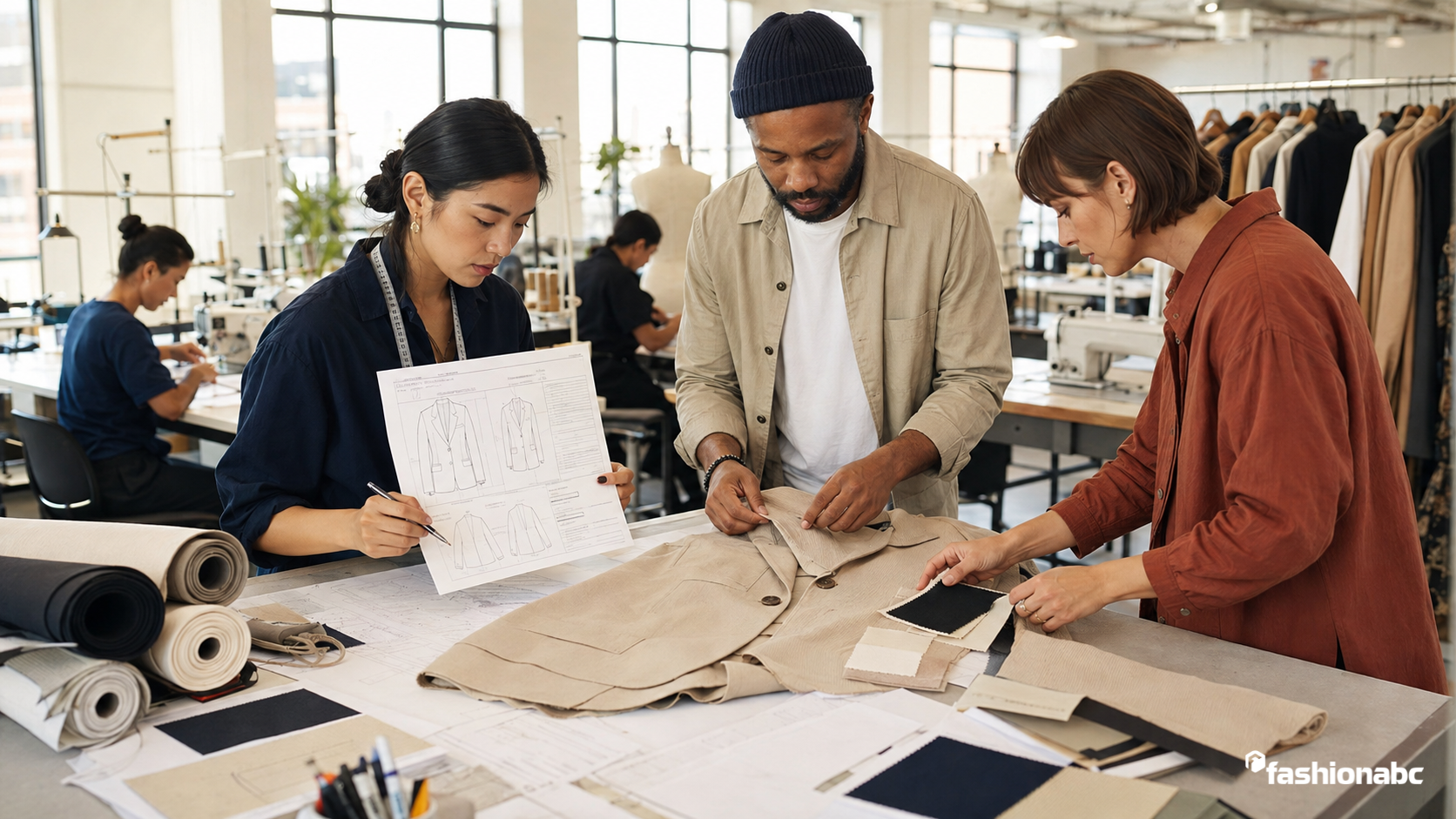
The clothing production process turns a design concept into garments that can be sold consistently and profitably. It covers product specifications, material sourcing, pattern development, sampling, minimum order quantities, bulk manufacturing and quality control.
For a new fashion brand, understanding this process can prevent unclear quotations, repeated sample revisions, inconsistent sizing and expensive production mistakes.
For the complete journey from concept to launch, read Fashionabc’s guide on how to start a clothing brand.
Key takeaways
- A tech pack converts a creative concept into measurable manufacturing instructions.
- Sampling tests the garment’s construction, fit, materials and performance.
- MOQ means minimum order quantity, but it may apply per style, colour or fabric.
- Bulk manufacturing should not begin until the pre-production sample is approved.
- Quality control should take place throughout production—not only before shipment.
What is the clothing production process?
The clothing production process is the sequence through which a garment moves from an initial design to finished inventory.
The precise workflow depends on the business model. A private-label product based on an existing garment requires less development than an original cut-and-sew jacket with custom patterns, fabrics and hardware.
Most clothing production follows eight stages:
- Define the product.
- Create the tech pack.
- Source materials and manufacturers.
- Develop and fit-test samples.
- Confirm costing and MOQ.
- Approve the pre-production sample.
- Manufacture the bulk order.
- Inspect, package and ship the garments.
Step 1: Define the product
Begin with a clear product brief. A manufacturer cannot accurately quote or develop an idea described only as “premium streetwear” or “sustainable activewear.”
Define:
- Target customer and use case
- Product category and silhouette
- Fit and size range
- Materials and performance requirements
- Colours and branding placements
- Estimated quantity
- Target retail price
- Required delivery date
- Countries where the product will be sold
Also choose the appropriate production model. Founders using existing products can explore private-label fashion, while brands seeking an original fit and construction normally require custom cut-and-sew development.
Step 2: Create a fashion tech pack
A fashion tech pack is the technical document used to communicate how a garment should be made. It gives the designer, pattern maker, sample room and factory one controlled source of information.
A complete tech pack may contain:
Technical drawings
Show the garment from the front, back and any relevant side or internal views. Mark seams, pockets, panels, fastenings, topstitching and construction details.
Measurement specifications
Provide measurements for the base size and identify each point of measurement. Include acceptable tolerances rather than relying on descriptions such as “slightly oversized.”
Bill of materials
The bill of materials, or BOM, lists everything needed to make and package the garment:
- Main and contrast fabrics
- Linings and interlinings
- Thread
- Buttons, zips and hardware
- Elastic, cords and tapes
- Brand, size and care labels
- Hangtags and packaging
Construction details
Specify seam types, stitch types, seam allowances, hems, reinforcement and finishing. Reference photographs can help, but they should not replace measurable instructions.
Colours and artwork
Record colour references, print or embroidery methods, artwork dimensions and exact placement measurements.
Labels and packaging
Define label content, size, material and placement. Include folding, protective bags, hangers, barcodes and carton instructions where relevant.
The brand identity must also work in physical production. FashionABC’s guide to clothing-brand logos explains how to prepare marks for embroidery, woven labels, printing and hardware.
Control every revision
Add a date and version number whenever the tech pack changes. Confirm that the manufacturer is working from the latest file and record all approvals in writing.
Step 3: Find the right clothing manufacturer
Choose a factory with relevant experience. A manufacturer specialising in basic jersey garments may not have the equipment or expertise required for tailoring, seamless activewear or technical outerwear.
Ask prospective manufacturers about:
- Experience with similar products
- Pattern-making and sampling services
- Material sourcing
- Available machinery
- Sample charges
- Minimum order quantities
- Production capacity and lead times
- Payment terms
- Testing and quality-control procedures
- Processes completed by subcontractors
- Relevant certifications and references
Send the same brief and tech pack to each shortlisted manufacturer. This makes quotations easier to compare.
For specialist categories, investigate product-specific requirements. Fashionabc’s guide to finding a children’s clothing manufacturer covers considerations relevant to childrenswear production.
Step 4: Develop and review garment samples
Sampling reveals whether the specifications work as a physical garment. It should test fit, construction, materials, appearance and function before the brand commits to bulk manufacturing.
Factories may use different names for samples, so confirm the purpose of each stage.
| Sample | Purpose |
|---|---|
| Development sample | Interprets the initial design and construction |
| Fit sample | Tests measurements, proportion, balance and movement |
| Size set | Checks grading and fit across selected sizes |
| Pre-production sample | Confirms final materials, trims and construction |
| Top-of-production sample | Checks an early unit from the bulk production line |
| Shipment sample | Records what was completed and shipped |
Not every garment requires every sample. Complexity, quantity, risk and factory procedures determine the appropriate sequence.
How to review a clothing sample
Compare every sample with the current tech pack and check:
- Silhouette and proportions
- Measurements and tolerances
- Fit, comfort and movement
- Fabric, colour and trims
- Seam and stitch quality
- Pockets and fastenings
- Print or embroidery placement
- Labels and packaging
- Appearance after washing or wear
Make feedback specific. “Improve the fit” gives the pattern maker little direction. A comment such as “reduce the sleeve length by 1.5 cm and review cuff placement” is measurable.
Depending on the garment, testing may also cover shrinkage, colourfastness, pilling, seam strength, stretch recovery, abrasion and print durability.
Step 5: Understand MOQ in clothing production
MOQ means minimum order quantity: the smallest production commitment a supplier will accept under specific commercial conditions.
A manufacturer offering an MOQ of 300 units might mean:
- 300 units per style
- 300 units per colour
- 300 units per fabric
- 300 units across the complete order
A fabric mill or trim supplier may also impose a separate MOQ. Always ask how the minimum is calculated before approving the quotation.
Why do manufacturers have MOQs?
Factories incur setup costs before production begins, including:
- Pattern and marker preparation
- Machine configuration
- Cutting-room setup
- Fabric and trim purchasing
- Print or embroidery setup
- Production-line planning
Small orders spread these costs across fewer garments, making the unit price higher.
Can MOQ be negotiated?
Manufacturers may reduce an MOQ when the brand:
- Accepts a higher unit price
- Uses stock fabrics or available colours
- Reduces the number of styles
- Uses one fabric across several products
- Pays a small-order surcharge
- Starts with a trial order
- Avoids custom trims and packaging
A lower MOQ is not automatically a better deal. The resulting unit cost must still support a viable selling price and margin.
Calculate the SKU impact
Three styles offered in four colours and five sizes create 60 stock-keeping units. An order of 600 garments would average only ten units per SKU before differences in size and colour demand are considered.
Keep the first collection focused to reduce inventory and forecasting risk.
Step 6: Approve the pre-production sample
The pre-production sample, commonly called a PPS, should represent the garment authorised for bulk manufacturing.
Before approving it, confirm:
- Final pattern and grading
- Production fabric and colours
- Trims and hardware
- Construction and measurements
- Artwork placement
- Labels and care information
- Packaging
- Measurement tolerances
- Testing requirements
Keep an approved physical sample where possible. This sealed or “golden” sample can be compared with garments taken from the production line.
Avoid approving a sample “with changes” unless the outstanding corrections are documented clearly. Significant changes should be verified before production begins.
Step 7: Begin bulk clothing manufacturing
Once the purchase order, specifications, sample and payment terms are approved, the manufacturer can begin bulk production.
A typical sequence includes:
- Receiving and inspecting materials
- Relaxing and preparing fabric where required
- Creating markers and cutting fabric
- Bundling cut components
- Sewing and assembling garments
- Adding prints, embroidery or finishes
- Pressing and finishing
- Attaching labels
- Inspecting garments
- Folding and packaging the order
Review early production units before the full order is completed. A mistake identified at the start of the production line is easier to correct than one repeated across every garment.
Step 8: Conduct clothing quality control
Clothing quality control checks whether the finished garments meet the approved specifications and agreed workmanship standards.
It should take place at several points:
Before production
Inspect materials, trims, colour references and labels. Hold a pre-production meeting to review the tech pack, approved sample and known risks.
During production
Inspect early and in-line garments for construction, measurements and recurring defects. Confirm that corrective action is taken before production continues.
After production
Check finished and packed garments against the purchase order, approved sample and quality requirements.
Clothing quality-control checklist
Confirm that:
- Measurements fall within approved tolerances.
- Fabric, colours and trims match the sample.
- Seams and stitches are secure.
- Prints and embroidery are correctly positioned.
- Fastenings work properly.
- Garments are clean and undamaged.
- Labels contain the approved information.
- Size and colour quantities are correct.
- Packaging matches the instructions.
- Failed garments are isolated, repaired or replaced.
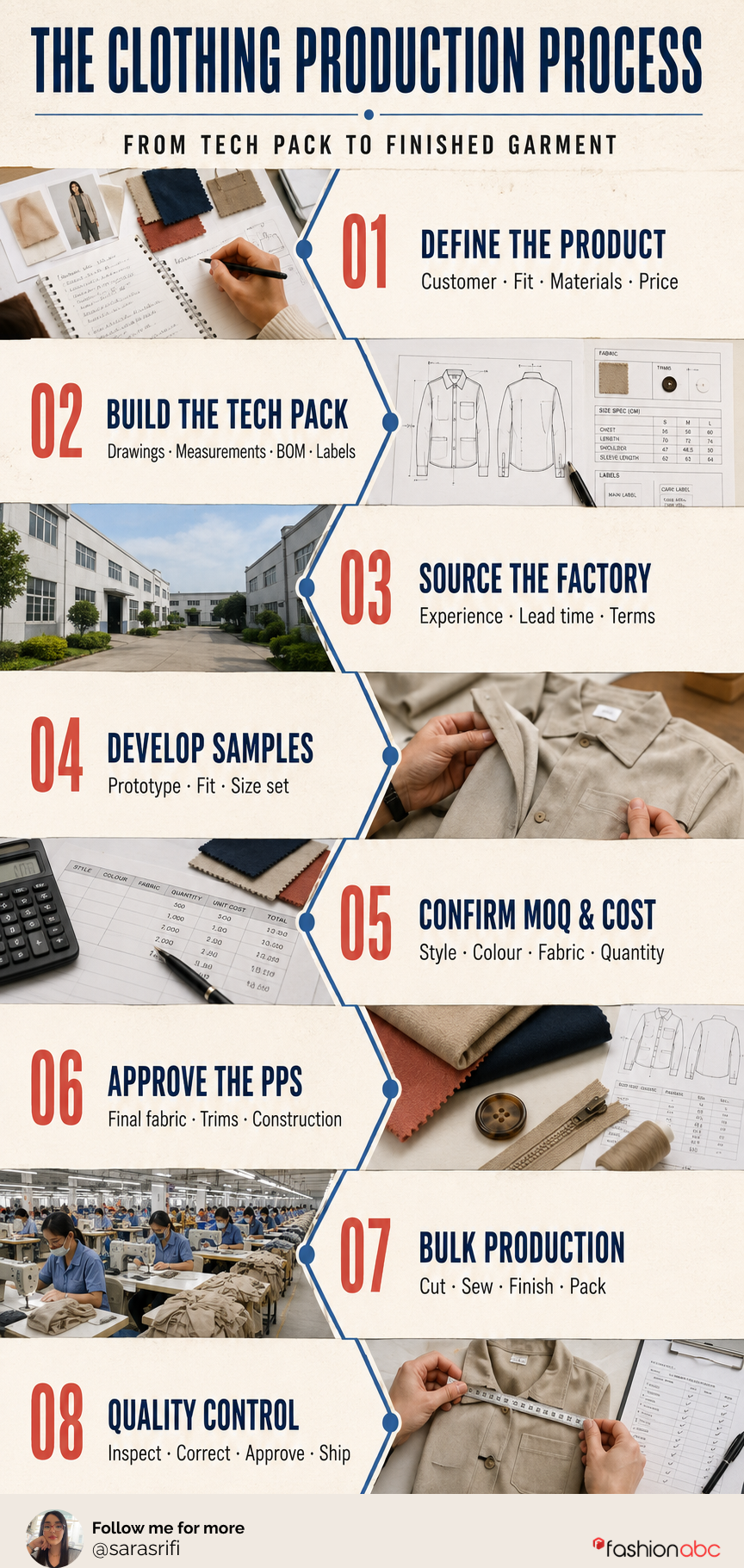
The clothing production process – Created by Sara Srifi for Fashionabc
What is AQL in clothing inspection?
AQL is commonly used to describe an acceptance-quality limit within a statistical sampling plan. An inspector examines a defined number of randomly selected garments and compares the defects found with agreed acceptance and rejection criteria.
Defects are commonly grouped as:
- Critical: A safety, legal or serious usability problem
- Major: A defect likely to cause rejection or return
- Minor: A smaller departure from the agreed standard
A passed sample inspection does not prove that every unit is perfect. It indicates that the inspected lot met the agreed sampling criteria. ISO 2859-1 provides sampling procedures for inspection by attributes, but the appropriate inspection plan depends on the product and its risks.
Clothing labels and compliance
Product requirements depend on the garment and markets where it will be sold.
In the United States, covered textile products may require information including fibre content, country of origin and the identity of the manufacturer or responsible business. The Federal Trade Commission also administers the Care Labeling Rule.
Additional safety and testing requirements can apply to particular products, especially children’s clothing. Review applicable rules before printing labels or beginning bulk production.
This is general production information rather than legal or regulatory advice.
Common clothing-production mistakes
- Sending only a sketch: Factories need measurements, materials and construction specifications.
- Approving colours from a screen: Review physical swatches or lab dips when colour accuracy matters.
- Changing too many variables together: Revise systematically so new problems can be identified.
- Misunderstanding MOQ: Confirm whether the minimum applies by style, colour or fabric.
- Skipping the pre-production sample: Development samples may use substitute materials.
- Inspecting only at the end: Late checks can uncover problems after the full order is complete.
- Choosing only by price: Delays, defects and poor communication create additional costs.
- Ignoring schedule contingency: Sampling, testing, materials and freight can all cause delays.
Frequently asked questions
What is a fashion tech pack?
A fashion tech pack is a controlled document containing the drawings, measurements, materials, construction and finishing instructions needed to develop and manufacture a garment.
How many samples are required?
There is no fixed number. Sampling should continue until the relevant fit, materials, construction and performance requirements are approved.
What does MOQ mean in clothing?
MOQ means minimum order quantity—the smallest order a manufacturer or material supplier will accept under the quoted conditions.
What is a pre-production sample?
It is the final approval sample made using the intended production specifications. It becomes a reference for bulk manufacturing.
What is the difference between quality assurance and quality control?
Quality assurance creates processes intended to prevent defects. Quality control inspects materials and garments to determine whether they meet those requirements.
Final takeaway
The clothing production process depends on four connected controls: the tech pack defines the garment, sampling tests the design, MOQ establishes the commercial commitment and quality control checks whether production matches the approval.
Keep the first collection manageable, document every revision and never authorise bulk manufacturing before confirming the materials, fit, construction and inspection requirements.
Return to How to Start a Clothing Brand: Business Plan, Branding, Production and Launch to connect production with positioning, pricing and launch planning.
Sources
- Federal Trade Commission: Textile and wool labelling requirements
- Federal Trade Commission: Care Labeling Rule
- US Consumer Product Safety Commission: Clothing and textiles guidance
- ISO: ISO 2859-1 sampling procedures
- International Chamber of Commerce: Incoterms rules