
Starting a clothing brand means building more than a collection of garments. You need a defined customer, a commercially viable product, a recognisable identity, reliable production, workable margins and a launch plan that creates demand before inventory becomes a financial burden.
The strongest clothing brands usually begin with a narrow promise: a particular product for a particular person, delivered better than the available alternatives. This guide explains how to turn that promise into a business—from the first market test to production and launch.
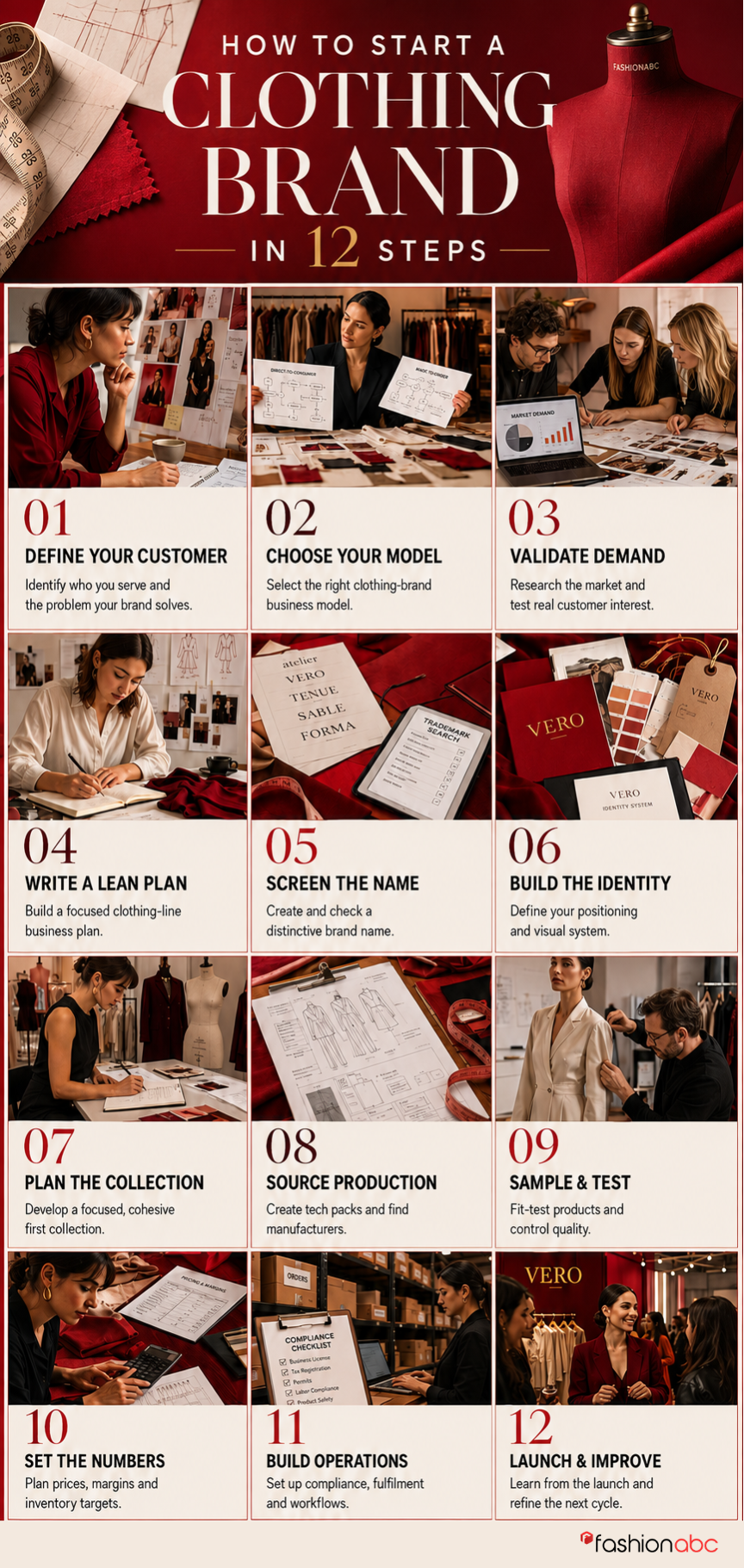
How to start a clothing brand in 12 steps
- Define the customer and the problem your brand solves.
- Choose a clothing-brand business model.
- Research the market and validate demand.
- Write a lean clothing-line business plan.
- Create and screen the brand name.
- Build the brand identity and positioning system.
- Plan a focused first collection.
- Develop tech packs and source manufacturers.
- Sample, fit-test and control quality.
- Set prices, margins and inventory targets.
- Establish operations, compliance and fulfilment.
- Launch, learn and improve the next production cycle.
1. Define the customer and the problem
Do not begin with “I want to make streetwear” or “I love fashion.” Those statements describe your interest, not the reason a customer should buy. Start with a defined audience, buying situation and unmet need.
A useful positioning sentence is:
We make [product] for [specific customer] who needs [outcome], unlike [alternative], because [credible difference].
For example, a brand might create washable workwear for women who travel frequently, modest activewear engineered for high-movement training, or premium heavyweight T-shirts with transparent local production. The niche does not need to be tiny; it needs to be specific enough to guide product and marketing decisions.
- Customer: Who is most likely to care and pay?
- Use case: When, where and why will the product be worn?
- Pain point: What is wrong with the current options—fit, quality, availability, values, price or design?
- Difference: What can the brand prove, rather than merely claim?
- Price position: Is the offer value-led, mid-market, premium or luxury?
2. Choose the right clothing-brand business model
Your business model determines how much control, capital and operational complexity the brand requires. Choose it before developing dozens of designs.
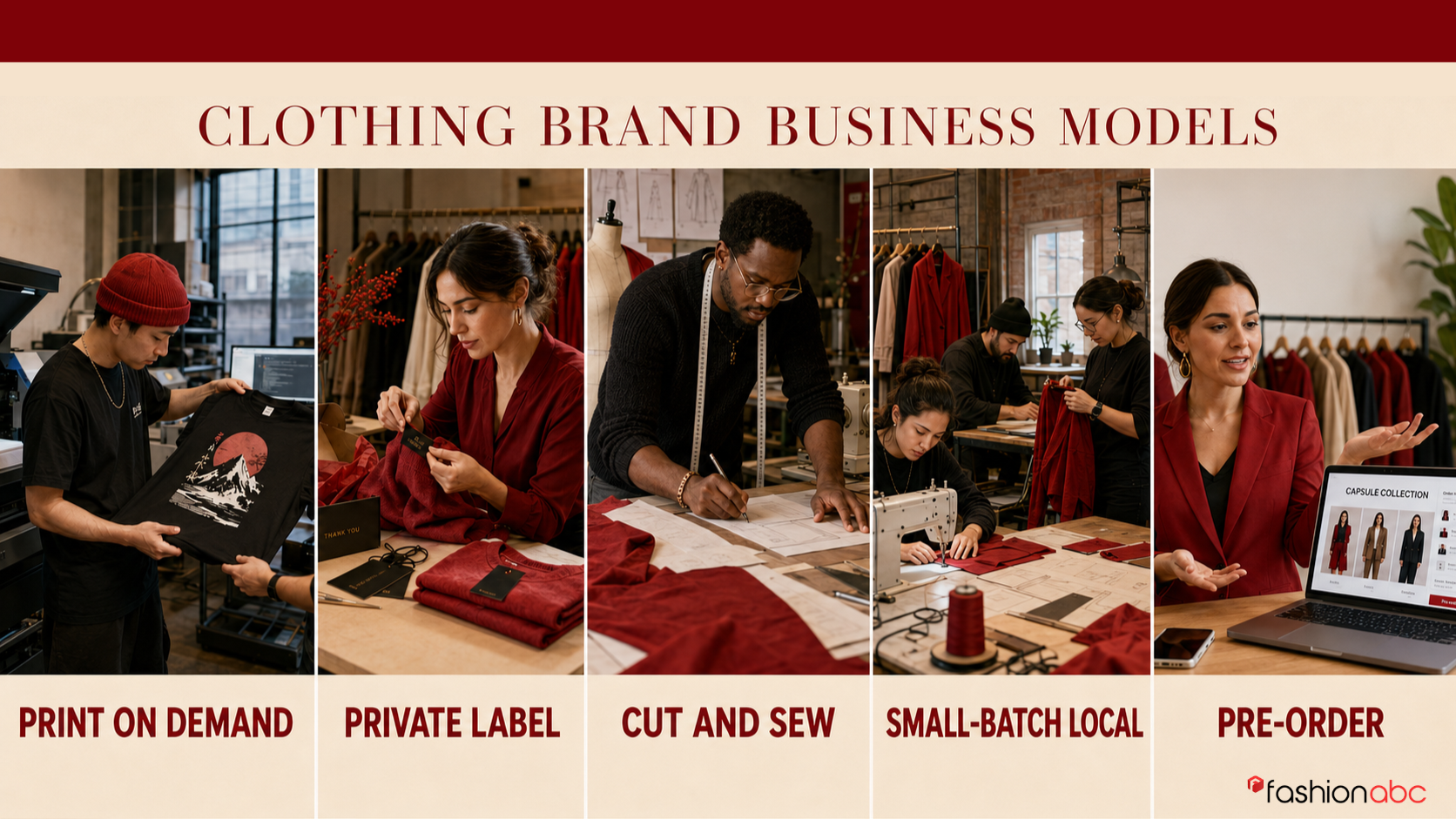
| Model | How it works | Best for | Main trade-off |
|---|---|---|---|
| Print on demand | A supplier prints and ships after each order. | Fast concept testing and creator-led brands | Low inventory risk, but lower control and margins |
| Private label | Existing products are customised with your label, colours or details. | Faster market entry with a branded range | Less product uniqueness |
| Cut and sew | Products are developed from original patterns and specifications. | Distinct fit, construction and long-term product IP | Higher development cost, time and minimums |
| Small-batch local | A nearby studio or factory produces limited runs. | Quality oversight and measured launches | Higher unit costs |
| Pre-order | Orders are collected before the main production run. | Demand validation and cash-flow control | Requires trust and realistic delivery dates |
A brand can combine models. For example, it might validate graphics through print on demand, move the strongest designs into small-batch production, and later develop proprietary cut-and-sew products.
3. Research the market and validate demand
Market research should reduce uncertainty, not decorate a pitch deck. Study the exact products customers already buy, the language they use, the price points they accept and the complaints competitors repeatedly receive.
- Map 10–15 direct competitors and record their hero products, prices, materials, size range, delivery proposition and customer reviews.
- Read low-rated reviews to identify recurring problems with fit, transparency, durability, returns and customer service.
- Interview potential customers about recent purchases, not hypothetical preferences.
- Test a landing page, waitlist, sample sale, pop-up or pre-order before committing to a large run.
- Track intent signals separately: likes are weak; email sign-ups, deposits, pre-orders and repeat enquiries are stronger.
Validation does not mean asking friends whether they like the logo. It means testing whether the right customer will take a meaningful action at a viable price.
4. Write a lean clothing-line business plan
A business plan is useful when it forces decisions. The U.S. Small Business Administration frames planning around market research, competitive analysis, funding and business structure. For an early clothing brand, a concise operating plan is often more useful than a long document built on speculative forecasts.
| Plan section | What to decide |
|---|---|
| Brand concept | Customer, problem, positioning and why the brand can win |
| Product | First collection, materials, sizes, colourways and development route |
| Market | Competitors, price bands, demand evidence and market-entry angle |
| Sales channels | Direct-to-consumer site, marketplaces, wholesale, pop-ups or social commerce |
| Operations | Suppliers, lead times, quality checks, inventory, fulfilment and returns |
| Marketing | Launch narrative, content system, partnerships, email and acquisition tests |
| Finance | Development cost, landed cost, pricing, margin, break-even point and cash buffer |
| Milestones | Sample approval, production order, content shoot, launch and reorder decision |
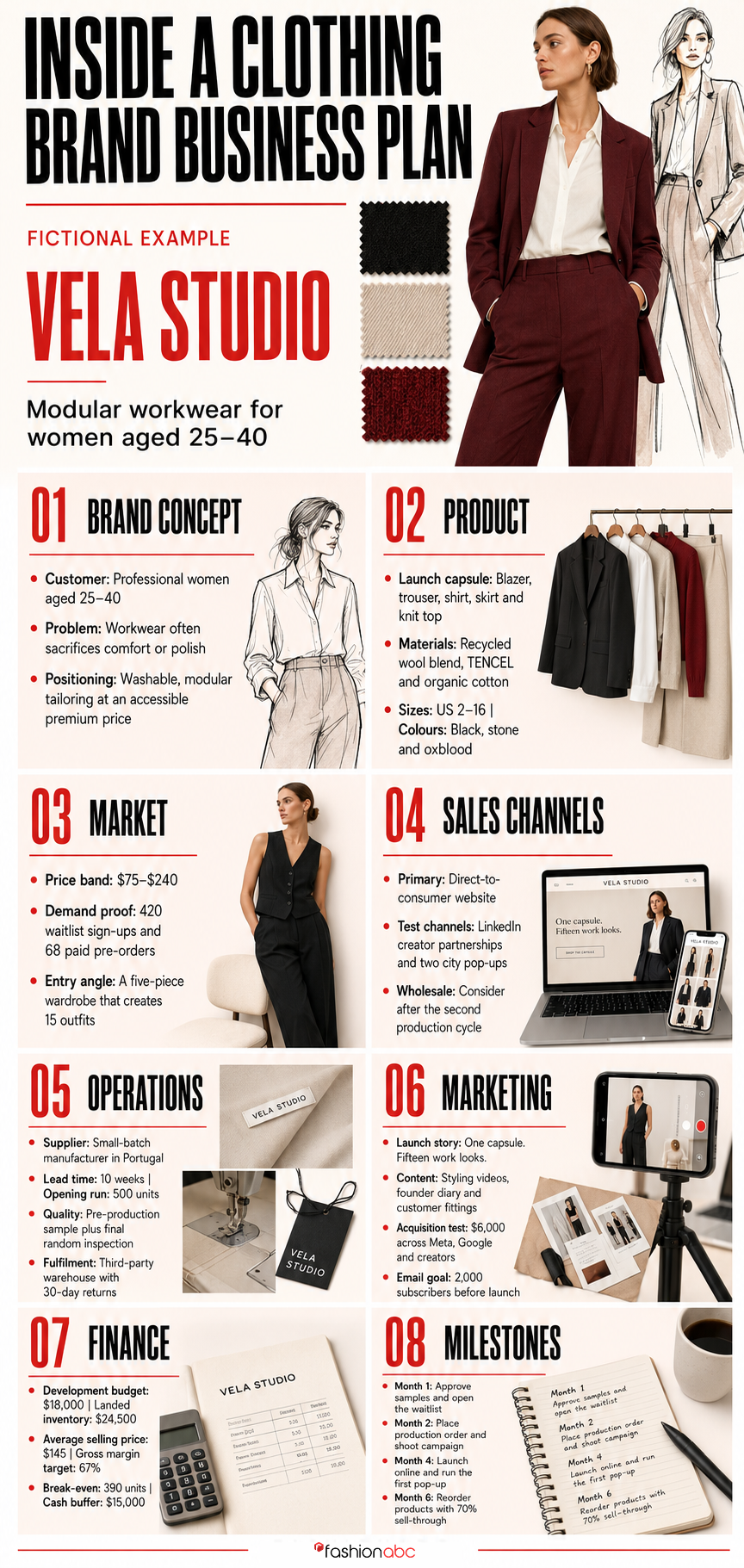
INSIDE A CLOTHING BRAND BUSINESS PLAN – Example: VELA STUDIO
How much does it cost to start a clothing brand?
There is no universal startup figure. The cost depends on product complexity, quantity, manufacturing location, materials, photography, packaging and whether the founder performs work that would otherwise be outsourced. The planning ranges below are illustrative—not industry averages or quotations.
| Launch route | Illustrative planning range | Typical scope |
|---|---|---|
| Lean validation | $500–$2,500 | Samples, basic identity, landing page and demand test |
| Small-batch launch | $3,000–$15,000 | A focused range, modest inventory, content and fulfilment setup |
| Custom cut-and-sew | $15,000–$50,000+ | Patterns, tech packs, multiple samples, custom materials and larger production commitments |
Build the budget from supplier quotations and a unit-economics model. Keep a contingency for sample revisions, freight, duties, failed units, returns and delayed production.
5. Create and screen the clothing brand name
A strong name should be distinctive, pronounceable, memorable and flexible enough to support future product categories. It should also be practical across trademarks, domains and social platforms.
- Generate names from the brand’s customer, values, origin story, materials, design language and cultural references.
- Remove names that are generic, confusingly similar to established brands or difficult to spell after hearing once.
- Search the web, marketplaces, company registers, domains and relevant social handles.
- Use the USPTO trademark search system when evaluating a name for the U.S. market, and review similar marks—not only exact matches.
- Consult a qualified trademark professional when the commercial stakes justify formal clearance and registration.
Important: an editorial naming checklist is not legal clearance. A free domain or social handle does not establish that a name is safe to use as a trademark.
6. Build a brand identity—not only a logo
The visual identity should make the brand recognisable across a garment label, ecommerce page, social video, packaging insert and wholesale line sheet. A logo is one component of that system.
- Positioning: the audience, promise, evidence and competitive frame
- Voice: how the brand sounds in product descriptions, campaigns and customer service
- Logo system: primary mark, compact mark and wordmark where needed
- Typography and colour: a usable hierarchy with accessible contrast
- Art direction: photography, casting, locations, styling, cropping and motion
- Applications: neck labels, care labels, hangtags, packaging, website and social templates
Avoid building an identity from whatever currently looks fashionable. The system should reflect the product and customer while remaining usable when design trends move on.
7. Plan a focused first collection
The first collection should prove the brand concept without creating unnecessary inventory complexity. Every additional style, fabric, colour and size creates another stock-keeping unit and another forecasting decision.
A disciplined launch may use one hero product, two supporting products and a restrained colour palette. The hero should communicate the brand’s difference most clearly and receive the strongest photography, storytelling and inventory support.
- Define the role of every product in the range.
- Limit colourways until demand is clearer.
- Choose a size range based on the customer and supplier capabilities—not habit.
- Create a collection architecture with good-better-best or entry-core-statement roles where relevant.
- Plan how products can be styled together to increase basket value without forcing bundles.
8. Develop tech packs and find manufacturers
A tech pack translates a design into production instructions. It reduces ambiguity between the founder, pattern maker, sample room and factory. Depending on the product, it may include technical drawings, measurements, construction details, seams, trims, fabric specifications, labels, colour references, artwork placement, grading notes and packaging instructions.
When evaluating manufacturers, ask about relevant product experience, machinery, minimum order quantity (MOQ), sampling charges, lead times, quality processes, material sourcing, payment terms, communication and production references.
- Send the same structured brief to shortlisted suppliers so quotations are comparable.
- Ask what is excluded from the quoted unit price.
- Clarify whether the MOQ applies per style, colour or total order.
- Confirm ownership and storage of patterns, screens, moulds and digital files.
- Use samples and a small trial order before increasing volume where commercially possible.
The cheapest quote is not necessarily the lowest-cost option. Rework, inconsistent sizing, missed launch dates and poor communication can erase the initial saving.
9. Sample, fit-test and control quality
Sampling is the process of discovering what the product actually is—not a ceremonial step before production. Record every change and version so approvals do not depend on memory or scattered messages.
- Review the first sample against the tech pack and intended customer.
- Conduct fit sessions on relevant bodies or approved forms and document measurements.
- Test wash, shrinkage, colourfastness, stretch recovery, seam strength and wear as appropriate.
- Approve materials, trims, artwork placement, labels, packaging and final measurements.
- Define acceptable tolerances and the inspection process before bulk production begins.
- Keep an approved sealed sample as the production reference.
Quality control should happen before, during and after production. A final inspection cannot always correct a problem already repeated across an entire run.
10. Price for a sustainable margin
Price must reflect the customer’s perceived value and the economics of operating the brand. Start with landed product cost—the product plus packaging, freight, duties and other costs required to make the unit sellable—then model transaction fees, fulfilment, returns, discounts, marketing and overhead.
Contribution margin per unit can be expressed as:
Selling price − variable product and selling costs = contribution margin
Do not confuse markup with margin. If a garment costs $30 and sells for $60, the markup on cost is 100%, but the gross margin before other variable costs is 50%. Wholesale plans require additional room because the retailer also needs a viable margin.
- Model full-price, promotional and wholesale scenarios separately.
- Calculate break-even units from fixed launch costs and contribution per unit.
- Include expected returns and damaged or unsellable stock.
- Avoid selecting a retail price first and forcing production economics to fit it later.
11. Establish operations and clothing compliance
Business formation, tax, product rules and consumer obligations vary by country, state and product category. In the U.S., founders should review business-structure and registration requirements, tax identification, textile and wool labelling, care labelling, country-of-origin marking and applicable product-safety rules.
The FTC’s textile guidance explains that covered products generally require information including fibre content, country of origin and the identity of the manufacturer or another responsible business. The FTC also administers the Care Labeling Rule for covered apparel. Imported products may face U.S. Customs and Border Protection marking requirements, while the Consumer Product Safety Commission provides clothing-related compliance guidance, including rules that can differ for children’s products.
- Choose and register the appropriate business structure.
- Obtain required tax registrations and an EIN where applicable.
- Use written supplier and contractor agreements.
- Confirm label content and placement before production.
- Set clear shipping, returns, privacy and customer-service policies.
- Review product liability and other insurance needs.
- Keep purchase orders, approvals, test results and production records organised.
This section is a planning overview, not legal, tax or regulatory advice. Requirements should be checked for the brand’s products and selling markets before launch.
12. Launch the clothing brand
A launch is not one announcement. It is a sequence that moves people from awareness to proof, consideration and purchase. Begin building the audience while the product is being developed, but do not create delivery promises the production process cannot support.
Before launch
- Create a landing page and email waitlist around the customer problem and brand point of view.
- Document product development, materials, fit decisions and founder reasoning.
- Recruit a small group of credible testers or customers and gather specific feedback.
- Prepare product pages with clear measurements, fit notes, materials, care, delivery and returns information.
- Build a content library for launch week rather than producing every asset at the last minute.
During launch
- Lead with the hero product and the clearest proof of difference.
- Use email, social, creator relationships, PR, pop-ups and partnerships according to where the audience already pays attention.
- Answer fit, delivery and product questions quickly; these are conversion inputs, not interruptions.
- Track product-page conversion, email performance, sell-through, returns, customer acquisition cost and contribution—not reach alone.
After launch
- Analyse sales by product, size, colour, channel and customer cohort.
- Code return reasons and customer-service questions into product insights.
- Reorder only when demand, cash flow and lead time justify it.
- Use the evidence to improve fit, assortment, pricing and production for the second cycle.
A realistic clothing-brand launch timeline
Timelines vary widely, particularly for custom product development. The example below assumes a focused small-batch or cut-and-sew launch and should be rebuilt around supplier lead times.
| Period | Primary work | Decision gate |
|---|---|---|
| Weeks 1–3 | Positioning, customer research, competitor map and business model | Is the customer problem and price position clear? |
| Weeks 4–7 | Brand naming, identity direction, range plan and supplier outreach | Is the concept distinctive and operationally realistic? |
| Weeks 8–14 | Tech packs, sourcing, first samples and landing-page validation | Does demand justify continued development? |
| Weeks 15–20 | Fit revisions, costing, compliance review and production approval | Do quality and margins meet the launch threshold? |
| Weeks 21–28 | Production, content, ecommerce setup, fulfilment and audience building | Is inventory on track and the customer journey ready? |
| Launch + 30 days | Sales, service, returns analysis and reorder planning | What should be repeated, fixed or stopped? |
Common mistakes when starting a clothing brand
- Starting with too many products. A wide collection multiplies development and inventory risk before demand is understood.
- Treating the logo as the strategy. Visual polish cannot replace a clear customer, product difference and route to market.
- Ordering inventory before validation. Supplier minimums should not dictate how much demand exists.
- Using vague sustainability claims. Claims should be specific, supportable and connected to evidence.
- Ignoring fit and product information. Inadequate measurements and fit guidance can increase hesitation and returns.
- Underpricing. Revenue can grow while the company loses cash on every order.
- Choosing suppliers only on unit price. Reliability, quality, communication and lead time are part of cost.
- Planning only the launch. The brand also needs customer service, returns, replenishment and a second-product cycle.
Your first 90 days: a practical action plan
| Month | Objective | Outputs |
|---|---|---|
| Days 1–30 | Prove the problem | Customer interviews, competitor map, positioning statement, business-model choice and initial budget |
| Days 31–60 | Prove the product direction | Range plan, name shortlist, identity direction, supplier shortlist, costing assumptions and validation page |
| Days 61–90 | Prove operational viability | First samples or prototypes, revised cost model, launch milestones, compliance checklist and go/no-go decision |
Frequently asked questions
Can I start a clothing brand with no money?
You can research customers, define positioning, build an audience and create a basic validation page with very little capital. Producing and delivering physical garments still creates costs. Pre-orders, services, partnerships or print on demand can reduce initial inventory risk, but they do not remove the need for quality, customer service and honest delivery commitments.
Do I need to be a fashion designer?
No. Founders can work with freelance designers, technical designers, pattern makers and manufacturers. However, the founder must be able to make product decisions, evaluate quality and communicate the customer and commercial brief clearly.
How many designs should I launch with?
There is no fixed number. Many new brands benefit from one hero product and a small group of supporting items. The right range is the smallest one capable of proving the brand concept and creating a credible customer offer.
Should I use private label or custom manufacturing?
Private label can shorten development time and reduce technical complexity. Custom manufacturing provides more control over fit, construction and differentiation but usually requires more capital and iteration. Choose according to the brand promise and the evidence of demand.
How do I find a clothing manufacturer?
Use industry directories, trade shows, professional referrals, local manufacturing networks and targeted outreach. Shortlist suppliers with relevant product experience, then compare sample quality, minimums, lead times, communication, payment terms and quality systems—not price alone.
What is an MOQ in clothing production?
MOQ means minimum order quantity: the smallest production commitment a supplier will accept. Confirm whether it applies per style, fabric, colour or total order because the commercial impact can differ substantially.
How long does it take to start a clothing brand?
A print-on-demand concept can launch in weeks, while a custom cut-and-sew collection may take many months because of design, patterns, sourcing, sampling, revisions and production. Build the schedule from actual supplier lead times and include contingency.
When should I trademark my clothing brand name?
Screen the name before investing heavily in identity, packaging and inventory. The timing and scope of an application depend on jurisdiction and commercial plans, so obtain qualified advice when formal protection matters.
Final checklist
- The target customer and use case are specific.
- Demand has been tested through meaningful actions.
- The first collection is focused and commercially coherent.
- The name has undergone practical screening.
- Supplier quotations and minimums are understood.
- Samples have passed fit, wear and quality review.
- Pricing covers landed and selling costs with a viable contribution.
- Labels, policies and relevant product requirements have been reviewed.
- The launch plan covers audience building, conversion and customer service.
- A post-launch review and reorder decision are scheduled.
A clothing brand becomes a business when its creative direction, customer demand and operational economics reinforce one another. Start narrow, test honestly and treat the first launch as the beginning of an evidence-driven product cycle—not the final verdict on the brand.
Sources
- U.S. Small Business Administration — Plan your business and Launch your business: https://www.sba.gov/counseling/plan-your-business/ and https://www.sba.gov/counseling/launch-your-business/
- United States Patent and Trademark Office — Trademark Search: https://tmsearch.uspto.gov/
- Federal Trade Commission — Threading Your Way Through the Labeling Requirements Under the Textile and Wool Acts: https://www.ftc.gov/business-guidance/resources/threading-your-way-through-labeling-requirements-under-textile-wool-acts
- Federal Trade Commission — Care Labeling Rule: https://www.ftc.gov/legal-library/browse/rules/care-labeling-textile-wearing-apparel-certain-piece-goods-text
- U.S. Customs and Border Protection — Marking of Country of Origin on U.S. Imports: https://www.cbp.gov/trade/rulings/informed-compliance-publications/marking-country-origin-us-imports
- U.S. Consumer Product Safety Commission — Clothing Business Guidance: https://www.cpsc.gov/Business–Manufacturing/Business-Education/Business-Guidance/Clothing-OLD
- Internal Revenue Service — Get an Employer Identification Number: https://www.irs.gov/businesses/small-businesses-self-employed/get-an-employer-identification-number