
Choosing a clothing brand name is one of the earliest—and most difficult—decisions a fashion founder makes. The name must fit the customer, express the brand’s position, look credible on a garment label and remain flexible enough to support future collections.
It must also be distinctive, pronounceable and legally defensible.
That is why the best clothing brand name ideas do not come from randomly combining fashionable words. They emerge from a structured process connecting the customer, product, brand story and commercial strategy.
This guide provides a practical naming framework, creative exercises, illustrative name ideas and a screening process for fashion startups.
IMPORTANT: The example names in this guide are creative prompts, not confirmed available names. Trademark, company-name, domain and social-handle availability must be checked before use.
What makes a good clothing brand name?
A strong fashion brand name usually meets six tests:
- Relevant: It supports the brand’s customer, category or worldview.
- Distinctive: It does not sound interchangeable with competing labels.
- Memorable: Customers can recall it after seeing or hearing it once.
- Pronounceable: People can confidently say and recommend it.
- Expandable: It can support new products, markets and price points.
- Defensible: It has a realistic chance of passing professional trademark clearance.
The name does not need to explain everything the company sells. Highly descriptive names can make a brand less distinctive and restrict future growth. A name such as ‘Manchester Sustainable T-Shirts’ communicates the initial offer but could become restrictive if the company later introduces accessories, tailoring or stores outside Manchester.
A more distinctive name can acquire meaning through the products, customer experience and marketing surrounding it.
Start with strategy, not a name generator
Before brainstorming clothing brand name ideas, define what the brand is intended to represent. If the underlying positioning is unclear, almost any name can initially sound plausible. That usually leads to endless subjective debates about which option ‘feels right.’
Founders developing the wider company should first complete the customer, positioning and product stages in this guide to starting a clothing brand. The brand name should express that strategy rather than substitute for it.
Write down the following:
- Who is the primary customer?
- What problem, need or aspiration does the brand address?
- What type of clothing will it initially sell?
- What is the expected price position?
- What makes the offer meaningfully different?
- What should customers feel when they encounter the brand?
- Which products or markets might the company enter later?
- Which names, phrases and visual conventions are overused by competitors?
These answers form the naming brief.
A practical clothing-brand naming framework
Step 1: Define the naming territory
A naming territory is the conceptual space from which potential names will be developed. A technical outdoor brand might explore endurance, navigation, geology, altitude and protection. A premium workwear label might examine craftsmanship, architecture, materials and industrial history.
Useful territories for a fashion startup may include:
- Place and origin
- Materials and construction
- Movement and performance
- Identity and belonging
- Art and architecture
- Nature and landscape
- Heritage and craftsmanship
- Rebellion and cultural change
- Simplicity and utility
- Transformation and self-expression
Choose three territories that genuinely fit the intended brand. Avoid choosing concepts merely because they currently look fashionable.
Step 2: Build a brand-word bank
Create a word bank for each territory. Include nouns, verbs, materials, places, emotions, historical references, sounds and fragments of language. For a minimalist travel-clothing brand, the bank might include Passage, Transit, Meridian, Carry, Fold, Light, Route, Elsewhere, Atlas, Field, Depart and Form.
Do not judge the words at this stage. Aim for at least 30 words in each naming territory.
Step 3: Choose a naming structure
- Founder names: Communicate authorship, heritage and personal accountability. Useful when the designer’s identity is central, but potentially less suitable when privacy or future saleability matters.
- Real-word names: Use recognisable words, places or concepts. They are easy to understand but can be harder to protect or secure online.
- Compound names: Combine two familiar words, such as material + place or movement + landscape. They can balance originality with readability.
- Invented names: Blend words, alter spellings or build around appealing sounds. Keep pronunciation and spelling intuitive.
- Suggestive names: Communicate an idea or benefit without directly describing the product, balancing relevance and distinctiveness.
- Initials and abbreviations: Create a concise visual identity but can be difficult to remember before the brand is established.
Step 4: Generate a large first list
Do not try to identify the winner immediately. Generate at least 50 candidates before evaluating them.
- Combine words from two naming territories.
- Translate a relevant concept into languages connected legitimately to the founder or brand.
- Explore historic names for materials, tools or production methods.
- Combine a short word with a geographic or architectural reference.
- Remove or change one syllable from a relevant term.
- List metaphors for the transformation the customer wants.
- Examine verbs connected to how the product moves, fits or functions.
- Explore the vocabulary customers already use to describe the problem.
Language borrowed from another culture should be researched carefully. Confirm its real meaning, pronunciation and cultural context rather than treating it as decoration.
Step 5: Reduce the list strategically
Score each candidate from one to five against the following criteria:
| Criterion | Question |
|---|---|
| Strategic fit | Does it support the brand’s position and customer? |
| Distinctiveness | Does it sound different from competing labels? |
| Memorability | Can someone recall it after one exposure? |
| Pronunciation | Can customers say it without assistance? |
| Spelling | Could someone type it after hearing it? |
| Visual potential | Does it work on labels, packaging and a website? |
| Expansion | Can it support future products and markets? |
| Screening | Are obvious conflicts absent from initial searches? |
Do not allow personal preference to override serious weaknesses. A founder may love a name that customers repeatedly mispronounce or associate with the wrong market.
60 illustrative clothing brand name ideas
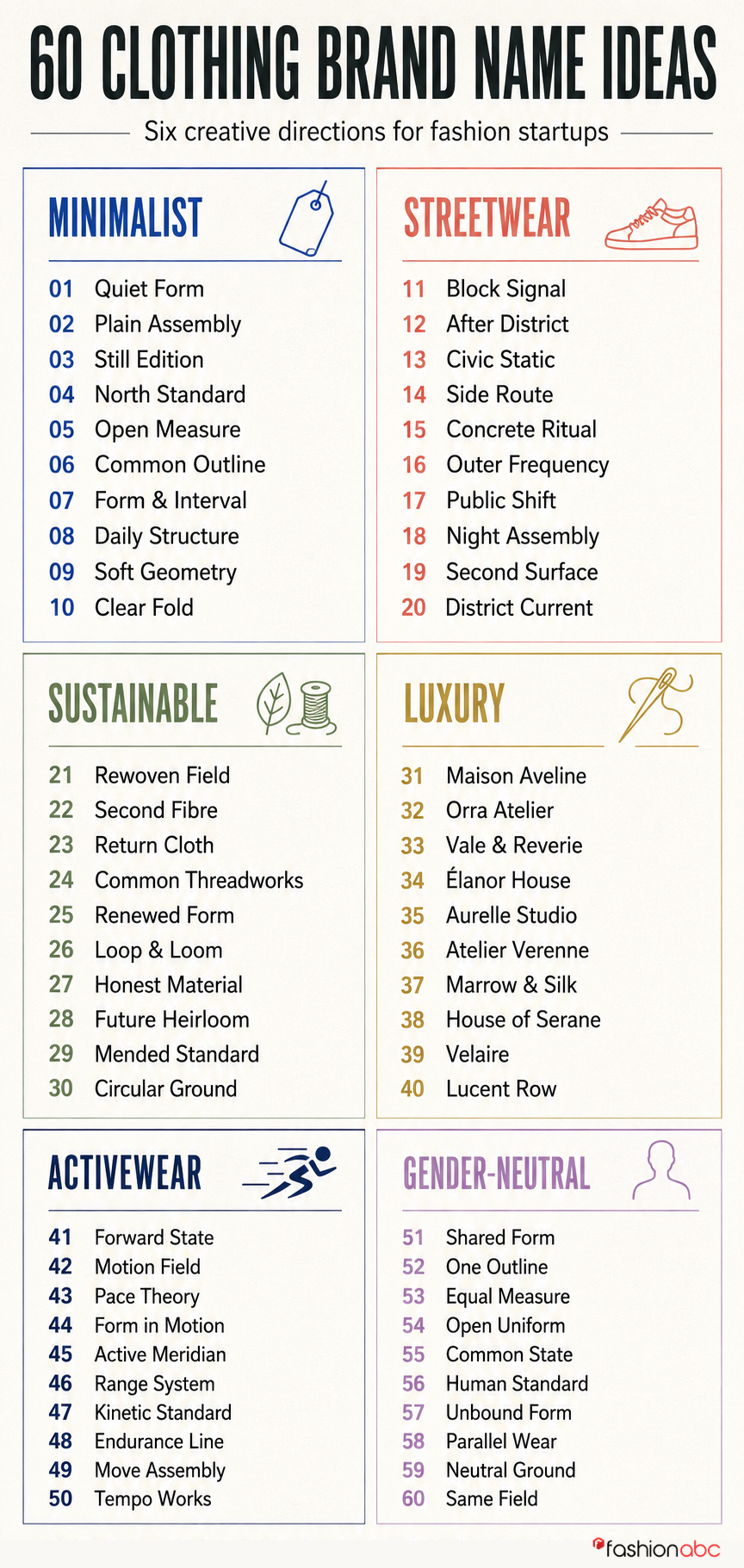
Minimalist clothing brand name ideas
- Quiet Form
- Plain Assembly
- Still Edition
- North Standard
- Open Measure
- Common Outline
- Form & Interval
- Daily Structure
- Soft Geometry
- Clear Fold
Streetwear brand name ideas
- Block Signal
- After District
- Civic Static
- Side Route
- Concrete Ritual
- Outer Frequency
- Public Shift
- Night Assembly
- Second Surface
- District Current
Sustainable fashion name ideas
- Rewoven Field
- Second Fibre
- Return Cloth
- Common Threadworks
- Renewed Form
- Loop & Loom
- Honest Material
- Future Heirloom
- Mended Standard
- Circular Ground
Luxury fashion brand name ideas
- Maison Aveline
- Orra Atelier
- Vale & Reverie
- Élanor House
- Aurelle Studio
- Atelier Verenne
- Marrow & Silk
- House of Serane
- Velaire
- Lucent Row
Activewear brand name ideas
- Forward State
- Motion Field
- Pace Theory
- Form in Motion
- Active Meridian
- Range System
- Kinetic Standard
- Endurance Line
- Move Assembly
- Tempo Works
Gender-neutral fashion name ideas
- Shared Form
- One Outline
- Equal Measure
- Open Uniform
- Common State
- Human Standard
- Unbound Form
- Parallel Wear
- Neutral Ground
- Same Field
How to assess clothing brand name ideas
Say the name aloud
A name may look attractive on a mood board but sound awkward in conversation. Use it in realistic sentences: ‘I bought this jacket from ___’, ‘Have you seen the new ___ collection?’ and ‘You can find it at ___ dot com.’
Ask people unfamiliar with the project to pronounce the name without help. Then say it aloud and ask them to spell it. Repeated confusion is a warning, not a branding opportunity.
Test memory
Show participants five candidate names for several seconds. Discuss an unrelated topic, then ask which names they remember. A memorable name may have a distinctive rhythm, visual image or unexpected combination.
Test customer associations
Ask target customers what type of company they imagine, which price level they associate with the name, what three words come to mind and whether they would feel comfortable recommending it aloud. Do not simply ask whether they like it.
Test it visually
Place the shortlisted name on realistic applications: neck and care labels, hang tags, packaging, website headers, social profiles, embroidery, retail signs, invoices and wholesale line sheets.
A strong name should remain legible in small formats. After selection, connect it to FashionABC’s support guide, Clothing Brand Logos: Design Principles, Examples and Trademark Checks.
Check trademark risk before committing
Finding an unused social handle or domain does not mean a name is legally available.
In the United States, the USPTO recommends searching federal applications and registrations, state trademark databases and wider internet use. The search should cover marks that may be similar in appearance, sound, meaning or overall commercial impression—not just exact matches. Related goods and services must also be considered.
Clothing commonly falls within International Class 25, but a fashion business may require other classes depending on its products and services. Accessories, jewellery, retail services, cosmetics and downloadable digital goods may involve different or coordinated classes. The USPTO warns that searching too narrowly by class can conceal relevant conflicts.
A sensible initial screening process includes:
- Search the exact name.
- Search singular, plural and spacing variations.
- Search alternative spellings and similar pronunciations.
- Search the strongest word independently.
- Search for similar fashion and lifestyle businesses online.
- Check relevant national and regional trademark databases.
- Review company-name registrations where the business will operate.
- Check domains and major social platforms.
- Take shortlisted candidates to a qualified trademark professional.
LEGAL NOTE: A preliminary search can eliminate obvious problems. It cannot guarantee that a name is safe to use or registrable. This guide provides an editorial framework, not legal clearance.
Check domains and social handles
A perfect exact-match .com is useful, but its absence does not automatically disqualify a name. Workable structures can include brandname.com, brandnamestudio.com, brandnamewear.com, shopbrandname.com, brandnameofficial.com or a suitable country-code domain.
Avoid complicated punctuation, repeated letters and spellings that customers are unlikely to remember. Check major social platforms, but do not let one unavailable handle force a weak brand name. A clear modifier can be used consistently across channels.
Registering a domain does not create trademark rights. ICANN’s registration framework places responsibility on registrants to avoid infringing third-party rights, while its dispute policy covers certain trademark-based domain conflicts.
Common fashion naming mistakes
- Copying successful labels: A name built to resemble an established luxury house or streetwear label weakens differentiation and can create legal risk.
- Choosing a name that is too descriptive: A phrase such as ‘Premium Organic Womenswear’ explains the offer but provides little distinctive identity and may restrict future growth.
- Adding spelling complications: Removing vowels or adding repeated letters does not automatically create distinction. Word-of-mouth suffers if customers cannot spell the name.
- Following a temporary aesthetic: Names built around a short-lived online trend can age faster than the garments.
- Ignoring international meaning: Check pronunciation, meaning and unintended associations in every important target market.
- Designing the logo before screening: Screen the verbal name before investing in identity design, packaging and garment labels.
- Treating a domain as proof of ownership: Domain availability, company registration and trademark rights are separate matters.
A seven-day fashion-brand naming process
Day 1 — Write the brief: Define the customer, positioning, product, price level, personality and expansion plans.
Day 2 — Choose three territories: Select three strategically relevant conceptual areas and build a word bank for each.
Day 3 — Generate 50 names: Use real words, compounds, suggestive terms, founder names and invented words.
Day 4 — Score the longlist: Evaluate fit, pronunciation, memorability, distinction and expansion potential. Reduce to approximately ten names.
Day 5 — Test with customers: Conduct pronunciation, recall and association tests with people resembling the target customer.
Day 6 — Conduct initial searches: Review search engines, marketplaces, social platforms, domains, company registers and relevant trademark databases.
Day 7 — Begin professional clearance: Discuss the finalists with a qualified trademark professional in the markets where the brand expects to trade.
Clothing brand naming checklist
- Fits a clearly defined customer and position
- Does not depend on explaining an obscure meaning
- Is easy to say and reasonably easy to spell
- Remains legible on a small garment label
- Does not closely imitate a competitor
- Can support future categories and markets
- Has survived customer recall and association testing
- Has passed preliminary internet and marketplace searches
- Has been checked across relevant trademark databases
- Has workable domain and social-handle options
- Has received professional legal review where appropriate
Frequently asked questions
How do I create a unique clothing brand name?
Start with the customer, positioning and story. Develop naming territories, create a large word bank and explore different structures. Uniqueness should come from a meaningful strategic combination—not deliberately confusing spelling.
Should a clothing brand name describe the clothes?
Not necessarily. A descriptive name communicates the initial offer, but a suggestive or distinctive name may be easier to differentiate and expand.
Can I use my own name for a fashion brand?
Yes, provided appropriate searches do not identify conflicting rights. It is particularly suitable when personal authorship and creative direction are central.
Do I need the exact-match domain?
An exact-match domain is helpful but not essential. A credible modifier such as ‘studio’, ‘wear’ or ‘shop’ may work. Trademark risk must be evaluated separately.
How many clothing brand names should I create?
Generate at least 50 candidates before selecting a shortlist. The first few ideas are often the most predictable.
Can an AI name generator choose my brand name?
AI can expand a word bank or suggest combinations, but it cannot decide whether a name fits the strategy or is legally available.
How do I know whether a clothing brand name is trademarked?
Search appropriate official databases for similar—not only identical—marks used for related goods or services. Consult a qualified professional before investing in the name.
Final thoughts
A clothing brand name should not be selected because it sounds fashionable for a few minutes. It should connect the company’s strategy to an identity customers can remember, pronounce and trust.
Begin with the customer. Define the naming territory. Generate more options than you think you need. Test the strongest candidates in realistic situations, then complete the appropriate trademark, company-name, domain and cultural checks.
The objective is not simply to find a name that looks good on a label. It is to build a name capable of carrying the brand through production, launch and long-term growth.
Sources
- United States Patent and Trademark Office, Comprehensive clearance search for similar trademarks: https://www.uspto.gov/trademarks/search/comprehensive-clearance-search-similar-trademarks
- United States Patent and Trademark Office, Federal trademark searching: https://www.uspto.gov/trademarks/search/federal-trademark-searching
- United States Patent and Trademark Office, Using coordinated classes: https://www.uspto.gov/trademarks/search/using-coordinated-classes-your-federal-trademark-search
- ICANN, Uniform Domain-Name Dispute-Resolution Policy: https://www.icann.org/resources/pages/help/dndr/udrp-en