
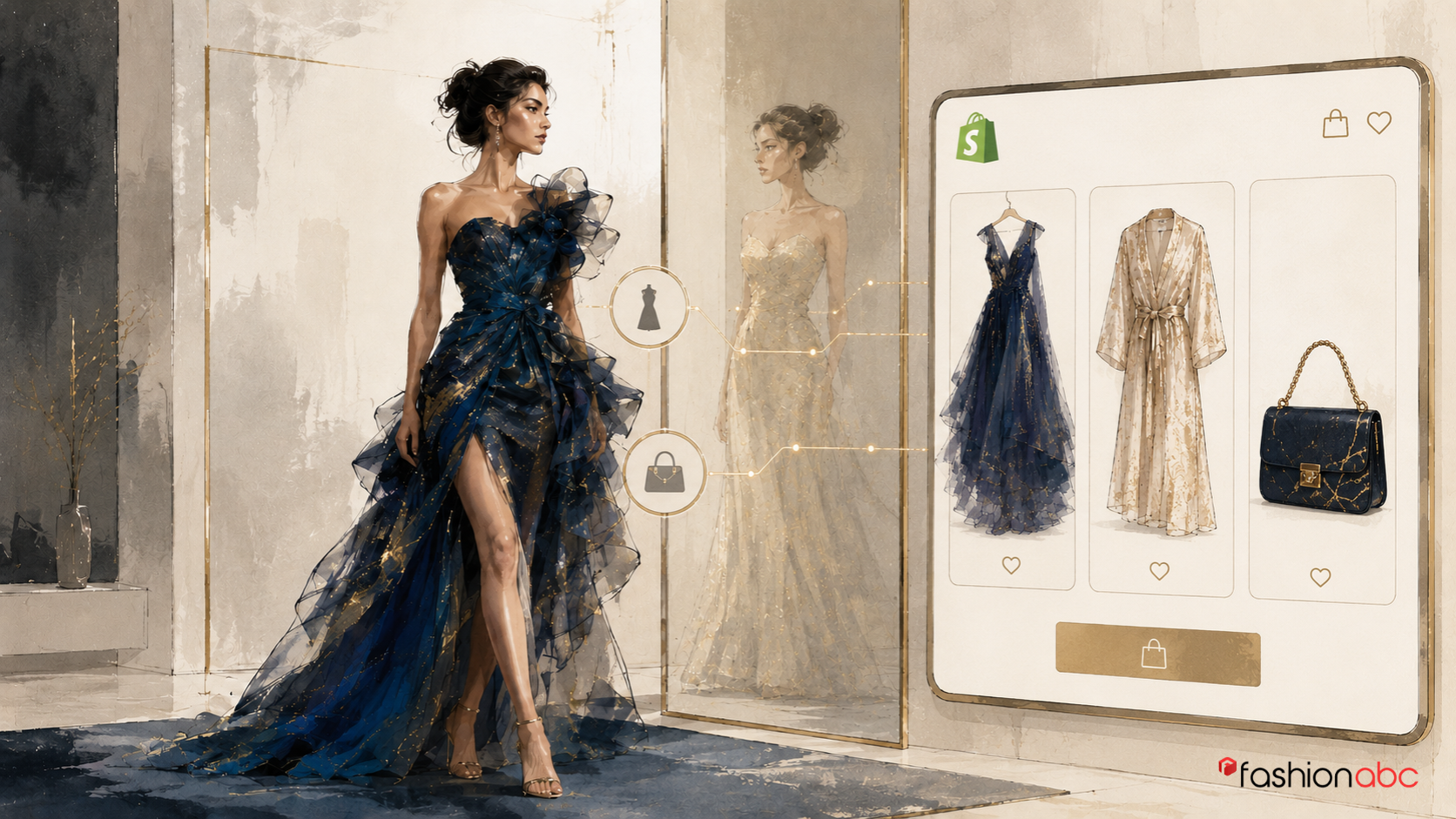
From personal styling and virtual try-on to conversational discovery and agent-led purchasing, artificial intelligence is changing how fashion brands attract, understand and serve online customers.
Fashion e-commerce was built around the digital catalogue. A shopper selected a category, applied filters, opened product pages and decided whether an image, description and size guide provided enough confidence to buy.
Artificial intelligence is beginning to replace that linear journey with something more conversational, predictive and personal.
Instead of searching for “black dress”, a customer can ask for an outfit suitable for a summer wedding in Lisbon, within a particular budget and available in her size. An AI shopping assistant can interpret the occasion, climate, silhouette and price constraints, recommend coordinated products and potentially complete the transaction without requiring the customer to navigate a conventional storefront.
For fashion brands using Shopify, this shift is moving quickly from experiment to infrastructure. Shopify is expanding AI across store management, product discovery, content creation and customer service. Its Agentic Storefronts initiative also allows merchants to make products available within AI channels while synchronising inventory and pricing with the underlying store.
The future fashion storefront may therefore be less like a fixed website and more like an intelligent interface that adapts to the individual shopper wherever the conversation begins.
Personalisation Becomes a Form of Digital Clienteling
Fashion purchases are unusually personal. Style, fit, colour, occasion, identity and cultural context can matter as much as price or product specifications. This makes fashion especially suited to AI-powered personalisation—and especially exposed when that personalisation is poorly designed.
Machine-learning systems can use browsing patterns, previous purchases, cart contents and stated preferences to rank products differently for each customer. A returning shopper might see a jacket that complements trousers purchased previously. A new visitor might receive recommendations based on an occasion, aesthetic or fit preference expressed in natural language.
The ambition is not simply to increase the number of products shown. It is to recreate elements of luxury clienteling at digital scale: understanding the customer, remembering context and offering relevant guidance without overwhelming them.
McKinsey has reported that 82% of surveyed consumers want AI to reduce the time they spend researching purchases, while half of fashion executives identified AI-led product discovery as a priority. The implication is clear: personalisation creates value when it reduces effort, not when it merely increases targeting.
Discovery Moves From Keywords to Conversation
Traditional fashion search depends on structured product information. If a garment is described as “oxblood” while the shopper searches for “dark red”, the result depends on synonyms, tagging and the quality of the retailer’s search system.
Conversational AI can interpret intent rather than requiring an exact term. A customer can describe a need—“comfortable shoes for walking all day that still work with tailoring”—and receive recommendations based on several attributes at once.
This changes the role of product data. Garment composition, cut, colour, care requirements, availability, sizing and styling context must be structured accurately enough for AI systems to understand. Brands with incomplete catalogues or vague product descriptions risk becoming invisible in AI-mediated discovery.
Shopify’s Catalog and agentic-commerce infrastructure are designed to make merchant products understandable and purchasable across AI interfaces. In 2026, Shopify said merchants could activate Agentic Storefronts and keep product information, pricing and inventory synchronised across participating AI channels.
For fashion businesses, optimisation will increasingly mean preparing products for machines as well as people.
Virtual Try-On Narrows the Imagination Gap
One of fashion e-commerce’s oldest problems is that customers cannot see how a garment will look on their own body before buying it. Static model photography offers inspiration but limited personal certainty.
Generative AI and augmented reality are narrowing that gap. Google Shopping has introduced virtual try-on experiences that allow shoppers to upload an image and visualise selected clothing on themselves. Shopify’s app ecosystem also includes virtual fitting-room tools for apparel, accessories and beauty products.
These systems can help a shopper assess colour, proportion and styling. They may improve confidence and reduce some avoidable returns. However, a generated image is not the same as a physical fitting. Fabric weight, compression, movement and precise sizing remain difficult to reproduce digitally.
Fashion brands should therefore present virtual try-on as a decision aid, not a guarantee of fit. The technology is most useful when combined with accurate garment measurements, clear size guidance, diverse photography and straightforward returns policies.
AI Changes Merchandising Behind the Storefront
The customer-facing applications of AI receive the most attention, but the operational impact may be equally significant.
Fashion merchandisers make continuous decisions about assortment, timing, inventory, promotions and product placement. AI can analyse sales, searches, returns, browsing behaviour and regional demand to identify rising interest or weak performance earlier.
On Shopify, AI tools can support product categorisation, descriptions, campaign development, customer segmentation and store analysis. Shopify’s Sidekick assistant is designed to help merchants work with store data and perform administrative tasks through natural-language instructions.
These capabilities can be particularly valuable for independent labels with small teams. Automation can reduce the time spent cleaning product data, drafting variations of marketing copy or answering repetitive questions. The value is not simply lower labour cost. It is the ability to direct scarce human attention towards design, sourcing, community and customer relationships.
Human judgement remains essential. Historical sales data can reproduce yesterday’s preferences and miss an emerging cultural shift. A model may optimise for immediate conversion while weakening long-term brand positioning. Merchandising is partly quantitative, but fashion also depends on taste, timing and creative risk.
Customer Service Becomes an Always-On Styling Interface
AI assistants can answer questions about delivery, returns, care instructions and order status at any hour. They can also operate as stylists, helping customers coordinate pieces, compare options or find alternatives when an item is unavailable.
Shopify’s developer tools now allow merchants to build storefront agents that search products, answer policy questions, make recommendations and manage shopping carts through natural conversation.
The strongest model is hybrid. AI handles routine requests and initial discovery, while human advisers take over when a question requires empathy, discretion or specialist product knowledge. A customer dealing with a failed delivery before an important event does not need another automated loop; she needs a person authorised to solve the problem.
Brands should measure AI service by resolution quality and customer trust, not merely by the number of conversations deflected from staff.
Agentic Commerce Changes Where the Store Begins
The most significant change may be that customers no longer need to begin their journey on a brand’s website.
Shopify has developed infrastructure intended to make merchant catalogues available through AI conversations and other agentic channels. Products can be discovered and purchased while inventory and pricing remain connected to Shopify. The company has also supported commerce integrations with major AI platforms and introduced an open protocol with Google for agent-led transactions.
This creates new distribution opportunities, but it also raises a strategic question for fashion: who controls the relationship when an AI assistant stands between the brand and the customer?
Fashion is not a purely functional category. Editorial imagery, store design, storytelling and cultural meaning influence perceived value. If AI agents reduce products to price, attributes and predicted relevance, brands may gain reach while losing part of the environment that makes them distinctive.
The answer is not to reject agentic commerce. It is to ensure that structured product data communicates provenance, materials, craftsmanship, fit and brand context—not only inventory and price—and that the merchant retains access to customer relationships within applicable privacy rules.
Personalisation Requires Trust
The more personalised the storefront becomes, the more data it may process. Browsing histories, purchase records, style preferences, body images and inferred characteristics can create intimate customer profiles.
The UK Information Commissioner’s Office states that organisations using AI with personal data must consider lawfulness, fairness, transparency, accuracy and risks to individual rights. Fashion retailers should collect only the data they need, explain how it is used, secure uploaded images and provide meaningful choices about personalisation.
Bias is another concern. Recommendation systems trained on past behaviour can repeatedly promote a narrow range of bodies, aesthetics or price points. Virtual try-on tools must represent different skin tones and body types credibly. Regular human review is required to test whose preferences and identities the system overlooks.
Trust is not a compliance layer added after deployment. It is part of the customer experience.
The Future Belongs to Brands With Intelligence and Identity
AI will make fashion commerce faster, more conversational and increasingly distributed across digital assistants. Product discovery will become more predictive. Virtual try-on will improve. Merchandising and customer service will incorporate more automation. Some purchases may be delegated almost entirely to agents.
Yet fashion will not become a purely computational market. Customers still respond to originality, community, craftsmanship and emotional connection. A recommendation engine can identify a likely purchase; it cannot independently build the cultural meaning that makes a label desirable.
The strongest Shopify fashion businesses will use AI to remove friction while preserving the human qualities that create loyalty. They will treat product data as strategic infrastructure, personalisation as a service, automation as support for creative teams and agentic commerce as a new channel rather than a replacement for brand experience.
The intelligent storefront is not defined by how much AI it displays. It is defined by how effectively technology helps the customer discover something relevant, understand it, trust it and feel confident enough to make it part of her life.
Sources
- Shopify: The agentic commerce platform and AI shopping channels
- Shopify: Agentic Storefronts for merchants
- Shopify: Spring 2026 agentic-commerce developer infrastructure
- Shopify Developers: Building an AI storefront agent
- Shopify: AI personalisation in e-commerce
- Shopify: Virtual fitting rooms and augmented-reality try-on
- Google: AI shopping and virtual try-on
- McKinsey & Company: Fashion discovery and consumer expectations
- McKinsey & Company: Generative AI in fashion
- UK Information Commissioner’s Office: Guidance on AI and data protection