



Summary
Alexander McQueen is a Scottish fashion designer. Creative, provocative, theatrical and handcrafted describe the aesthetic of Alexander McQueen, to a T. Synonymous with British contemporary couture, the label has produced some of the most iconic, critically acclaimed collections in global Fashion — driven by the designer’s unparalleled vision that respects both craftsmanship and new technology.
Early Years
Alexander McQueen was born on March 17, 1969, in London, England, to a working-class family. Growing up in the East End of London, he faced early challenges, including a difficult relationship with his father. His passion for fashion was evident from a young age, and by the age of 16, he left school to pursue his interest. McQueen began his training at Savile Row, where he worked as an apprentice for prestigious tailoring houses such as Anderson & Sheppard. His time in Savile Row was crucial in shaping his technical skills and understanding of traditional craftsmanship, which would later become integral to his design identity.
In his early years, McQueen further honed his talents at Central Saint Martins College of Art and Design, Central Saint Martins College of Art and Design where he earned a master’s degree in fashion design in 1992. His graduation collection, which was famously bought by fashion icon Isabella Blow, garnered immediate attention for its boldness and innovation. McQueen’s early work was marked by its edgy and sometimes controversial approach, blending avant-garde concepts with a deep respect for fashion history. His unique vision and rebellious spirit laid the foundation for what would become one of the most iconic careers in the fashion industry.
Fashion
In 1992 McQueen launched his own label and in less than ten years became one of the most powerhouse fashion designers. His early runway collections earned him the title “l’enfant terrible” as he put on a series of superlative shows, each one more dramatic than the next. In 1995, “Highland Rape” witnessed models in ripped lace walk down a runway strewn with dead flowers, to a soundtrack of whistling wind and church bells. His take on how Scotland was ravaged by the wars.
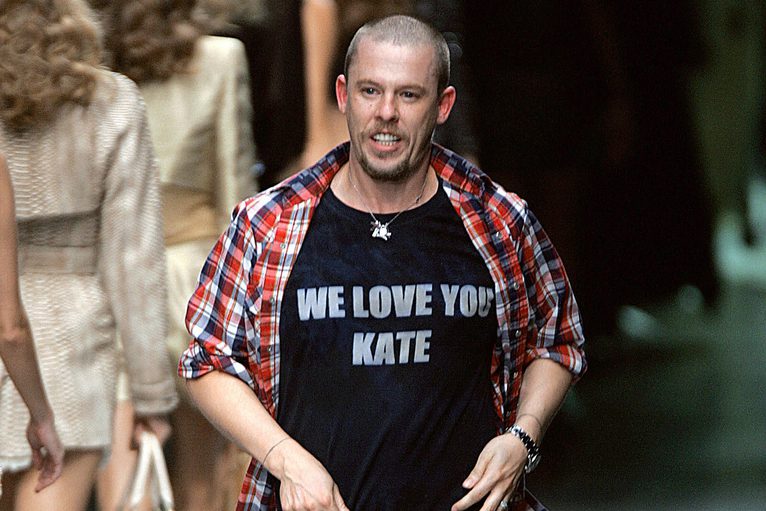
In 1997’s “The Doll” Kate Moss strode down a wet runway in precariously low-slung bumster trousers. His Fall ’98 show “Joan”, referenced the Catholic martyr; McQueen printed portraits of Romanov children on the garments and ended the show with a model trapped in a circle of fire! Renowned for lavish, unorthodox runway shows, he awed guests with his recreations of a shipwreck, merry-go-round or wind-tunnel corridor bridging a snow-covered wasteland; birdcages, feathered wings, vertiginous heels — McQueen is credited with bringing a theatrical element to the catwalk.
In 1996, he succeeded iconic designer John Galliano as head designer at Givenchy. Upon taking his post, McQueen insulted the founder by calling him “irrelevant”. His feisty attitude earned him the label “hooligan of English fashion.” McQueen toned down his designs and silenced critics with impeccable tailoring but continued to fan his rebellious streak, causing controversy when double amputee model Aimee Mullins walked down the runway on intricately carved wooden legs! The same year also witnessed McQueen’s legendary showing where a single model, Shalom Harlow, graced the runway in a strapless white dress, before she sat on a revolving catwalk and got sprayed with paint, by robotic guns. That said, he also created beautiful, wearable looks — the razor-sharp suit, the pencil skirt, the summer prints.
McQueen stayed with Givenchy for his five- year term and then left to focus on his own brand. In December 2000, Gucci Group acquired 51 per cent of his label, with McQueen serving as Creative Director. The catwalk presentations were creative; in one of his shows, a dance based on Sydney Pollack’s film ‘They Shoot Horses, Don’t They?’, Anna Wintour gave him a standing ovation. McQueen’s most dramatic show was in 2001, titled VOSS. It sent shockwaves when a cube transformed into a psychiatric ward where a nude model hid her face with a gas mask, surrounded by moths. Menswear was introduced in 2004, followed by a secondary line, McQ, in 2006.
McQueen used technology to add a twist — In 2006, he projected a state-of-the-art hologram of supermodel Kate Moss inside a glass pyramid on the runway; the apparition, dressed in a white dress, danced for few seconds, then disintegrated!! Other shows featured a volcanic catwalk that erupted in flames or a Plexiglass snowstorm! By 2007, he had boutiques in London, New York, Los Angeles, Milan, and Las Vegas, and celebrities Nicole Kidman, Lady Gaga, Penélope Cruz, Sarah Jessica Parker and Rihanna were spotted in his label. In 2009, McQueen hit a creative high with Plato’s Atlantis. Sadly, a few months later, following the death of his mother, the designer took his own life.
Post Humous
Alexander McQueen passed away in 11 February 2010. McQueen, who had been diagnosed with anxiety and depressive disorder, took an overdose prior to hanging himself., and left a note that read, “Look after my dogs, sorry, I love you, Lee.” He is survived by his father, three sisters and two brothers. Following his death, McQueen’s colleague Sarah Burton took over creative direction and development of all collections. In April 2011, she received global recognition as designer of the wedding dress for HRH Duchess Of Cambridge, Catherine Middleton.
Personal Life
In 2000, McQueen married his partner and documentary filmmaker George Forsyth, on a yacht in Ibiza, with Kate Moss and Annabelle Neilson as bridesmaids. The marriage was not official though as same-sex marriage in Spain was not legal at that time! The relationship ended a year later, with McQueen and Forsyth maintaining a friendship.
Read More: edith head net worth
Awards and Recognition
Alexander McQueen, one of the most influential and celebrated fashion designers of the 21st century, received numerous accolades throughout his career, reflecting his extraordinary impact on the fashion industry. He was named British Designer of the Year four times (1996, 1997, 2001, and 2003), an honour that cemented his reputation as a visionary. His work was consistently praised for its daring, theatrical qualities and its ability to combine art and fashion, earning him widespread recognition in both the UK and international fashion communities.
McQueen was awarded the CFDA International Designer of the Year in 2003, a prestigious recognition from the Council of Fashion Designers of America. This global acknowledgment further solidified his position as one of the most important figures in modern fashion, pushing boundaries in design, structure, and presentation. His work consistently challenged conventions, and his runway shows became some of the most talked-about events in fashion history.
After his untimely death in 2010, McQueen’s legacy continued to be honoured. He posthumously received the Fashion Icon Award at the 2010 Fashion Awards, a testament to his lasting influence. His innovative approach to fashion, which blended craftsmanship with avant-garde design, continues to inspire designers and fashion enthusiasts today. Through his brand and its ongoing influence, McQueen’s legacy is one of both artistic brilliance and an unflinching challenge to the status quo of the fashion industry.
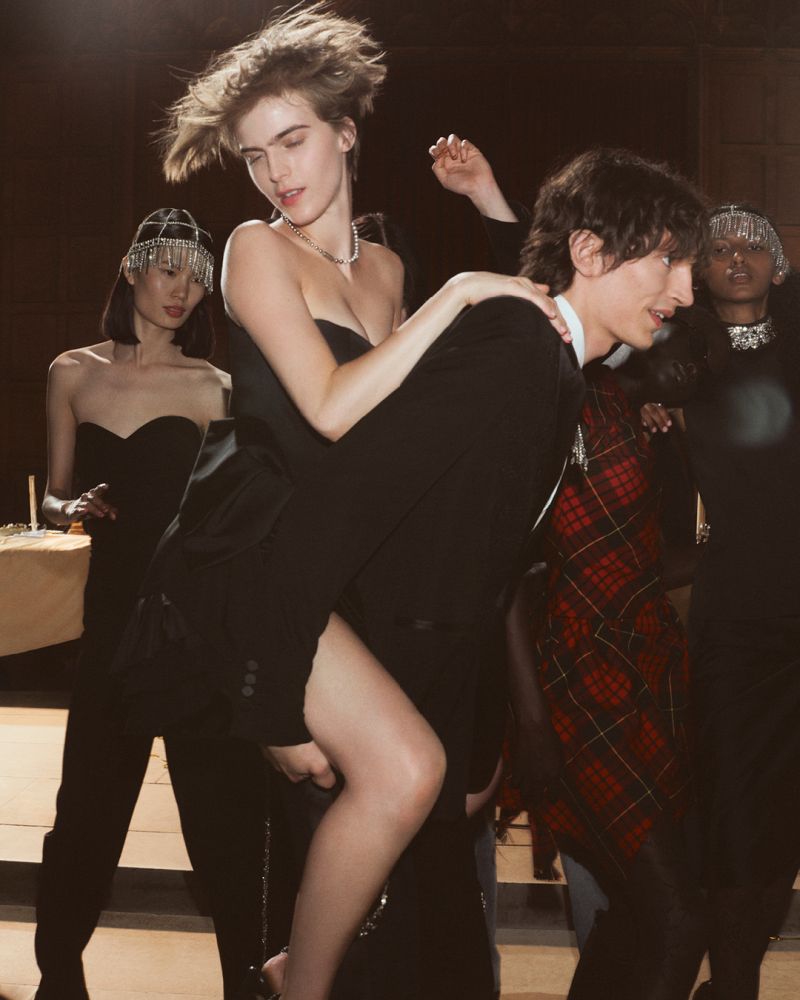
McQueen SS26
References
- “Alexander McQueen, UK fashion designer, found dead”. BBC News.
- “Biography: Sarah Burton”. alexandermcqueen.com.
- “Obituary: Fashion king Alexander McQueen”. BBC News.
- “Six ways Alexander McQueen changed fashion”. BBC News
- “Alexander McQueen: fashion mourns the loss of its brilliant ‘enfant terrible'”. The Daily Telegraph
- “Meeting the Queen was like falling in love”. The Guardian.
- “Boy done good”. The Guardian.
- “Alexander McQueen Obituary”. The Times. London.
- “Alexander McQueen”. Famous Designers.
- Blow by Blow. HarperCollins.
- “Savile Row’s best tailors: Alexander McQueen”. GQ Magazine.
- “How Alexander McQueen changed the world of fashion – by the people who knew him best”. The Daily Telegraph.
- “Renegades Of Fashion: Alexander McQueen — “It’s a Jungle Out There””. Fashion Industry Broadcast.
- “Fashion designer Alexander McQueen dies”. The Guardian.
- “Alexander Mcqueen biography”. Catwalk Yourself.
- “Burton For McQueen”. Vogue.
- “Alexander McQueen Spring/Summer 2011 collection”. Vogue.
- “Alexander McQueen unveils his collection for Puma”. RTÉ Fashion.
- “Alexander McQueen: an illustrated history of the iconic British fashion designer”. Financial Review.
- “Alexander McQueen Found Dead”. People.
Contact with business owner
 Your request has been submitted successfully.
 Own or work here?
Claim Now!
Claim Now!
Own or work here?
Claim Now!
Claim Now!