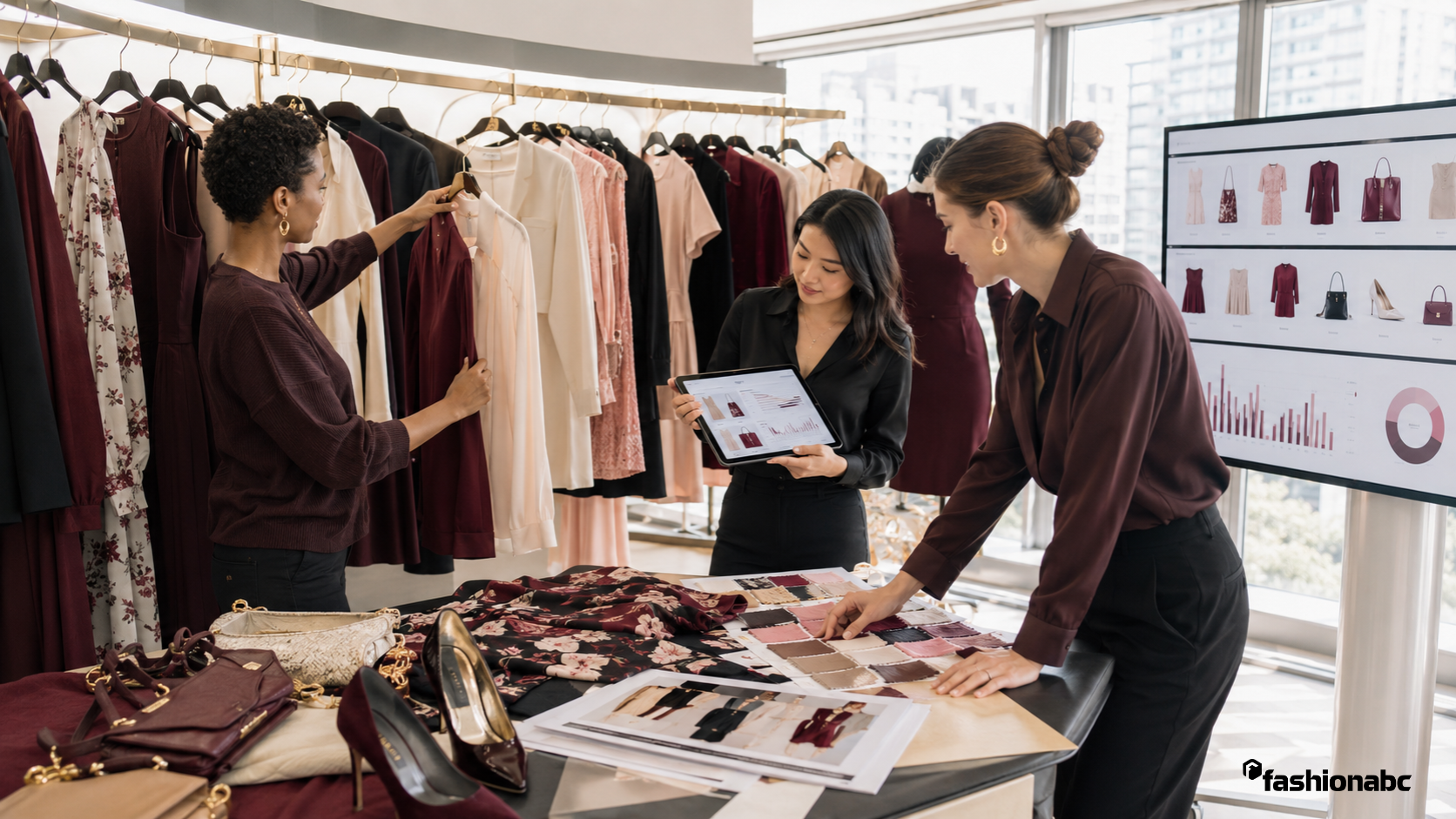
Fashion merchandising connects creative products with commercial demand. It involves deciding what products a fashion business should offer, how much inventory to purchase, where and when products should be sold, and how they should be presented to customers.
Merchandisers work between design, buying, production, marketing, retail and finance. Their decisions influence whether the right product reaches the right customer at the right price and whether it sells profitably.
Key takeaways
- Fashion merchandising combines product knowledge, consumer insight and commercial planning.
- It is different from fashion design and visual merchandising.
- Careers include buying, merchandise planning, allocation, ecommerce and retail management.
- Degree programmes commonly cover buying, retail mathematics, product development and marketing.
- Data analytics, artificial intelligence and connected inventory systems are changing the profession.
What does fashion merchandising mean?
Fashion merchandising is the planning, selection, pricing, promotion and management of fashion products for a target market.
A fashion merchandiser may help answer questions such as:
- Which products should the business sell?
- Who is the target customer?
- How much inventory should be ordered?
- Which sizes, colours and styles are likely to perform?
- When should products reach stores or ecommerce channels?
- Which products should be promoted or discounted?
- When should stock be reordered, transferred or cleared?
The role is both creative and analytical. Merchandisers need to understand trends, brand identity and customer behaviour, but they must also work with sales figures, margins, inventory levels and delivery schedules.
Fashion merchandising vs fashion design
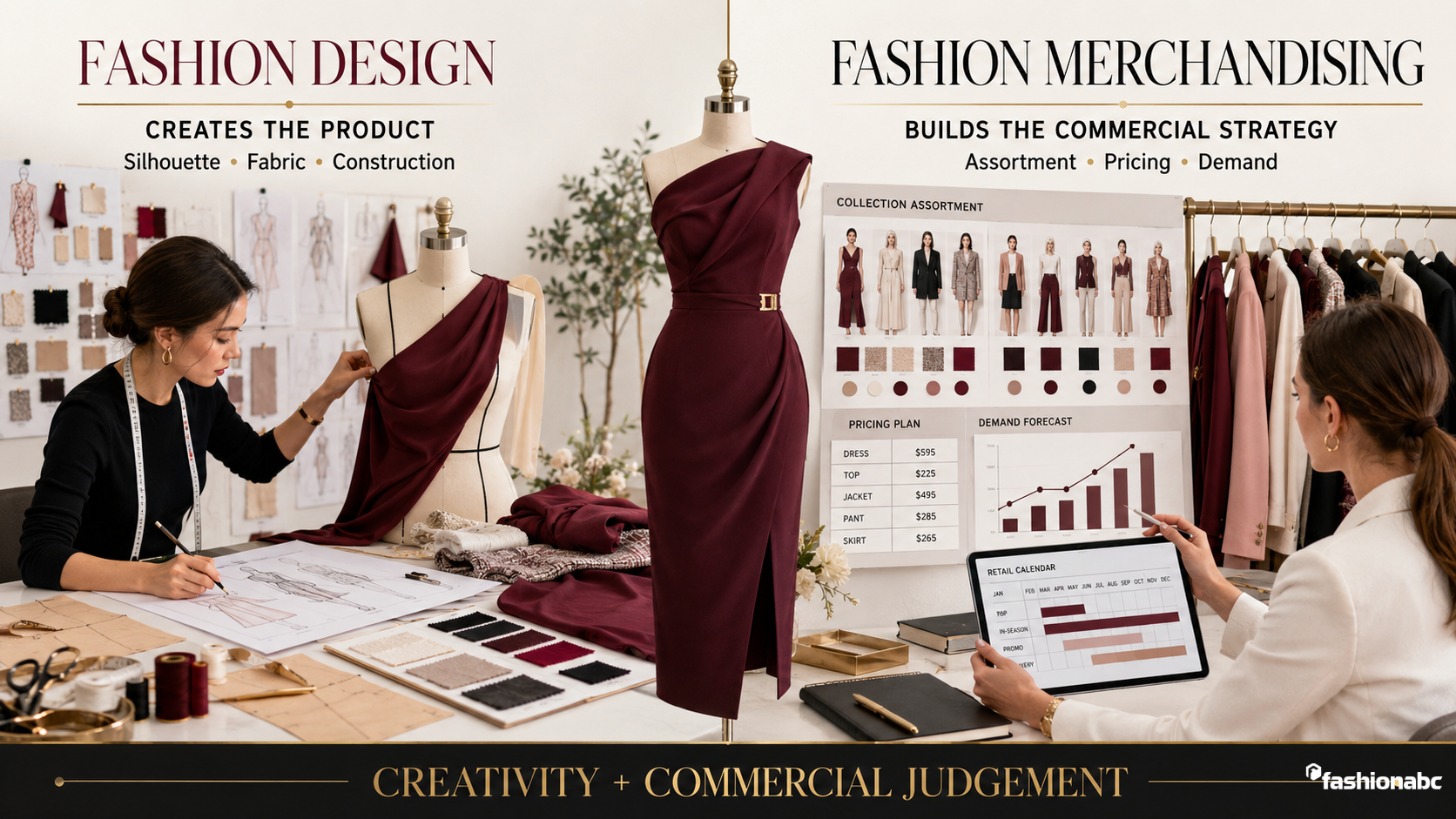
Fashion designers create or develop garments and accessories. Fashion merchandisers determine how those products can be positioned, purchased and sold successfully.
| Fashion design | Fashion merchandising |
|---|---|
| Develops the product’s creative direction | Develops the commercial product strategy |
| Works with silhouette, fabric and construction | Works with assortment, pricing and demand |
| Produces sketches and specifications | Produces range plans, forecasts and sales analysis |
| Focuses on how the product should look and function | Focuses on how, where and when the product should sell |
The two disciplines frequently collaborate. A commercially strong collection requires both a clear creative identity and a realistic understanding of customer demand.
Readers interested in the wider process can explore Fashionabc’s guide to starting a clothing brand.
Fashion merchandising vs visual merchandising
The terms are related but not interchangeable.
Fashion merchandising covers product selection, buying, inventory, pricing, sales performance and commercial planning.
Visual merchandising focuses on how products are presented through shop windows, store layouts, fixtures, product displays and sometimes ecommerce imagery.
A visual merchandiser may decide how a collection appears in a store. A merchandise planner may decide how many units should be available in that store.
What does a fashion merchandiser do?

Responsibilities vary by company and job level, but may include:
- Researching customer and market trends
- Planning seasonal product ranges
- Reviewing samples with design and buying teams
- Building sales and inventory forecasts
- Comparing product costs and retail prices
- Monitoring margins and sell-through
- Allocating stock between locations
- Coordinating product launches
- Recommending reorders, transfers or markdowns
- Analysing performance by product, size, colour and channel
Merchandisers may work for fashion brands, department stores, ecommerce companies, wholesalers, luxury houses or independent retailers.
Fashion merchandising degrees
A fashion merchandising degree usually combines fashion-industry knowledge with business education. Programmes may be called:
- Fashion Merchandising
- Fashion Business Management
- Fashion Buying and Merchandising
- Retail Management
- Fashion Marketing
- Merchandise Product Development
The Fashion Institute of Technology’s Fashion Business Management programme, for example, covers areas including product development, buying, planning, retail management and international business.
Common subjects
Students may study:
- Fashion-industry structure
- Consumer behaviour
- Retail mathematics
- Buying and assortment planning
- Product development
- Textiles and materials
- Fashion marketing
- Visual merchandising
- Supply-chain management
- Ecommerce
- Sustainability
- Data analytics
Strong programmes also include internships, employer projects or access to retail technology.
Do you need a degree?
Not every fashion merchandising role requires a specialised degree. Some employers accept qualifications in business, marketing, supply chain, economics or data analytics—particularly when combined with relevant experience.
Retail experience can also provide a valuable entry route because it develops direct knowledge of customers, products and store operations.
For buying-related occupations more broadly, the US Bureau of Labor Statistics states that a bachelor’s degree is typically required, although some employers accept candidates with a high-school diploma and relevant experience.
Fashion merchandising careers and jobs
Fashion buyer
Buyers select products for a retailer or brand. They evaluate suppliers, negotiate terms, review samples and decide which products to purchase.
They need commercial judgement because buying too little can produce missed sales, while buying too much creates markdowns and unsold inventory.
Assistant buyer
Assistant buyers support product selection, supplier communication, purchase orders, sample management and sales reporting. It is a common entry-level route into fashion buying.
Merchandise planner
Merchandise planners determine how much stock the business should purchase and how sales, inventory and margins should develop over a season.
The role is highly analytical and normally involves forecasting, budgeting and scenario planning.
Allocator
Allocators distribute inventory between stores, warehouses and digital channels. They monitor local demand and may transfer stock to improve availability and reduce markdown risk.
Ecommerce merchandiser
Ecommerce merchandisers organise digital product ranges and improve how customers discover and purchase products online. Their work may include category pages, search results, product recommendations, promotions and performance analysis.
Visual merchandiser
Visual merchandisers translate brand and product strategy into physical or digital presentation. They create window displays, store layouts, styling stories and product groupings.
Product developer
Product developers coordinate designs, materials, costs, samples and suppliers to move a product from concept towards production.
This role overlaps with merchandising because development decisions affect pricing, delivery and commercial viability. Fashionabc’s guide to the clothing production process explains how tech packs, sampling and minimum order quantities influence that work.
Retail or merchandising manager
Managers oversee teams, budgets, seasonal strategies and commercial performance. These roles typically require several years of experience in buying, planning, allocation or retail operations.
Fashion merchandising salaries and job outlook
Pay varies considerably by role, location, employer and experience. Fashion merchandising is not represented by one universal occupational category in US labour data.
The Bureau of Labor Statistics reports that buyers and purchasing agents across all industries earned a median annual wage of $75,650 in May 2024. This should not be interpreted as a fashion-specific salary.
The BLS projects employment for purchasing managers, buyers and purchasing agents to grow by 5% between 2024 and 2034. It also notes that automation and artificial intelligence may limit growth in some routine procurement activities while businesses continue to require professionals who can manage suppliers, complex supply chains and commercial decisions.
How technology is changing fashion merchandising

Technology is automating parts of the job, but it is also increasing the amount of information merchandisers must interpret.
AI demand forecasting
Artificial intelligence can analyse sales histories, search behaviour, weather, promotions and product attributes to estimate future demand.
These systems can support forecasting, but they cannot eliminate uncertainty. New designs, cultural shifts and incomplete data still require informed human judgement.
Product lifecycle management
Product lifecycle management systems organise product information from development through production. Teams can use them to manage specifications, costing, approvals, samples and delivery milestones.
Connected inventory systems
Enterprise resource planning, warehouse and point-of-sale systems allow merchandisers to monitor inventory across stores and ecommerce channels.
RFID and item-level tracking can improve stock visibility, although the value depends on implementation and data accuracy.
Ecommerce personalisation
Digital retailers can adjust product recommendations, search rankings and category pages using customer behaviour. Ecommerce merchandisers increasingly work with experimentation, conversion data and recommendation systems.
3D product development
Digital samples and 3D garment tools can help teams review colours, silhouettes and assortments before every physical sample is produced.
Technology is influencing the whole fashion value chain, as explored in Fashionabc’s analysis of AI’s impact on the fashion value chain.
Skills needed for fashion merchandising
Successful fashion merchandisers typically combine:
- Commercial awareness
- Numerical confidence
- Product knowledge
- Consumer understanding
- Communication and negotiation
- Spreadsheet and analytics skills
- Inventory management
- Attention to detail
- Presentation and storytelling
- Ability to work under seasonal deadlines
Excel or comparable spreadsheet skills remain important, but candidates can strengthen their prospects by learning business-intelligence dashboards, retail planning systems and ecommerce analytics.
How to start a career in fashion merchandising
- Learn the commercial fundamentals. Understand margin, markup, sell-through, stock turn and markdowns.
- Gain customer-facing experience. Retail work can reveal why customers choose, return or ignore products.
- Develop analytical skills. Practise interpreting product-level sales and inventory data.
- Build a relevant portfolio. Create a range plan, competitive analysis, buying proposal or visual-merchandising concept.
- Seek internships or entry-level roles. Assistant buyer, merchandising assistant and allocator positions can provide practical experience.
- Follow the complete product cycle. Learn how design, costing, manufacturing, delivery and sales affect one another.
Fashionabc’s overview of business and fashion careers provides additional pathways across the industry.
Final thoughts
Fashion merchandising is where fashion creativity meets commercial decision-making. Merchandisers help determine what products enter the market, how inventory is managed and how customer demand becomes profitable sales.
Technology will continue to automate reporting and forecasting, but strong judgement remains essential. The most valuable professionals will be able to combine product instinct with data, commercial discipline and a clear understanding of the customer.
Frequently asked questions
Is fashion merchandising a good career?
It can suit people who enjoy fashion but also want to work with strategy, customers and commercial data. The profession includes both creative and analytical career paths.
Is fashion merchandising the same as marketing?
No. Marketing creates demand and communicates the brand, while merchandising determines the products, quantities, prices and sales timing. The teams often work together.
Does fashion merchandising involve mathematics?
Yes. Merchandisers frequently calculate margins, sales forecasts, stock levels, sell-through and markdown performance.
Can fashion merchandisers work in ecommerce?
Yes. Ecommerce merchandising is a major career route involving digital assortments, product discovery, search, promotions and conversion performance.
Sources
- Fashion Institute of Technology: Fashion Business Management degree
- US Bureau of Labor Statistics: Purchasing managers, buyers and purchasing agents
- O*NET: Wholesale and retail buyers
- National Retail Federation Foundation: Careers and education