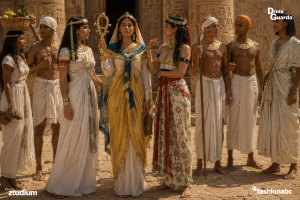
Divine Drapery — Egyptian Elegance (3100–30 BCE) – Created by Dinis Guarda with AI tools for Fashionabc
This article is part of an ongoing series adapted from The ABC History of Fashion, whitepaper by Dinis Guarda
“Along the Nile, fashion flowed like the sacred river itself—eternal, life-giving, and divinely inspired.”
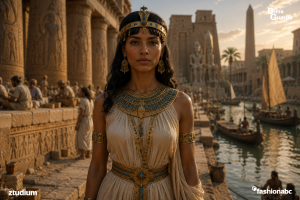
Created by Dinis Guarda with AI tools for Fashionabc
Egyptian fashion did something no earlier civilisation had quite managed: it turned clothing into a complete philosophy. Dress served three purposes at once — protection from the elements, a marker of social standing, and a form of spiritual expression. The Egyptians were aware of other materials, but linen, made from the region’s abundant flax plant, became the default. Wool, by contrast, was considered impure under religious standards and was banned outright from temples and other sacred spaces.
This wasn’t a minor stylistic preference. Egyptian dress represented a genuine fusion of practicality, aesthetics, and belief, clothing that functioned almost as material prayer. Linen wasn’t chosen only for comfort in the desert heat; its transformation from raw flax into brilliant white cloth mirrored ideas about the soul’s own journey from ordinary life toward something more eternal. The finest Egyptian linen, woven so fine it was nearly see-through, represented the height of textile achievement, fabric that seemed less woven than conjured from light itself.
Linen as Luxury
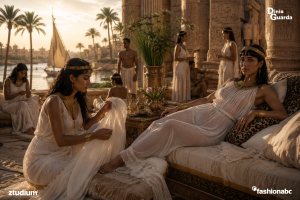
Linen as Luxury – Created by Dinis Guarda with AI tools for Fashionabc
Linen’s dominance in Egyptian fashion came from both climate and belief. Its breathability made it ideal for desert conditions, while its purity of colour aligned with religious ideas about cleanliness and the divine. The most refined linen — nearly transparent — became a status symbol in its own right, worn by those who could afford cloth of that quality and craftsmanship.
Garment Geometry
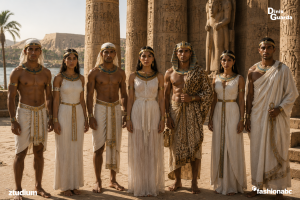
Garment Geometry – Created by Dinis Guarda with AI tools for Fashionabc
Egyptian clothing celebrated the human form through geometric simplicity rather than elaborate cutting. The core garments — the schenti (a wrapped loincloth), the kalasiris (a fitted tunic), and various ceremonial mantles — were built from rectangular pieces of fabric. This restraint wasn’t a limitation; it produced the clean, linear silhouettes that echo throughout Egyptian art more broadly, where straight lines and balanced proportion carried their own aesthetic authority.
Accessories as Art
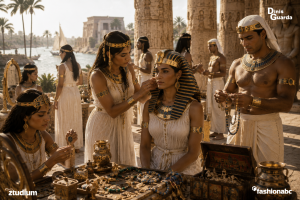
Accessories as Art – Created by Dinis Guarda with AI tools for Fashionabc
If the garments themselves stayed simple, the accessories did not. Egyptian fashion effectively invented the idea of accessories as artistic statements in their own right. Headdresses ranged from a plain linen band to the pharaoh’s elaborate nemes — the striped cloth that turned the wearer’s head into something closer to sculpture. Jewellery went beyond decoration, too: specific amulets were believed to offer real protection, both from earthly danger and from the trials awaiting the wearer in the afterlife. In Egypt, fashion routinely crossed the line from aesthetic to genuinely metaphysical.
Key Benchmarks
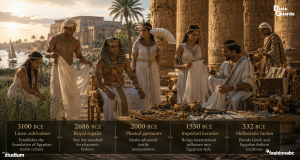
Key Benchmarks – Created by Dinis Guarda with AI tools for Fashionabc
| Period | Innovation | Significance |
| 3100 BCE | Linen cultivation | Establishes the foundation of Egyptian textile culture |
| 2686 BCE | Royal regalia | Sets the standard for pharaonic fashion |
| 2000 BCE | Pleated garments | Marks advanced textile manipulation |
| 1550 BCE | Imported luxuries | Brings international influence into Egyptian style |
| 332 BCE | Hellenistic fusion | Blends Greek and Egyptian fashion traditions |
By the time Alexander’s conquest brought Greek influence into Egypt, this was a fashion tradition already thousands of years deep — one built not around change for its own sake, but around the belief that what you wore in life shaped how you’d be remembered, and perhaps reborn, beyond it.
Sources:
- Clothing in ancient Egypt — Wikipedia
- Ancient Egyptian Clothing and Fashion: Style, Status, and Sacred Symbolism — Egypt Tours Portal
- Ancient Egyptian Clothing, Fashion & Textiles — Egypt Fun Tours
- The History of Linen: From Ancient Egypt to Modern Fashion — Fabric Material Guide
- Linen — the Heart of Fashion in Ancient Egypt
- The Nemes, Royal Headdress of Ancient Egypt
- What Did Egyptian Pharaohs Wear? Everyday Royal Fashion
- The Magical Powers of Ancient Egyptian Amulets
- Egyptian Amulets and Their Meanings — Ancient & Oriental
Previous articles in this series:
- Chapter 1: The Dawn of Dress — Prehistoric Origins (300,000–10,000 BCE)
- Chapter 2: Ancient Foundations — Mesopotamian Innovations (3500–539 BCE)