

“In the beginning was the need, and the need became form, and form became expression.”
Fashion’s real origin story doesn’t start in a Parisian salon. It starts with survival. The oldest physical evidence for woven fabric clothing comes from figurines in the southern Levant, dated to roughly 11,700–10,500 years ago but the deeper story reaches back much further than that.
We arrive in fabric and we leave in it. Everything in between is a long, layered record of who we’ve been, not just what we wore, but why. Fashion tracks the shift from purely practical clothing in the earliest human societies to the status symbols of Mesopotamia, Rome, and Egypt, all the way to the birth of haute couture in 19th-century Paris.
It began, simply, with a need for protection; skins, plants, and bone worked into something wearable. But even in these first, rough garments, a distinctly human instinct was already showing itself: the drive to turn necessity into meaning, function into art. Where other animals evolved fur, scales, or feathers, humans took a different route entirely. We became the species that manufactures its own plumage, that builds identity out of raw material rather than inheriting it from biology.
The evidence suggests this instinct is old. Around 120,000 years ago, in caves along the Moroccan coast, early humans were already crafting garments from jackal, fox, and wildcat skins, using bone awls and stone tools with a level of care that goes well beyond basic insulation. These weren’t crude wraps, they were early, deliberate acts of self-presentation.
Then came a genuine turning point: the eyed needle, invented roughly 40,000 years ago. It’s a tiny object, barely the length of a finger, but it changed everything. For the first time, garments could be fitted, shaped to follow the body rather than simply draped over it. The Cro-Magnons who mastered this technology gained more than warmth; many researchers link the advantage of tailored clothing to their eventual dominance over Neanderthals, who never developed the same sewing technology and were limited to loosely wrapped hides.
As societies organised themselves, clothing quickly became a form of social shorthand, readable at a glance. A Roman’s toga, a pharaoh’s ceremonial regalia, a Mesopotamian king’s kaunakes: each one was a compressed statement about power, divine favour, and one’s place in the order of things. Purple dye, elaborate headdresses, fine jewellery, these weren’t just beautiful. They were claims. They suggested that through dress, a person could reach past the ordinary and toward the divine.
That belief, that clothing can elevate, transform, even sanctify, is one of the oldest ideas in fashion, and it has never really left us. It’s the same instinct running through cave paintings at Lascaux showing figures in animal skins, and through today’s digital runways where models walk through entirely virtual worlds.
For a striking stretch of prehistory — an estimated 90,000 years — anatomically modern humans lived without clothing at all. That makes its eventual invention less an evolutionary inevitability and more a conscious choice, a decision to start using the body as a canvas rather than leaving it bare.
Climate as Couturier

Created by Sara Srifi with AI tools for Fashionabc
Clothing’s invention lines up closely with a changing climate. Even in a relatively mild region like Morocco, clothing appears to have emerged around 120,000 years ago, alongside the onset of an Ice Age. But the timing tells only half the story, this same period also saw the appearance of personal ornaments like shell beads, suggesting that from the very start, clothing wasn’t only about staying warm. It was already about style.
Ötzi: Prehistoric Haute Couture
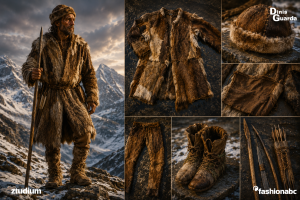
Created by Sara Srifi with AI tools for Fashionabc
Few discoveries capture this sophistication better than Ötzi the Iceman, preserved in alpine ice for roughly 5,300 years. His outfit was no rough bundle of hides. It was a considered ensemble: a long fur coat stitched from multiple pieces and reaching nearly to the knees, leather leggings, a loincloth, grass-insulated leather boots, and a fur cap, each piece cut, fitted, and sewn with sinew for both warmth and durability. It’s not an exaggeration to call this an early form of tailoring: garments built with real attention to construction, fit, and balance.
Technology as Turning Point
The leap to fitted clothing required real innovation — fine stone blades for cutting hide with precision, and the eyed needle for stitching it into shape. Cro-Magnons carried this technology into Europe around 35,000 years ago. Neanderthals, occupying the same landscape, never developed it, remaining limited to crudely draped skins — a gap researchers now consider one of several factors behind their eventual extinction.

Created by Sara Srifi with AI tools for Fashionabc
Key Benchmarks
| Period | Innovation | Significance |
| 300,000 BCE | Loss of body hair | Made eventual clothing development necessary |
| 120,000 BCE | First leather/fur clothing | Earliest evidence found in Moroccan caves |
| 40,000 BCE | The eyed needle | Enabled complex, fitted garment construction |
| 35,000 BCE | Cro-Magnon fitted clothing | A likely survival advantage over Neanderthals |
| 11,700 BCE | Fabric clothing evidence | Earliest known textile evidence, southern Levant |
From this point forward, clothing would never again be purely functional. The dawn of dress had already planted every idea fashion would spend the next 300,000 years elaborating on: adornment, status, belief, and the simple, stubborn human urge to turn covering into meaning.
Sources:
- Evidence of Fur and Leather Clothing, Among World’s Oldest, Found in Moroccan Cave — Smithsonian Magazine
- Moroccan Cave Find Shows Ancient Humans Made Clothes 120,000 Years Ago — Ancient Origins
- When Did Humans Start Wearing Clothes? — CNN
- How the Humble Eyed Needle Allowed Humans to Invent Fashion More Than 40,000 Years Ago — ZME Science
- Paleolithic Eyed Needles and the Evolution of Dress — Science Advances
- Eyed Needles Were Invented Around 40,000 Years Ago in Eastern Eurasia — Sci.News
- Sewing Needles Reveal the Roots of Fashion — SAPIENS
- Clothing — South Tyrol Museum of Archaeology (Ötzi)
- Ötzi the Iceman’s Wild Wardrobe Revealed — Scientific American
- Here’s What the Iceman Was Wearing When He Died 5,300 Years Ago — National Geographic