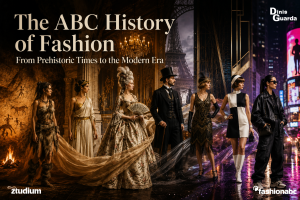
History of Fashion: The ABC Thread of Humans, The History of Us
Fashion is the one constant companion of a human life. We arrive in it, wrapped before we can speak, grow into it, using it to test out who we are, who we want to be, and who we refuse to be. And when life ends, we are dressed one last time, sent off in fabric chosen with care and meaning. Fashion, then, is not decoration bolted onto the outside of a person. It is closer to architecture: the visible structure of an inner world, quietly narrating the story of the people who wear it.
History, the saying goes, is written by the victors. But there is another history running alongside it, one written in thread, dye, weave, and silhouette. Fashion is a timeline you can touch. It carries the fingerprints of politics, religion, rebellion, and everyday survival. A pleated Mesopotamian tunic, a gold-threaded robe from an imperial court, a rigid Victorian corset, each says more about what a society valued and feared than a page of text ever could.
Every generation rolls its eyes at what its parents wore, right before chasing its own definition of “new.” And yet the impulse never changes: we keep returning to fashion to mark who we are. It is cyclical but never static, a mood ring for entire civilisations. In hard times, fashion tends to swing toward the outrageous, part rebellion and part escape. In times of plenty, it swings toward excess, a way of broadcasting status and control.
What began purely as necessity slowly became storytelling. Storytelling became power. Power became art. And now, in the 21st century, fashion is merging with technology — biometric fabrics, wearables that track our vital signs, wardrobes that exist only as data — pushing us toward an era where identity itself becomes digital, decentralised, and fluid.
Fashion has never stood still. It has always travelled with trade routes, wars, weather, and invention, clothed hunters and healers, priests and politicians, revolutionaries and monarchs, carried the discipline of monks and the excess of pharaohs in the same breath. In every era, what people wore was never separate from what they believed.
From Survival to Symbol
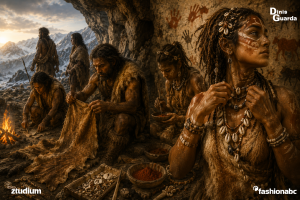
Created by Sara Srifi with AI tools for Fashionabc
Long before the word “fashion” meant anything like haute couture, it meant staying alive. As far back as 300,000 BCE, early humans were turning animal skins, bark, leaves, and bone into wearable protection against the elements. Crude as these garments were, they marked something enormous: the start of culture itself.
Clothing was never purely practical, even then. The moment someone strung shells into a necklace or rubbed natural pigment into a hide, they weren’t just covering skin — they were sending a signal. Identity, status, mood, belonging: all of it was already being spoken through material, long before anyone had a word for fashion.
Fashion as Identity and Power in the Ancient World
Created by Sara Srifi with AI tools for Fashionabc
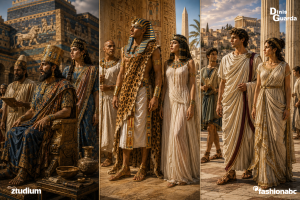
As villages became cities and cities became kingdoms, clothing turned into something closer to a uniform of belief and rank. In Mesopotamia, around 3500 BCE, Sumerians wrapped themselves in woolen skirts and shawls pinned with fibulae, while priests and rulers set themselves apart with embroidered robes and elaborate headdresses. What you wore told everyone your class, your trade, and your place in the religious order.
In Egypt, clothing did double duty — practical relief from the desert heat, and a declaration of divine order. Light linen suited the climate, but gold sandals and leopard-skin cloaks marked pharaohs as something more than mortal, while priests shaved their heads and wore spotless white as a sign of purity. Egyptian dress carried a belief in eternity: what you wore in life shaped how you’d be remembered — or resurrected — after it.
Greece and Rome brought a different obsession: geometry and civic duty. The flowing chiton and himation in Greece stood for grace and intellect; the Roman toga stood for citizenship itself, a garment that quite literally could not be worn by just anyone. Fashion here wasn’t just style — it was a visible index of who belonged in public life.
Every stitch, in every one of these civilisations, tied a person to their gods, their laws, their land, and their legacy.
From Feudal Wool to Renaissance Ambition
Created by Sara Srifi with AI tools for Fashionabc
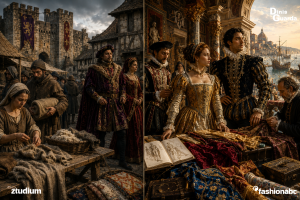
The Middle Ages piled on the layers, literal and social. Wool clothed the masses; velvet and silk were locked away for nobility. Even colour carried law-like weight, purple for royalty, red for power, blue for virtue.
Then came the Renaissance, roughly 1485 to 1600, and fashion stitched itself permanently into the arts. Italy and France drove a new kind of fashion consciousness, one built on individualism, humanism, and appetite for the wider world. Doublets, ruffs, and corsets stopped being just garments and became artistic statements — clothing as canvas, broadcasting wealth, intellect, and taste. Tailoring itself became a respected craft, marking the shift from clothing-as-function to clothing-as-form. As trade routes opened further, Asian silks, Indian cottons, and African textiles began weaving themselves into European wardrobes, creating something genuinely new out of genuinely old traditions.
Baroque Theatre and Rococo Excess
Created by Sara Srifi with AI tools for Fashionabc
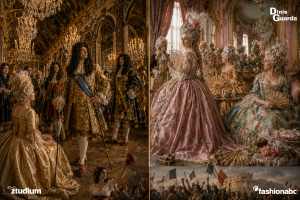
By the 17th and 18th centuries, dress had become theatre. High wigs, lace collars, and wide pannier skirts turned the human body into architecture. This wasn’t clothing for comfort — it was clothing as a statement of power. The court of Louis XIV effectively ran fashion the way a capital runs a country, setting trends that rippled from Paris to Prague.
Rococo softened the palette — pastels, floral motifs, an aesthetic built around pleasure — but underneath the silk and powder, political pressure was building. As the French Revolution approached, fashion picked up a new job: not just displaying wealth, but arguing for equality and demanding change.
Industry Reshapes the Wardrobe
Created by Sara Srifi with AI tools for Fashionabc
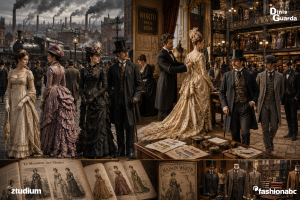
The 19th century industrialised fashion itself. Early neoclassical simplicity — high waists, flowing muslin — gave way by mid-century to crinolines, bustles, and tightly boned corsets.
This was also when haute couture was born, in Paris. Charles Frederick Worth opened his fashion house in 1858 and effectively invented the modern fashion business: branding, seasonal collections, a designer’s name as a mark of prestige. Illustrated magazines and department stores turned fashion into something aspirational and accessible at once.
Men’s fashion moved the opposite direction — toward restraint. Tailored suits, waistcoats, and top hats defined the gentleman, with British tailoring setting the tone for menswear well beyond its borders. Fashion, by the century’s end, lived comfortably in both the factory and the salon.
The 20th Century, Decade by Decade
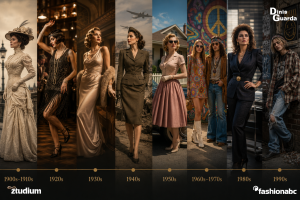
Created by Sara Srifi with AI tools for Fashionabc
No century broke more rules faster. Fashion became democratic, experimental, and dizzyingly varied — a genuinely new mood every ten years:
- 1900s–1910s: The Gibson Girl and Edwardian elegance, still bound by the structured S-bend corset.
- 1920s: The Jazz Age flapper — short hemlines, bobbed hair, and a new kind of freedom.
- 1930s: Depression-era practicality alongside Hollywood glamour — bias-cut satin as escapism.
- 1940s: Wartime austerity and military structure, followed by Dior’s postwar “New Look,” which brought back the full skirt and the cinched waist.
- 1950s: Suburban America in tailored glamour and poodle skirts.
- 1960s–1970s: Counterculture takes over — mod style, bohemian looks, bell bottoms, psychedelic prints.
- 1980s: Power dressing, bold colour, shoulder pads — corporate ambition worn on the body.
- 1990s: A deliberate comedown — grunge, minimalism, and the rise of streetwear.
This was the century fashion became fast, famous, and unapologetically political.
Now: Digital, Ethical, Personal
Today fashion is everywhere and, in a strange way, nowhere fixed at all. Social media and e-commerce have dissolved geography. Trends go viral before most people have even seen them in person. Influencers now carry the cultural weight once reserved for fashion editors. AI helps design collections; virtual models walk runways that only exist as pixels. Fashion NFTs and digital skins are already shaping identity inside the metaverse.
But the industry is also being forced to look in the mirror. Its role in climate change, labour conditions, and overconsumption is under real scrutiny, and movements around slow fashion, sustainable sourcing, and ethical production are starting to reshape how clothes get made.
At the same time, fashion is becoming intensely personal. Algorithms predict individual taste. Wearables track health in real time. Clothing itself is starting to respond — lighting up, adjusting temperature, generating data about the body wearing it. We’re no longer just wearing clothes. We’re beginning to merge with them.
Fashion Is the History of Us
Fashion was never just fabric stitched into shape. It’s identity made visible — memory sewn into form, the fingerprint of an era, fluid and imperfect and deeply human.
As virtual wardrobes, digital avatars, and AI-generated designs become normal, it’s worth remembering that fashion’s roots have always been personal. Hand-stitched or code-printed, its core job hasn’t changed: it is a canvas for expression, a language for things we don’t say out loud.
From animal skin to smart fabric, from the toga to whatever comes after the “quantum hoodie,” fashion has always been both mirror and mask, ritual and rebellion at once. It’s what we wear when we’re born, what we’re remembered in when we’re gone, and everything in between is what we choose to say without ever opening our mouths.
Sources:
- The Roman Toga — World History Encyclopedia
- Toga — Wikipedia
- Did People in Ancient Rome Really Wear Togas? — History Facts
- Charles Frederick Worth — Wikipedia
- ‘Father of Haute Couture’: The Man Who Pioneered Fashion Marketing — CNN
- A Short History of Luxury: Charles Frederick Worth — Luxus Magazine
- Beyond Physical Clothes: How Digital Fashion, Virtual Clothing NFTs, and Metaverse Fashion Are Changing Style — Fashion Times
- Digital Fashion and the Metaverse: Redefining Identity and Consumption in Virtual Spaces — Medium
- 10 Fashion Brands Going Digital with NFT Wearables for the Metaverse — DappRadar