

Shutterstock/azorlu
There was a time when a diamond tennis necklace came out for one reason: something formal, something important, something that called for its own spotlight. That era’s over.
Walk through any fashion feed right now, and you’ll see tennis necklaces doing double duty, sitting under a paperclip chain, tangled up (intentionally) with a pendant, worn with jeans. The piece that used to be the whole outfit is now the anchor of a much bigger story. That shift says a lot about the fashion of diamond jewelry in general; diamonds aren’t reserved for “occasions” anymore. They’re part of how people get dressed.
Here’s how the actual mechanics of building a stack around a diamond tennis necklace work: lengths, metals, pairings, and the mistakes that turn a good idea into a tangled mess.
The 5 Golden Rules of Stacking a Diamond Tennis Necklace
Good stacking isn’t random. It looks effortless because someone thought it through, even if that someone spent four minutes in front of a mirror deciding.
- Vary your necklace lengths: This is the rule everyone breaks first. Leave at least two inches between each piece, or your necklaces will sit on top of each other and read as one confused blob instead of layers.
- Pick one anchor: Every good stack has a piece that does the heaviest lifting, usually the tennis necklace itself. Everything else supports it; nothing competes with it.
- Combine textures on purpose: A smooth diamond line against a chunky Cuban link or a soft paperclip chain creates contrast. Sameness is boring. Contrast is what makes people look twice.
- Balance the visual weight: If your tennis necklace is bold, don’t pile on three more statement pieces. Let something delicate carry the rest of the stack.
- Match the neckline: A crew neck limits your real estate. A V-neck or off-shoulder top gives your layers room actually to cascade instead of bunching up near your collarbone.
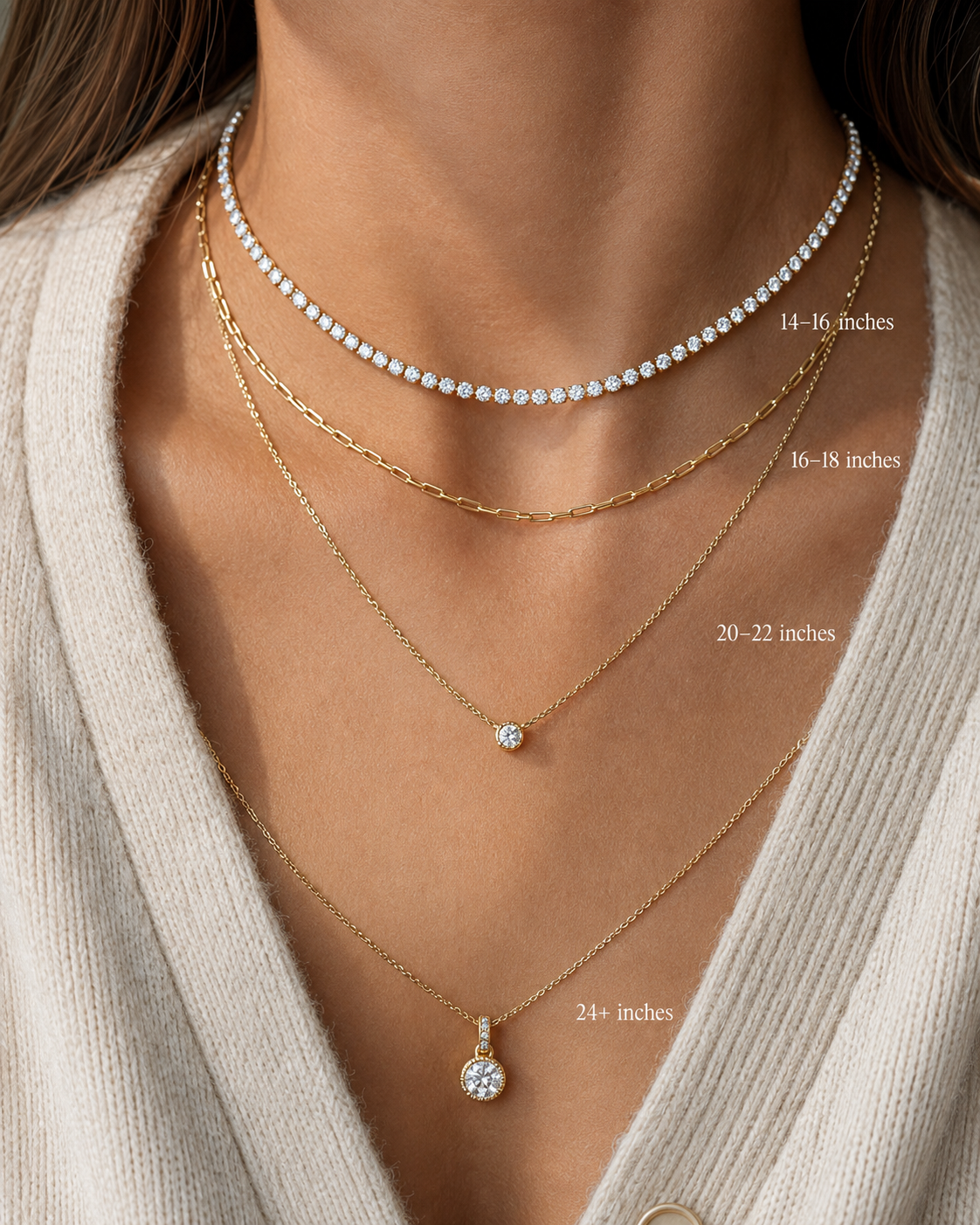
Diamond Tennis Necklace Stacking Lengths
Length is a major factor separating a stack that looks curated from one that looks accidental.
- 14–16 inches: Sits high at the base of the neck and works best as the choker layer.
- 16–18 inches: Falls around the collarbone, making it the ideal anchor layer for a diamond tennis necklace.
- 20–22 inches: Reaches the upper chest and is perfect for pendants or personalized charms.
- 24 inches and longer: Creates a dramatic statement or opera layer, adding length and visual balance.
Most diamond tennis necklaces land in that 16–18 inch window, which is exactly why they work so well as the anchor piece rather than the top or bottom layer. Setting matters here too, and it’s not just a technicality. A piece like the non-flip 4-prong natural diamond tennis necklace is built specifically to stay face-up against the skin, which is a bigger deal than it sounds once you’re wearing it every day inside a stack.
Necklaces that flip or twist under other chains end up showing their backing instead of their sparkle, and nobody’s re-adjusting their jewelry mid-meeting.
7 Diamond Tennis Necklace Stack Ideas to Try
There’s no single “correct” way to layer a diamond tennis necklace. The best combinations create contrast, balance, and enough space for each piece to have its own moment.
- Tennis Necklace and Paperclip Chain. The clean geometry of a paperclip chain against a continuous diamond line is one of the easiest contrasts to pull off. It looks modern without trying too hard, and it works in gold or silver depending on your everyday palette.
- Tennis Necklace and Initial Pendant. Adding an initial charm on a slightly longer chain turns a beautiful necklace into a personal one. It’s a small addition, but it’s the detail people actually ask about.
- Tennis Necklace and Choker. Layer a snug 14–16 inch choker above a non-flip tennis necklace, and you’ve got a stack that’s polished enough for the office without looking like you tried too hard to dress it up.
- Double Tennis Necklace Stack. Two tennis necklaces in different carat weights or lengths create depth through repetition instead of contrast. It’s a bolder move, and it reads unmistakably luxe.
- Tennis Necklace and Gold Herringbone or Cuban Link. This is the high-low pairing, delicate diamonds against a heavier, more textured gold chain. It’s the combination stylists reach for when a look needs an edge.
- Tennis Necklace and Colored Gemstone Chain. A sapphire or emerald station chain adds color without pulling focus from the diamonds. It’s a subtle way to make a classic piece feel seasonal.
- Tennis Necklace and Pearl Strand. Pearls and diamonds together feel almost old-world, but paired at different lengths, the combination reads current, romantic without being precious.
Minimalist vs. Statement Tennis Necklace Stacks
Not every day calls for the same amount of sparkle, and honestly, the “more is more” advice you see everywhere doesn’t fit every wardrobe or every personality.
A minimalist stack usually includes two necklaces, making it a practical choice for the office, travel, and everyday wear. Keeping the pieces in the same metal, such as all yellow gold or all white gold, creates a clean, refined look. A classic combination is a diamond tennis necklace layered with a delicate gold chain.
A statement stack typically features three to five necklaces layered at different lengths. It’s better suited to evening events, celebrations, or occasions where your jewelry becomes part of the outfit. Mixing metals and textures works well here, especially when the contrast feels intentional. A striking combination might include a diamond tennis necklace paired with a choker, a pendant necklace, and a bold gold chain.
If you’re new to layering, start minimal. You can always add a third piece later; it’s much harder to walk back a stack that’s trying too hard.
Yellow Gold, White Gold, or Mixed Metal – What Pairs Best?
Yellow gold tennis necklaces have had a real comeback. Pair a yellow gold tennis necklace with paperclip chains, herringbone styles, or classic cable chains for a relaxed luxury look that works year-round. There’s a reason resort-wear editorials keep reaching for yellow gold right now.
White gold and platinum settings lean cooler and more formal by nature. They sit naturally with silver chains, white pearls, other cool-toned pieces, and minimalist wardrobes and monochromatic outfits, giving off a cleaner, more corporate polish.
Also, anyone stacking multiple metal pieces daily cares about skin sensitivity. Mixed metal stacking is trendy, and it works, but it works best with a little discipline. The trick is maintaining one dominant metal. Aim for roughly 60 to 70 percent of the stack in one color, then introduce the second metal through a single chain, pendant, or bracelet.
That ratio keeps the look intentional instead of random. A balanced mix feels curated. An even split often feels accidental.
Natural vs. Lab-Grown Diamond Tennis Necklaces for Stacking
This is where opinions get loud, and honestly, most of the noise is unnecessary. Both have a real place in a stack.
Lab-grown diamond tennis necklaces let you build bigger, bolder layers without a bigger investment attached to every single piece. That’s genuinely useful if you’re stacking multiple tennis necklaces or building out a full collection over time.
Natural diamonds, on the other hand, remain the traditional investment choice. A solid gold natural diamond tennis necklace tends to function as the anchor investment layer: the one piece in the stack that isn’t going anywhere, that gets passed down, that you don’t rotate out with trends.
Neither choice is “wrong.” It just depends on whether you’re building a stack for the moment or building one for the long haul.
How to Wear a Diamond Tennis Necklace Stack for Every Occasion
For everyday effortless wear, keep it to two pieces max: your tennis necklace and one delicate chain. It should stay a full day without needing adjustment.
For the office, a choker plus your tennis necklace hits that “polished, not flashy” mark most workplaces respond well to.
Evening events are where you get to layer without restraint: three or four pieces, mixed textures, maybe even a colored gemstone chain thrown in. This is the one context where more genuinely does read as more, in a good way.
A little preparation saves a surprising amount of untangling later.
How to Prevent Tangling When Layering Tennis Necklaces
Tangling is the one thing that makes people give up on layering entirely, but it’s almost always fixable.
Necklace extenders, small clasps that hold multiple chains at fixed points on the back of the neck, solve most of the problem before it starts. They’re inexpensive and worth owning if you layer regularly.
Beyond that, vary the style of your chains, not just their length. Two flexible rope chains of similar weight will tangle constantly; a stiffer box chain paired with a fluid diamond line generally won’t.
And when you take your stack off at night, don’t just toss it in a drawer. Lay pieces flat, separated, or hang them on a multi-hook organizer. Five extra seconds of care save you a genuinely annoying ten minutes of untangling the next morning.
Final Thoughts
The best diamond tennis necklace stack isn’t the one with the most layers. It’s the one that feels balanced, comfortable, and unmistakably yours.
Trends will continue to evolve, but the principles behind great layering remain the same. Build your stack around one quality anchor piece, leave room for each necklace to shine, and choose combinations that reflect your personal style rather than chasing every new fashion trend.
The most memorable necklace stacks always look effortless, even when every detail has been carefully considered.