

Classical Columns — Greek & Roman Refinement (800 BCE–476 CE)
This article is part of an ongoing series adapted from The ABC History of Fashion*, whitepaper
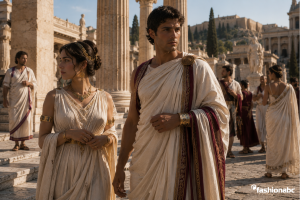
Classical Columns — Greek & Roman Refinement (800 BCE–476 CE) – Created by Sara Srifi using AI tools for Fashionabc
“In marble and in cloth, Greece and Rome carved humanity’s silhouette upon eternity.”
Greek and Roman fashion established aesthetic principles that still shape how we think about dress today. In these two civilisations, clothing wasn’t just something you put on — it was philosophy made wearable, an argument about beauty, proportion, and character stated in fabric rather than words.
Greek fashion celebrated the natural human form through drapery that suggested rather than revealed, an approach rooted in Hellenic ideas about modesty, balance, and the tension between concealment and display. The chiton and himation created flowing lines that seemed to echo the same ideals found in Greek sculpture. Arranging these garments well was itself a skill — the careful placement of folds could create a visual rhythm as deliberate as anything found in architecture or music.
Rome took that Greek elegance and turned it into something closer to imperial statement. Clothing here wasn’t just personal taste; it broadcast the power and reach of the empire itself. The toga became the ultimate marker of status — a garment so complex to drape correctly that it required both real skill and the kind of leisure time only the wealthy could spare. Properly arranged, its roughly eighteen feet of wool fabric created a sculptural silhouette that turned the wearer into a walking symbol of Roman dignity and authority.
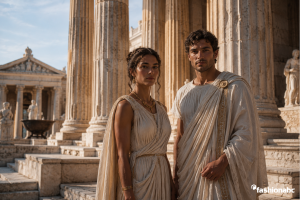
Greek & Roman Refinement – Created by Sara Srifi using AI tools for Fashionabc
Both cultures also understood something darker about fashion: its power to enforce order. Rome’s sumptuary laws regulated dress with the precision of a legal code, dictating exactly who could wear which materials, colours, and styles. Purple — extracted at enormous cost from thousands of murex sea snails — was reserved for imperial use, making it arguably the world’s first legally protected fashion element. These rules set a precedent that would echo through centuries of dress codes: the idea that what you wore could be regulated as carefully as what you said or did.
Greek Grace

Greek Grace – Created by Sara Srifi using AI tools for Fashionabc
Greek fashion built elegance around the natural body rather than against it. The chiton, a simple tunic of linen or wool, and the himation, a large draped cloak worn over it, together created fluid lines associated with modesty and beauty. How a himation was arranged — over one shoulder, wrapped tightly, left loose — could say almost as much about a person’s status and taste as the fabric itself. Draping became something close to an art form, with skilled arrangement carrying the same kind of prestige as fine sculpture.
Roman Pragmatism
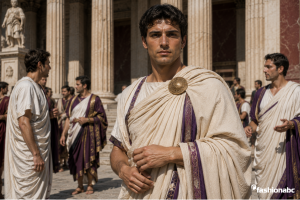
Roman Pragmatism – Created by Sara Srifi using AI tools for Fashionabc
Rome transformed that Greek elegance into something more overtly political. The toga became the definitive status symbol — its elaborate draping requiring both skill and, crucially, the free time to maintain it throughout the day. Roman fashion also gave rise to one of history’s first real accessories industries, with elaborately worked fibulae (brooches) becoming collectible items valued as much for craftsmanship as function.
Social Stratification
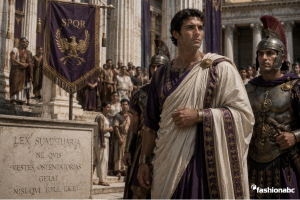
Social Stratification – Created by Sara Srifi using AI tools for Fashionabc
Both civilisations used clothing to draw hard lines between social classes. In Rome, sumptuary laws went further than mere custom — they were law. Full Tyrian purple, the empire’s most exclusive dye, was eventually restricted to emperors and triumphing generals alone; ordinary citizens might wear a narrow purple border at most, and wearing unauthorised purple could be treated as an act bordering on treason. This legal codification of fashion set the template for centuries of regulated dress that followed.
Key Benchmarks

| Period | Culture | Innovation | Significance |
| 800 BCE | Greek | Draped garments | Celebrates the natural body over rigid construction |
| 500 BCE | Greek | Loom improvements | Enables finer fabric production |
| 200 BCE | Roman | Toga development | Becomes the ultimate imperial fashion symbol |
| 100 CE | Roman | Sumptuary laws | Fashion regulated by legal code |
| 400 CE | Roman | Christian influence | Introduces new norms of religious modesty |
By the time Rome’s western empire fell, Greek and Roman dress had left behind a template that would echo through Byzantine, medieval, and even modern fashion: the belief that a garment’s cut and colour could say, before a single word was spoken, exactly who you were and where you stood.
Sources:
- Ancient Greek Dress: The Classic Look — The Art Institute of Chicago
- The Chiton, Peplos, and Himation in Modern Dress — The Metropolitan Museum of Art
- Himation — Fashion History Timeline (FIT)
- The Roman Toga — World History Encyclopedia
- Toga — Wikipedia
- Did People in Ancient Rome Really Wear Togas? — History Facts
- Tyrian Purple — Wikipedia
- Roman Elites Alone Wore Tyrian Purple, Maintaining Social Hierarchy — Ancient Origins
- Why Were Roman Citizens Punished for Wearing Purple? — World Atlas
Previous articles in this series:
- Introduction: History of Fashion — The ABC Thread of Humans, The History of Us
- Chapter 1: The Dawn of Dress — Prehistoric Origins (300,000–10,000 BCE)
- Chapter 2: Ancient Foundations — Mesopotamian Innovations (3500–539 BCE)
- Chapter 3: Divine Drapery — Egyptian Elegance (3100–30 BCE)