Some jewelry is mainly decorative. Other pieces seem to say something before the wearer does. The signet ring has always belonged closer to the second group.
For centuries, it was tied to family names, crests, institutions and inherited codes. It was not just an accessory; it was a mark. Today, that symbolism has loosened. The signet has moved out of the family archive and into everyday style, worn with tailoring, denim, knitwear, eveningwear or very little else.
Its return also makes sense in the current mood of fashion. People are looking again at objects with character: pieces that feel personal, slightly historical and less disposable than accessories bought for one season. A signet can look traditional, rebellious, minimal or quietly luxurious depending on the finger, the metal, the shape and the person wearing it.
What is a signet ring?
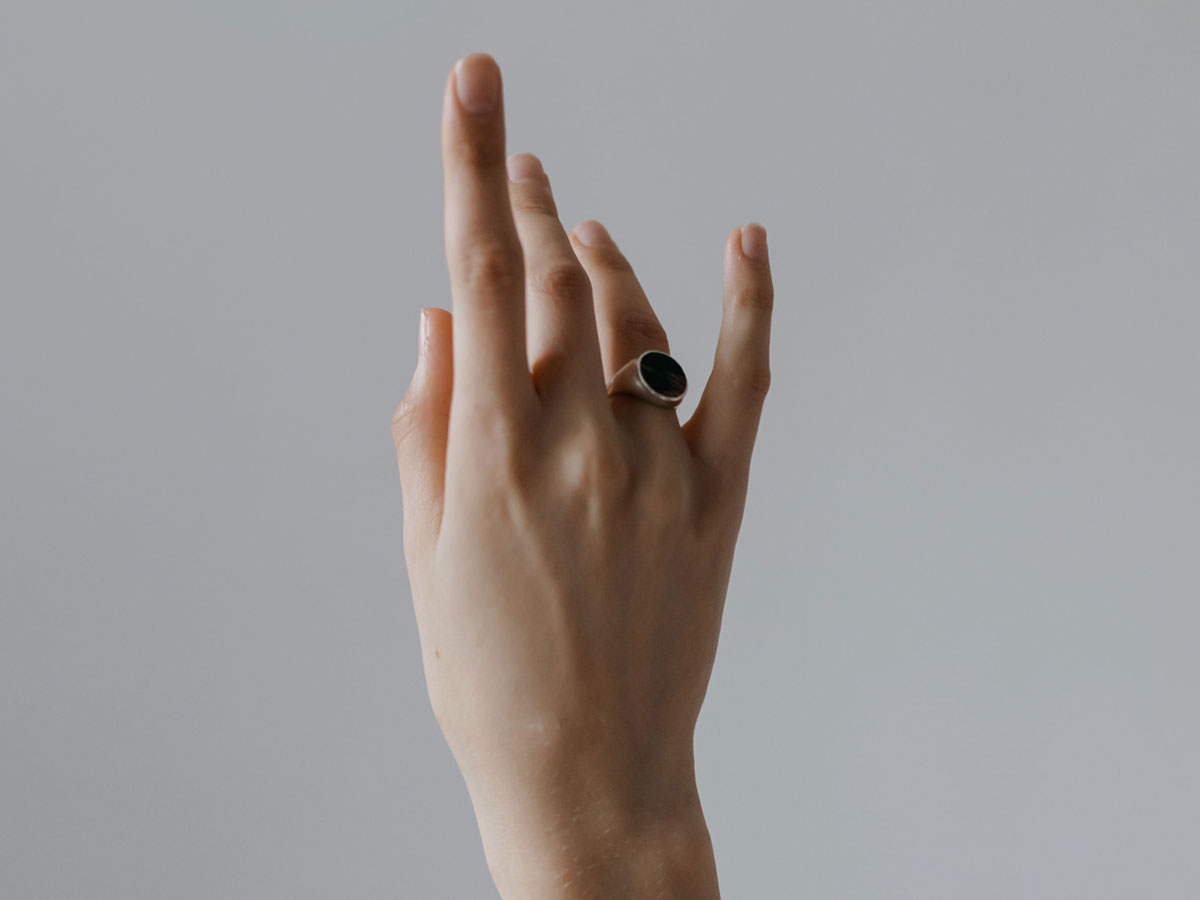
A signet ring is a ring with a flat or slightly raised face, traditionally engraved with a family crest, initials, symbol or emblem. Historically, it was used as a personal seal. The engraved face could be pressed into wax to authenticate letters and documents, which made the ring both ornamental and practical.
That function is not just a romantic detail from the past. Museum collections still show how long rings have been used as personal seals: The Met holds an Egyptian signet ring from the reign of Tutankhamun that shows signs of frequent use as a seal. The object may be small, but historically it carried legal, social and personal weight.
That history explains the shape. Unlike a simple band, a signet is built around its face. It may be oval, cushion-shaped, round, rectangular or shield-like, but the idea is usually the same: the top of the ring carries the identity.
Modern versions do not need to feel aristocratic or formal. Initials, zodiac signs, abstract motifs, birthstones, plain polished surfaces and vintage-inspired designs all sit comfortably within the category. The object has kept its link to identity, but the idea of identity itself has become much broader.
What it used to mean, and what it means now
The meaning has changed more than the design.
Traditionally, a signet represented lineage, authority or belonging. It was often connected to family heritage, social position, schools, clubs, military regiments or professional institutions. It was not chosen casually. It pointed to a name, a place or a group.
Now, the meaning is more personal. A signet can still carry a family crest, of course, but it can also mark independence, memory, taste or self-expression. Some people wear one because it belonged to a parent or grandparent. Others choose one because the shape feels strong and unfussy.
A plain gold signet can look almost conservative. An oversized silver one on the index finger says something else entirely. That flexibility is part of the appeal. The same basic form can suggest heritage on one hand and modern restraint on another.
Why the signet ring is back
The comeback is not accidental, but it is not really about nostalgia either. The signet sits at the intersection of several shifts in jewelry and personal style.
There is, first, the appetite for pieces that feel specific. Initial necklaces, birthstone jewelry, engraved bracelets and heirloom-inspired designs all speak to the same desire: accessories that feel connected to the wearer, not just to the season.
There is also a move away from delicate jewelry as the only default. Fine chains and slim bands still have their place, but more people are mixing them with heavier, sculptural or vintage-looking pieces. A signet gives structure to the hand. It has presence without relying on sparkle.
The renewed interest is not just about nostalgia. In its guide to the modern meaning of signet rings, Brides describes how the piece has moved from ancient symbols of status and authentication into something that can represent family legacy, membership, personal identity or simply style. That evolution explains why it feels relevant again: it has history, but it no longer has to be worn according to old rules.
Then there is the fact that the design is no longer easily confined to one gender. The signet has long been associated with men’s jewelry, especially in gold and on the pinky finger. That association now feels too narrow. Women wear signets as part of ring stacks, as minimalist statement pieces or as a sharper counterpoint to softer jewelry. Men wear them with suits, T-shirts, watches, bracelets or nothing else at all.
The best versions today do not feel like costume jewelry or borrowed formality. They feel chosen.
Which finger should you wear a signet ring on?
There is no single correct finger, although tradition does have its preferences.
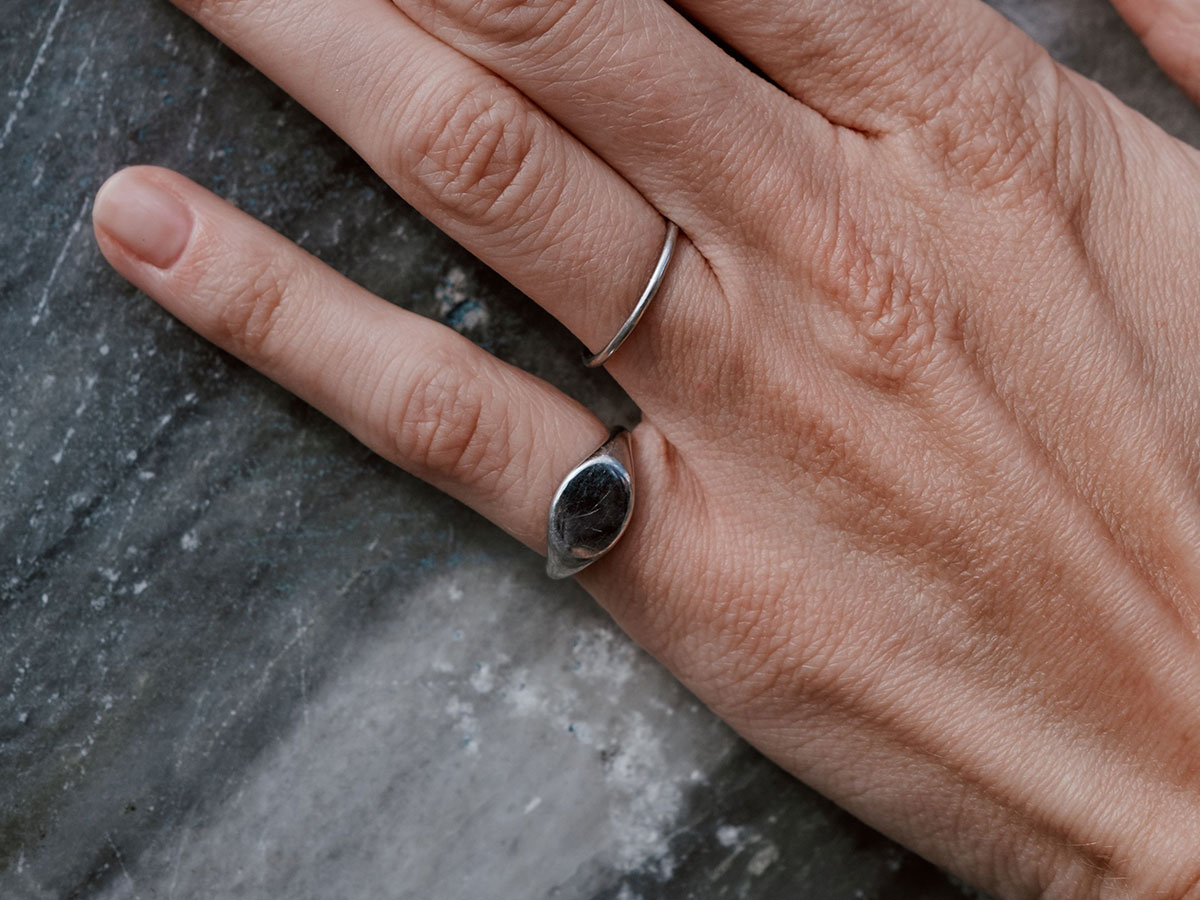
The pinky is the classic choice. Historically, especially in parts of Europe, signets were often worn on the little finger of the non-dominant hand. It remains the most traditional placement and still gives the ring a slightly old-world quality. A small oval or cushion shape on the pinky can look elegant rather than loud.
The ring finger is another common option, particularly when the piece has sentimental meaning. Some people wear a family signet there; others choose it as an alternative to a conventional band. It can also sit well near a wedding ring if the proportions are balanced, although two heavy rings on neighboring fingers may feel crowded.
The index finger makes the piece more visible. This is where a signet starts to read less as inherited jewelry and more as a style decision. A bolder face, a chunkier band or a silver finish can work well here, especially when the rest of the look is simple.
The middle finger gives a more modern balance. Because it sits centrally, it can handle a slightly larger ring, but comfort matters. A wide or heavy face can interfere with neighboring fingers if the design is too bulky.
The thumb is the least traditional option, but it has become more common in fashion styling. It gives the ring a stronger, more graphic presence. Clean designs usually work better here than highly ornate ones.
The right choice depends less on rules and more on proportion. A signet should feel deliberate on the hand, not accidental.
Getting the fit right
Fit matters more with a signet than with many other rings. The face is wider, the band is often heavier, and a poor fit becomes obvious quickly.
If the ring is too loose, the face can rotate around the finger. That is especially frustrating with engraved designs, where the orientation matters. If it is too tight, the width of the band can make it feel more restrictive than a thinner ring in the same size.
This is also why the finger comes before the size. A pinky ring, an index ring and a ring finger piece may all need different measurements. Even on the same hand, sizes can vary more than people expect.
If you are buying in a physical jewelry store, this is usually the easy part: a jeweler can measure your finger professionally and check how the ring sits on the hand. Online, the responsibility shifts to the buyer. Before ordering, measure the finger you actually plan to wear it on.
Ringsize.online explains how to measure ring size at home using the different methods people rely on when buying online: checking a ring they already own, printing a size guide, measuring the finger directly or using a ring sizer. It is especially useful with signets, because the site also covers what to keep in mind when measuring rings with a larger top. If you measure a signet on a sizing stick, the flat part of the ring should rest against the flat side of the stick, so the reading reflects the real fit rather than being thrown off by the weight or shape of the face.
For wider designs, comfort is as important as the number itself. The ring should slide over the knuckle with slight resistance, then sit securely without pinching. If you are between sizes, the width and weight of the piece should guide the final decision.
How to wear one now
The easiest way to wear a signet is not to over-style it. The piece already has presence, so it rarely needs much help.
A plain gold version works well with classic wardrobe pieces: a white shirt, knitwear, tailoring, denim, a leather belt, a simple watch. It does not have to look formal. In fact, it often looks better when the rest of the outfit is relaxed.
Silver feels cooler and less traditional. It pairs naturally with black, grey, denim, leather and more minimal wardrobes. A brushed or oxidized finish can make the ring feel less polished and more personal.
Engraved styles are strongest when the symbol means something, even privately. Initials, a date, a family motif or a small abstract mark can all work. The engraving does not need to be explained to everyone else.
For ring stacking, the signet usually works best as the anchor. Pair it with thinner bands rather than several equally heavy pieces. A signet on the pinky with a slim band on the ring finger can look considered. A bold index ring with several chunky pieces can also work, but it becomes a much stronger fashion statement.
Mixed metals are no longer a mistake. Gold and silver can sit together if the styling feels intentional. The trick is to repeat each metal at least once, perhaps with a watch, bracelet or another ring, so the contrast looks chosen rather than accidental.
Who can wear a signet ring?
Almost anyone. That is part of why the style feels interesting again.
The old codes around who “should” wear one have softened. A signet no longer needs a family crest, a particular background or a formal wardrobe. It can be inherited, commissioned, vintage, minimalist, oversized, engraved or completely plain.
Men’s signet rings often lean heavier, with larger faces and broader bands, but that is a convention rather than a rule. Women’s styles may be finer or more decorative, but many of the strongest modern looks come from ignoring those divisions altogether.
The better question is not who can wear one, but what kind of signet feels right. A small gold pinky ring gives a very different impression from a large silver index ring. A polished oval face feels different from a square engraved one. The category is broad enough to hold tradition and reinvention at the same time.
Less heirloom, more personal signature
The modern signet no longer has to obey the codes that made it famous. It can still carry a crest, an initial or a family story, but it can also be chosen simply because the shape feels right.
That shift is what keeps the piece relevant. It has enough history to feel grounded, but enough simplicity to adapt. On the pinky, it can look traditional. On the index finger, it becomes more assertive. In silver, it feels cleaner and cooler; in gold, warmer and more classic.
The old signet was about being recognized by others. The modern one is quieter than that: it works best when it feels unmistakably personal.