
You read the chapter three times. You highlighted everything. You made the flashcards. And then the test came — and half of it just wasn’t there.
If studying has ever felt like that, there’s a good chance the methods you were using didn’t match how your brain actually processes information. Left brain right brain learning styles aren’t just a personality quiz concept — they reflect real differences in how people take in, organize, and retain new material. If you’re not sure which way you lean, a free left or right brain test can give you a useful starting point in about four minutes. Then the techniques below will make a lot more sense applied to you specifically.
Why Does Your Thinking Style Change How You Learn?
Your cognitive style shapes not just what you find interesting — it determines how your brain prefers to receive, organize, and store new information. The same material can feel completely intuitive to one person and totally opaque to another, not because one is smarter, but because they’re processing it differently.
Left-brain learners tend to build understanding from the ground up. Give them the facts first, then the concept, then the big picture — and it clicks. They do well with sequential instruction, clear categories, and defined rules. Right-brain learners often work the opposite way: they need the big picture first. Without context, isolated facts don’t stick. They learn better when they can see how everything connects before they zoom in on the details.
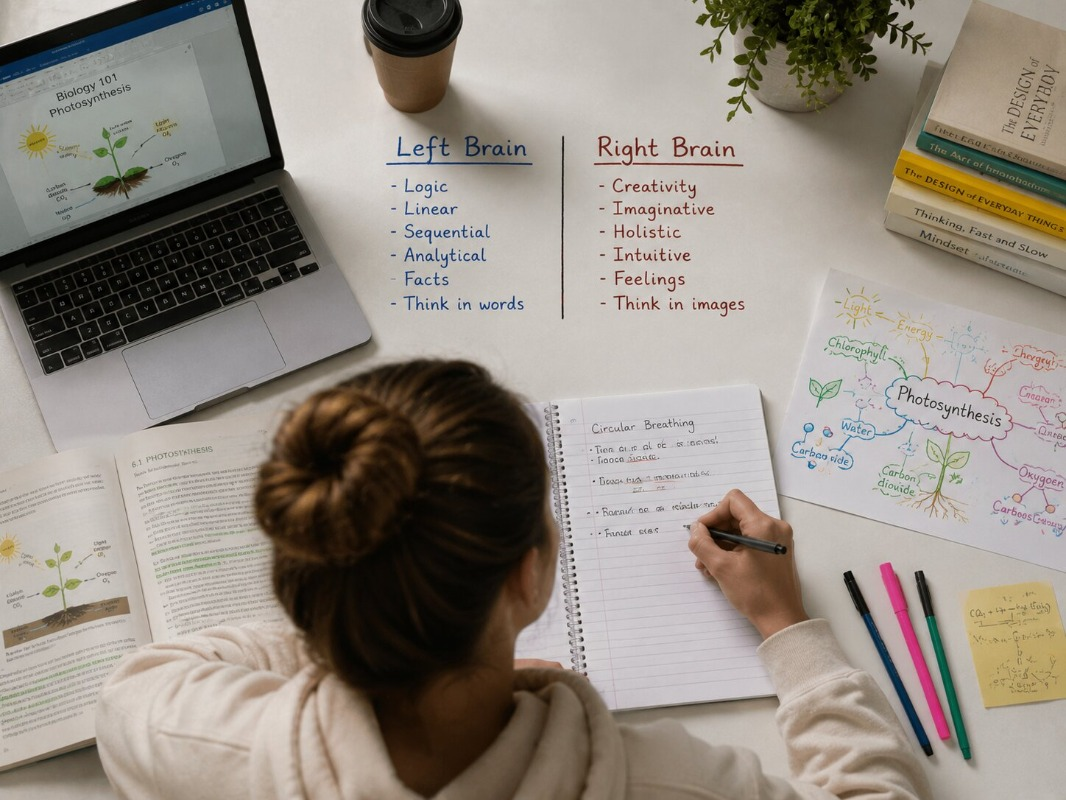
Here’s a simple example. Two students are studying the same history chapter. One reads straight through, makes an outline, and memorizes dates in order — and retains it well. The other reads the same chapter three times and remembers almost nothing, but the moment a teacher explains the why behind the events, everything falls into place. Neither student is doing it wrong. One is working with their natural learning style; the other is working against it.
Here’s what that means practically: when your study method matches your cognitive style, you spend less effort and retain more. When it doesn’t, you work twice as hard for half the result.
Study Techniques for Left-Brained Analytical Learners
Left-brained learners do their best work with structure, sequence, and clear logic. If you prefer knowing the rules before the exceptions and feel most confident when information is organized into neat categories, these techniques are built for how you think.
The Outline Method
Before diving into material, build a hierarchical outline — main topics, subtopics, supporting details. Left-brain learners often find that the act of organizing information is the learning. The structure itself becomes the memory.
Spaced Repetition with Flashcards
Harvard Graduate School of Education research on the spacing effect confirms that reviewing material at increasing intervals dramatically improves long-term retention. For left-brain learners who like systematic approaches, apps like Anki that schedule reviews algorithmically are a natural match — there’s a defined system to follow and the results are measurable.
Practice Problems First
Rather than re-reading notes, work through problems or past exam questions. Analytical learners usually hold onto material better when they’ve tested their understanding against a concrete challenge. Getting something wrong and then correcting it is more effective than passive review.
The Cornell Note Method
Divide your notebook page into a narrow left column for cues and a wider right column for notes. After class, use the left column to write questions that the right-side notes answer. It’s a structured, active system that forces you to process information rather than just transcribe it.
Teach It Logically
Pick a concept and explain it step-by-step out loud — as if teaching someone who knows nothing. Left-brain learners often discover gaps in their understanding when they try to construct a logical explanation from scratch. The gaps are exactly where the studying needs to go.
Picture a pre-med student who spends Sunday afternoons reworking every practice problem from the week’s lectures, then reviewing only the ones they got wrong. That’s left-brain learning working efficiently — systematic, measurable, and self-correcting.
Why Does Traditional Studying Feel Hard for Right-Brained Learners?
It’s not you — it’s the method. Most traditional study approaches are designed around left-brain learning: sequential reading, memorization through repetition, linear note-taking, and fact-by-fact review. For students whose left brain right brain learning style leans creative and holistic, these methods can feel like trying to build a puzzle by staring at one piece at a time.
If you’ve spent years thinking you’re just “bad at studying,” there’s a good chance the problem was never you.
The mismatch is real and well-documented in education research. Right-brain learners need context before detail — meaning before facts. When that’s missing, information doesn’t stick, not because they’re not trying, but because the method isn’t giving their brain what it needs to form lasting connections.
This shows up in a specific way: a right-brained student can sit through a lecture, take careful notes, and leave remembering almost nothing — then watch a documentary on the same topic and retain everything effortlessly. The difference isn’t effort. The documentary gave them narrative, emotion, and visual context first. The lecture gave them data.
Once you recognize that the method is the problem — not your ability — everything shifts. You can stop studying harder and start studying differently.
Study Techniques for Right-Brained Creative Learners
Right-brained learners absorb information best when it arrives with context, emotion, and visual structure. If you retain stories better than facts and understand concepts more easily when you can see how they connect, these techniques play to how you naturally think.
Start with the Big Picture
Before reading a chapter or starting a unit, spend five minutes getting an overview — read the summary, scan the headings, watch a short explainer video. Right-brain learners often find that a five-minute overview unlocks an hour of reading — because now the details have somewhere to land.
Mind Mapping
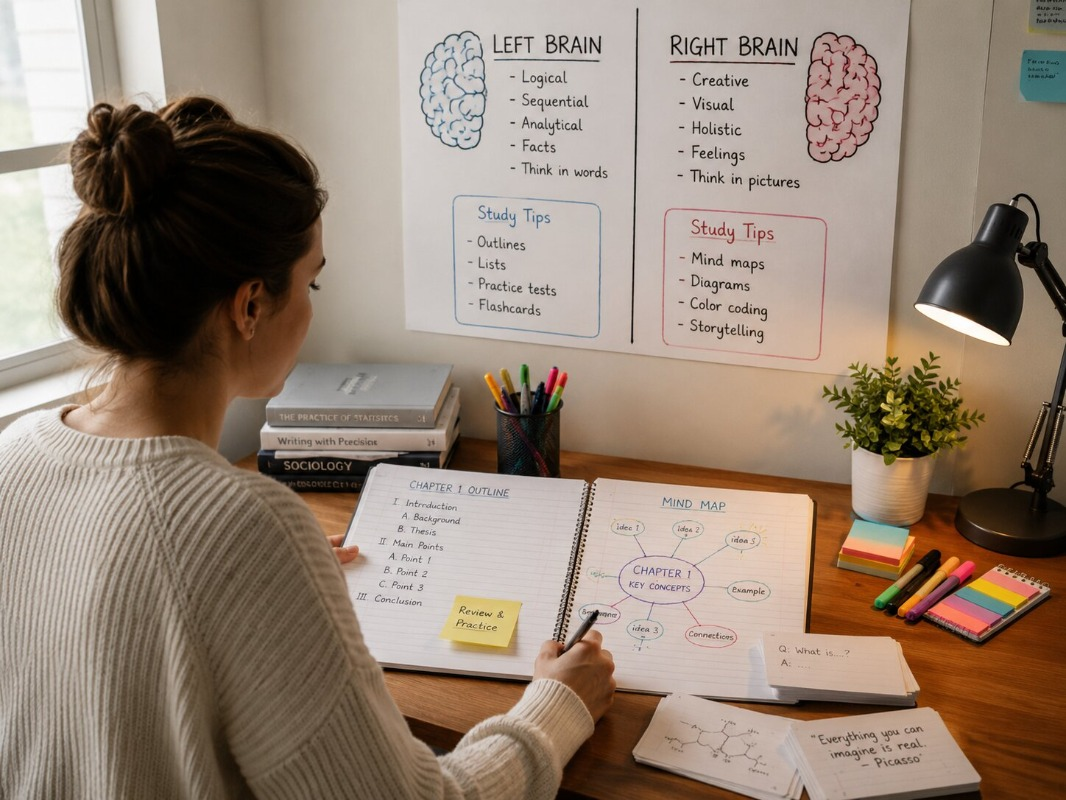
Instead of linear notes, draw a central concept in the middle of a page and branch out with related ideas, examples, and connections. A peer-reviewed systematic review published by the National Institutes of Health found that mind mapping consistently improves memory retention and recall by engaging visual memory and conceptual association simultaneously — a natural match for right-brain processing.
The Story Method
Turn information into a narrative. If you’re studying historical events, economic concepts, or scientific processes, build a story around them — who are the characters, what’s the conflict, what changes? Right-brain learners usually hold onto narratives far more reliably than isolated facts.
Color Coding and Visual Cues
Use different colors for different categories of information. Create simple diagrams or sketches alongside written notes. Visual encoding gives right-brain learners an additional memory pathway — the same information is stored in more than one format, which strengthens retrieval later.
Teach It Emotionally
Rather than explaining a concept step-by-step, explain why it matters — what’s interesting about it, what real problem it solves, what would happen without it. Emotional and contextual hooks are often how right-brain learners lock information into long-term memory.
A college student studying anatomy who draws every system by hand rather than using pre-made diagrams — and aces the practical exam — is using right-brain learning techniques without even realizing it. The drawing forces her to reconstruct the information visually, which is exactly how her memory works best.
Are There Study Methods That Work for Both Thinking Styles?
Yes — and they’re worth knowing regardless of where you fall. Some techniques are effective precisely because they engage multiple types of processing at once, which means they work whether you lean analytical or creative.
Here’s a quick comparison of how the approaches differ and where they overlap:
| Technique | Best for | Why it works |
| Spaced repetition | Left-brain learners | Systematic, measurable review intervals |
| Mind mapping | Right-brain learners | Visual, contextual, connection-based |
| Teach-back method | Both | Forces active processing regardless of style |
| Practice problems | Both | Tests understanding, not just recognition |
| Big picture first | Right-brain learners | Provides context before detail |
Notice that the two universal techniques — teach-back and practice problems — both require you to actively produce knowledge rather than passively absorb it. That’s the key variable. Cognitive psychology research, including landmark studies by Roediger and Karpicke at Washington University, consistently shows that actively retrieving information produces far greater long-term retention than re-reading or passive review. That principle holds regardless of thinking style.
A practical approach for mixed learners: use big-picture context first, then organize the details in whichever format feels most natural — outline or mind map. Both get you there. The format is less important than the active processing.
How Do You Know Which Type You Are?
The fastest way is a structured self-assessment rather than self-guessing. Most people have an instinct about whether they lean analytical or creative — but instincts are often shaped by how you were told you learn, not how you actually do.
A free left or right brain test measures your actual response patterns across a range of scenarios and gives you a score across both analytical and creative dimensions. It takes about four minutes. The result won’t be a revelation — but it will be a more honest baseline than trying to figure it out from a traits list.
From there, pick two or three techniques from the relevant section above and try them for one week. Most people notice a difference within the first week — not just in what they retain, but in how much less exhausting studying feels.
Studying smarter starts with understanding how you actually process information — not how you think you should. Left-brain learners tend to thrive with structure, sequence, and systematic review. Right-brain learners retain more when they start with context, use visual formats, and connect material to meaning. And most people find that the universal techniques — active retrieval and teaching back — work regardless of which way they lean.
The method matters more than the hours. If studying has always felt harder than it should, there’s a good chance you’ve been using someone else’s system. The right approach for how your brain works is usually a lot less painful — and a lot more effective.
References
1. Harvard Graduate School of Education. Repetition, Repetition, Repetition: The Spacing Effect. 2010.
2. National Institutes of Health / PMC. Implementation of a Spaced-Repetition Approach to Enhance Undergraduate Learning. 2025.
3. National Institutes of Health / PMC. Using the Mind Map Method in Medical Education: A Systematic Review. 2025.
4. National Institutes of Health / PMC. The Use of Retrieval Practice in the Health Professions: A State-of-the-Art Review. 2025.
5. Wharton Executive Education. The Right/Left Brain Myth and More Neuroscience Insight. 2023.
Frequently Asked Questions
How does your brain type affect the way you study?
Your cognitive style shapes how you prefer to receive, organize, and store new information. Left-brain learners tend to build understanding sequentially — facts first, then the big picture. Right-brain learners often need context and meaning first before the details stick. When your study method matches your natural processing style, you retain more with less effort. When it doesn’t, studying feels exhausting even when you’re putting in the hours.
What are the best study techniques for right-brained creative learners?
Right-brained learners retain information best when it arrives with context, narrative, and visual structure. The most effective techniques include starting with the big picture before diving into details, using mind maps instead of linear notes, turning material into stories, color-coding information by category, and explaining concepts by focusing on why they matter rather than how they work step-by-step. These methods engage both visual memory and emotional connection — the two pathways right-brain learners use most naturally.
Why does traditional studying feel so hard for right-brained students?
Most traditional study methods — sequential reading, repetition, linear note-taking — are designed around left-brain processing. Right-brain learners need meaning and context before detail, so when those are missing, information simply doesn’t stick. It’s not a lack of effort or ability. A right-brained student can sit through a lecture, take careful notes, and remember very little — then watch a documentary on the same topic and retain everything. The difference is that the documentary provided narrative and context first.
What study methods work best for left-brained analytical learners?
Left-brained learners do best with structured, systematic approaches. The most effective techniques include the outline method, spaced repetition with flashcards, working through practice problems rather than re-reading notes, the Cornell note-taking system, and the teach-back method using step-by-step logical explanations. Harvard Graduate School of Education research confirms that spaced repetition — reviewing material at increasing intervals — significantly improves long-term retention, making it a natural match for analytical thinkers who prefer measurable, systematic study systems.
How do I find out if I’m a left-brain or right-brain learner?
A structured self-assessment is more reliable than guessing from a list of traits. A free left or right brain test measures your actual response patterns across analytical and creative scenarios, giving you a score across both dimensions in about four minutes. Once you know where you lean, you can match your study approach to your natural processing style — and spend less time studying the hard way.