
Gothic fashion stays powerfully relevant without effort because its continuous survival relies on a coherent visual identity, economic adaptability, and deep historical grounding.
Unlike mainstream fashion movements that exhaust themselves chasing cultural relevance every eighteen months, this aesthetic has maintained an unbroken presence since the late-1970s post-punk era.
By operating independently of typical rebranding efforts, it effortlessly outlasts the very industries attempting to commodify its visual signatures.
The persistence of the Gothic style is not an accident of nostalgia or a byproduct of cyclical revivals.
Instead, it is structurally embedded in a precise visual grammar and a centuries-old design inheritance.
To understand this permanence, one must analyze the structural pillars supporting its longevity, including uncompromising visual identity and historical inspiration.
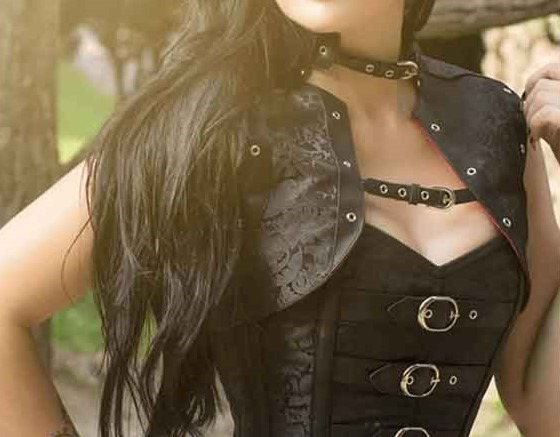
Image from Medieval Collectibles
1. Visual Language That Refuses to Be Appropriated
The longevity of gothic fashion begins with a visual grammar so internally coherent that it cannot be appropriated without immediate attribution.
It occupies an aesthetic register that no other subculture has successfully colonized, diluted, or erased.
At the core of this durability is an uncompromising aesthetic vocabulary based on monochrome anchors.
Abyssal black, deep burgundy, and midnight blue carry profound psychological and historical weight simultaneously.
Silhouettes lean heavily into structural choices that echo ancient design logic, featuring corseted waists, dramatically draped sleeves, and architectural collars.
Materiality plays an equally crucial role, with lace overlays, heavy leather, and industrial hardware embellishments carrying distinct subcultural resonance.
Achieving this authenticity requires garments built on true historical foundations rather than superficial modern trends.
Enthusiasts often look to curated sources such as Medieval Collectibles’ dark Gothic clothing collection to find pieces that honor these deep medieval roots.
This visual consistency operates as a dual signal for profound personal expression and a clear declaration of subcultural membership.
It communicates a deliberate rejection of mainstream aesthetic norms without requiring simple verbal explanation.
Within the community, this represents an expression of individuality through symbolic subtext that signals undeniable depth.
The meticulous layering of these elements ensures that a gothic ensemble is never misread as a casual stylistic detour.
A heavy velvet coat paired with ecclesiastical hardware instantly broadcasts a specific ideological stance regarding beauty, mortality, and history. Consequently, the aesthetic continuously defends itself against mainstream homogenization.
| Key Insight: Gothic fashion’s visual grammar acts as a defensive shield. While fast-fashion can mimic individual pieces, the comprehensive symbolic language belongs exclusively to the subculture, making it impossible to fully homogenize or dilute. |
2. How Gothic Fashion Adapts Across Multiple Markets
When examining gothic fashion’s cross-stratum fluency, the operative word is adaptability, never reinvention.
Gothic fashion bends its context without abandoning its core grammar, allowing it to maintain cultural relevance across shifting demographics.
In the realm of luxury fashion, haute couture designers have repeatedly drawn from gothic motifs with striking regularity.
Corseted silhouettes, themes of dark romanticism, and ecclesiastical references appear across major international fashion weeks.
These elements are absorbed by luxury houses as an essential aesthetic vocabulary rather than cited as temporary subcultural loans.
Simultaneously, the aesthetic translates flawlessly into contemporary streetwear markets and urban environments.
Graphic layering, oversized black silhouettes accented with heavy hardware, and dark normcore all carry undeniable gothic DNA.
Crucially, the foundational motifs scale up or down gracefully without ever losing their core legibility.
The same architectural collar or intricate lace overlay that anchors a runway finale translates into daily wear effortlessly.
This creates a remarkable socioeconomic reach, functioning credibly at both the vintage market level and the high-end runway tier.
This expansive range is a direct consequence of a visual grammar whose internal logic holds firm at any production scale.
Such cross-stratum fluency actively prevents the cultural stagnation that frequently traps other subcultures.
It aligns with a broader cultural pattern where aesthetics with genuine symbolic depth tend to survive economic translation.
Conversely, styles built entirely on novelty or irony inevitably collapse when production values shift.
Because the aesthetic refuses to be locked into a single generational cohort, it avoids becoming a relic.
This adaptability makes gothic fashion a preferred vocabulary for media professionals who communicate complex visual narratives.
3. Why Directors Rely on Gothic Editorial Grammar
Gothic aesthetics appear far beyond the actual demographic size of the core subcultural community.
Their presence in editorial fashion photography, album art, and digital content is structurally disproportionate.
This widespread editorial influence serves as a powerful testament to the aesthetic’s enduring communicative power.
Gothic visual language conveys complex moods with a precision that few other stylistic frameworks can effectively match.
Melancholy, transgressive power, timeless glamour, and spiritual weight are all instantly legible within a single styled frame.
This communicative efficiency is deployed across four primary media contexts to great effect. In high fashion editorials, darkness is frequently utilized as a reliable marker of uncompromising luxury.
Shadow and severity function as clear indicators of intellectual elegance rather than mere thematic absence.
Within music and album aesthetics, gothic visuals signal artistic seriousness and a deliberate distancing from commercial accessibility.
In film and television costuming, severe silhouettes consistently mark characters possessing moral complexity or dangerous intelligence.
The meticulously chosen wardrobe does the heavy lifting long before the actor even speaks a line.
Finally, in digital landscapes, micro-movements like dark academia and witchcore draw directly from the rich gothic archive.
The professional logic driving this pattern is entirely pragmatic for modern visual storytelling. Editors and stylists return to gothic aesthetics precisely because global audiences decode them instinctively.
There is no warm-up period required to understand the visual weight of a sweeping black cloak. The true source of this unforced recognition lies in centuries of design history that predate modern marketing.
4. Historical Foundations Making Gothic Fashion Feel Permanent
Gothic fashion’s deepest source of authority is not primarily subcultural, but fundamentally historical.
It draws heavily from design traditions that predate modern fashion by centuries. This distinct lineage provides a permanence that purely trend-driven aesthetics simply cannot manufacture.
The grounding relies on two primary anchors, which are medieval design influence and Victorian mourning culture.
Pointed arches translated into silhouette logic and ecclesiastical embroidery contribute heavily to the historical form language.
There is an embedded cultural reverence for shadow, ceremony, and spiritual weight intrinsic to medieval architecture.
The elaborate social codification of nineteenth-century mourning dress established rigorous markers of personal dignity.
Intricate lace, jet jewelry, and corseted silhouettes were profound philosophical statements rather than fleeting aesthetic choices.
Contemporary gothic fashion inherits that exact philosophical register, establishing credibility that trend-chasing movements cannot replicate.
By referencing a design logic that existed before modern fashion marketing, the style carries undeniable historical authority.
The garments that carry real atmospheric weight are those built from an understanding of this original structural intention.
Each piece reflects an era where the craftsman’s intention was embedded directly in the careful cut.
This historical authenticity is precisely what allows gothic fashion to be repeatedly revived without ever feeling derivative.
Each return to the historical archive reveals new relevance for contemporary stylistic expression.
The underlying source material, spanning centuries of human design, remains virtually inexhaustible for dedicated designers.
Taken together, these foundational elements explain why the aesthetic persists effortlessly across multiple decades.
| Pro Tip: To achieve true gothic depth, look for garments where the design logic is structural rather than decorative. Focus on pieces reflecting medieval craftsmanship and Victorian mourning silhouettes to ensure authenticity and historical authority. |
The Bottom Line
Ultimately, gothic fashion endures because it was structurally designed to never require fleeting cultural validation.
The style’s persistence is deeply rooted in an uncompromising visual identity that provides instant global recognition.
Its remarkable cross-stratum adaptability grants it a vast demographic range without risking aesthetic dilution.
Furthermore, its outsized influence on editorial styling lends it a cultural gravity far beyond its immediate community.
Its deep historical grounding provides the permanence that only a pre-modern design inheritance can reliably supply.
As fashion cycles continue to accelerate, aesthetics with genuine historical roots will increasingly hold their ground.
They survive not because they stubbornly resist change, but because they remain independent of ephemeral industry conditions.
Gothic fashion’s unforced cultural authority serves as a definitive model for enduring stylistic permanence.
| Author Profile: Medieval Collectibles is the leading online retailer of authentic medieval replicas and fantasy collectibles for history enthusiasts, reenactors, and collectors worldwide. |