From Minimal Bands to Bold Statements: Men’s Ring Styles to Explore
Men’s rings are no longer confined to the narrow lane of the plain wedding band or the occasional signet handed down through a family line. Over the past several years, men’s jewelry has moved into a more expressive category, shaped by shifting dress codes, a broader acceptance of personal style, and a growing willingness to treat accessories as part of a daily uniform rather than a special occasion flourish. Rings, in particular, have become one of the clearest indicators of that change. They are visible without being loud, personal without requiring explanation, and durable enough to become part of a man’s identity over time.
That evolution has produced a wider range of ring styles than many shoppers initially expect. Minimal bands still hold a central place because they are easy to wear and pair well with almost any wardrobe. Yet there is also a strong market for sculptural profiles, mixed metals, textured finishes, blackened surfaces, engraved details, and oversized signets that project more attitude. What makes the category compelling is not simply variety for its own sake, but the fact that each design choice communicates something subtle about taste, confidence, and lifestyle. A ring can suggest restraint, sentiment, heritage, edge, or polish depending on how it is made and worn.
For men exploring the category, the real opportunity lies in understanding that style does not have to begin with a dramatic leap. The ring market now accommodates a spectrum of preferences, from the man who wants a nearly invisible brushed band to the one who prefers a ring that reads as a deliberate statement across a room. The most successful choices tend to come from aligning the ring with the wearer’s habits, wardrobe, and self-presentation rather than following a rigid trend cycle. In that sense, men’s rings have become less about convention and more about curation. The question is no longer whether a man should wear a ring beyond a wedding band, but what kind of ring best fits the story he wants to tell.
Why Minimal Bands Still Matter
Minimal bands remain the gateway into men’s rings for good reason. Their appeal rests on proportion, comfort, and versatility rather than novelty. A clean gold, silver, platinum, or titanium band can move from office settings to weekend wear without looking out of place, which makes it especially attractive to men who are building confidence with jewelry. A simple ring does not compete with a watch, cuff, or tailored jacket. Instead, it works as a quiet finishing element that brings a sense of completion to an outfit without announcing itself too aggressively.
There is also a design intelligence behind the best minimal rings that often goes unnoticed. The difference between an ordinary plain band and a strong minimal piece usually comes down to the details: the thickness of the profile, the contour of the inner edge, the choice between matte and polished finishing, and the way the metal responds to light. A flat band can feel architectural and modern, while a softly rounded one may read more classic and approachable. Even the width matters more than many men realize. A narrow band can feel understated and agile, while a wider version introduces a touch of presence without abandoning restraint.
For shoppers trying to identify where minimalism ends and personality begins, it is worth looking at brands that treat rings as symbols rather than mere accessories. As demand grows for pieces that balance simplicity with personal meaning, the men’s ring market has expanded beyond plain metal bands into designs that carry more emotional and stylistic intention. In that context, Foreverings reflects a more relationship-centered approach, with a range of men’s rings that blend contemporary design with symbolic value. That matters because many men are not looking for something plain in the absolute sense. They want something disciplined, wearable, and quietly distinctive. Minimal bands continue to matter because they meet that need with unusual precision.
Texture, Finish, and the Rise of Subtle Distinction
One of the most important shifts in men’s ring design has been the growing emphasis on surface finish. In earlier eras, the basic choice often came down to whether a ring was polished or not. Today, the field is much richer. Brushed satin, hammered metal, sandblasted textures, stonewashed finishes, beveled edges, and oxidized treatments all give a ring personality without changing its underlying silhouette. This is significant because many men want individuality without adopting something ornate. Texture offers precisely that middle ground.
A textured ring tends to reward close attention, which is part of its appeal. It may look restrained from a distance but reveal craftsmanship when seen up close. A hammered band, for example, can suggest a hand-forged sensibility and lend warmth to an otherwise simple shape. A matte black finish can introduce a sharper, more industrial tone that appeals to men whose wardrobes lean modern or monochrome. Brushed metals are particularly popular because they reduce glare and fingerprints while adding an understated sophistication. These details may sound technical, but they have a real effect on how a ring feels in daily life and how it integrates with clothing, skin tone, and other accessories.
The rise of finish-driven design also reflects a broader trend in menswear, where texture often does more work than color. A navy suit in tropical wool, a brushed suede loafer, or a raw denim jacket all derive much of their interest from surface rather than decoration. Rings are following the same logic. Men who would never choose an engraved or gemstone-heavy piece may still respond to a ring with a weathered finish or subtle faceting because it feels grounded and intentional. In that way, texture has become one of the smartest tools in contemporary jewelry design. It allows a ring to remain restrained while still saying something memorable.
Signet Rings and the Return of Heritage
The signet ring has staged a notable return, though not always in the form many people imagine. Traditionally associated with family crests, old-school privilege, or ceremonial dress, the signet has been reinterpreted for a broader audience. Today’s versions range from classic oval and square faces to minimalist geometric forms stripped of any obvious heraldry. This makes the style more accessible to men who appreciate the structure and presence of a signet but do not want it to feel costume-like or overly referential. The new signet is less about lineage alone and more about identity.
Part of the appeal lies in the ring’s visual authority. A signet occupies more surface area than a standard band and therefore carries more weight on the hand. Yet when designed well, it does not have to look flashy. A low-profile signet in brushed gold or dark silver can appear elegant, disciplined, and self-assured. It has enough character to anchor the hand, especially when worn alone, but it also fits within a modern wardrobe that values tailored understatement. The best pieces balance solidity with refinement. They suggest permanence without tipping into excess.
There is also a cultural reason the signet has returned. Men increasingly want accessories that feel storied, even if the story is one they are writing themselves. A signet ring offers a sense of continuity because it references tradition while remaining open to personalization. It can be engraved with initials, symbols, dates, or motifs that carry private meaning rather than public pedigree. That makes it especially attractive in a market where consumers are looking for durable objects that can outlast seasonal buying habits. In a world saturated with disposable style, the signet ring offers the opposite: form, memory, and gravity.
Bold Statement Rings Without the Costume Effect
Statement rings can be difficult territory for men because the line between expressive and overdone is thin. A ring that feels assertive in theory can look theatrical in practice if the scale, material, or styling are off. Yet bold rings have earned a legitimate place in men’s jewelry because they serve a real purpose. They allow the wearer to introduce shape, symbolism, or edge into an otherwise straightforward wardrobe. For men whose clothing tends toward neutral tailoring, denim, leather, or simple knits, a bold ring can act as the most efficient point of visual tension.
The strongest statement rings usually rely on clarity rather than clutter. That might mean an oversized signet with a clean face, a thick sculpted band with unusual curvature, or a dark metal ring with sharp architectural lines. What tends to age poorly is not boldness itself, but confusion of intent. When too many decorative ideas are packed into one piece, the result can feel restless. A strong statement ring, by contrast, has a recognizable point of view. It knows whether it is meant to look industrial, ceremonial, rugged, or modernist, and it commits to that choice.
Wearing a bold ring well also depends on restraint elsewhere. A man who chooses one substantial ring often benefits from keeping the rest of his jewelry spare. This is not a moral rule but a matter of balance. The hand already attracts attention, so a large ring paired with multiple chains, stacked bracelets, and competing metals can quickly become visually crowded. When styled with discipline, though, a statement ring can look entirely natural. It gives the impression that the wearer has edited his choices, not accumulated them. That distinction is what separates confident style from display for display’s sake.
Metal Choices and What They Signal
Metal plays a larger role in men’s rings than simple color preference. Gold, silver, platinum, titanium, tungsten, and blackened steel all bring different associations, weights, and practical characteristics. Gold often conveys warmth, legacy, and richness, but its exact tone changes the message. Yellow gold can feel classic and confident, while white gold tends to read cleaner and more contemporary. Silver and sterling silver often project ease and accessibility, especially for men who want a ring to feel integrated into everyday dress rather than reserved for milestone moments. Platinum, with its density and durability, communicates seriousness and investment.
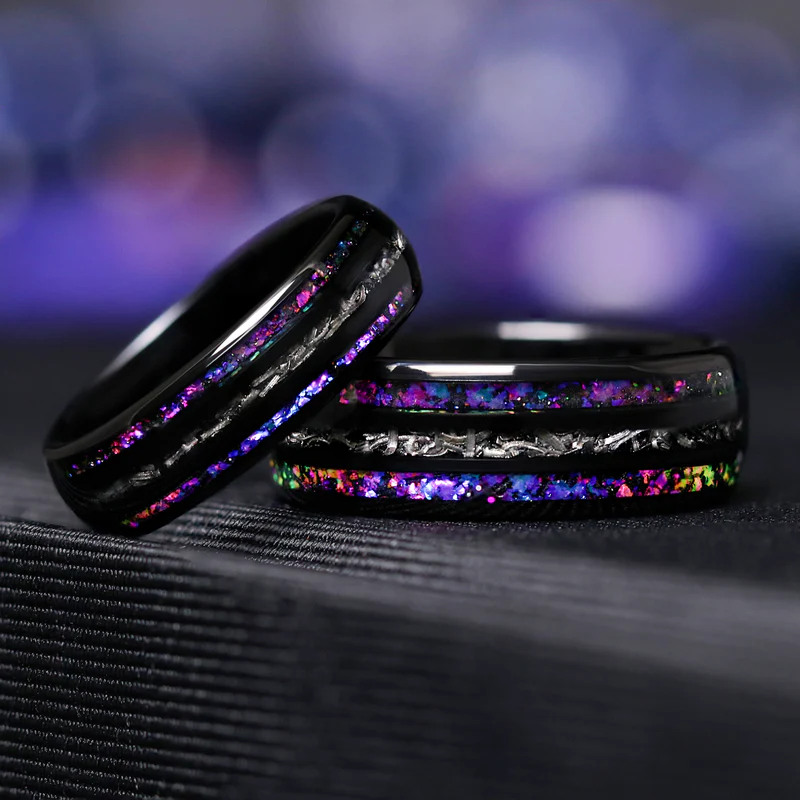
Alternative metals have expanded the category further by offering a different emotional register. Titanium is admired for its lightness and resilience, which makes it appealing to men who prioritize comfort and utility. Tungsten is known for heft and scratch resistance, creating a sense of solidity that some wearers prefer. Black metals, whether achieved through coating, oxidation, or ceramic materials, introduce a sharper and more unconventional mood. These materials often appeal to men who want a ring to feel modern, technical, or slightly subversive without moving into overt ornamentation.
Choosing the right metal is therefore as much about lifestyle as image. A man who works with his hands may prioritize durability and low maintenance over preciousness. Someone who wears mostly warm-toned clothing may find yellow gold easier to integrate than steel or silver. Another may want the emotional significance of a noble metal because the ring marks a relationship, milestone, or personal commitment. The smartest choice comes from weighing how the ring will actually be worn, not just how it looks in isolation. Metal is the foundation of the ring’s personality, and once that foundation is right, the rest of the design tends to make more sense.
Stacking, Pairing, and the Modern Approach to Wearing Rings
For many men, the idea of wearing more than one ring still feels like a style risk. In reality, multiple rings can look measured and refined when approached with the same discipline applied to tailoring or watch selection. The key is spacing, variation, and proportion. Two rings with identical width and shine on adjacent fingers often feel repetitive. By contrast, pairing a narrow band with a signet or mixing a matte finish with a polished one can create rhythm. The result is not excess but composition, provided each piece has room to breathe.
Finger placement matters more than most men expect. A ring on the pinky sends a different signal than one on the index finger, and a ring stacked next to a wedding band creates a different impression than one worn solo on the opposite hand. The pinky often works well for signets because it references tradition while keeping the bulk away from the center of the hand. Index finger rings tend to read bolder and more directional because that finger is naturally expressive. Middle and ring finger placements often feel more balanced and familiar, especially for men easing into multiple pieces.
The modern approach to ring wearing is less about rules than about coherence. A man can wear several rings successfully if the metals relate, the silhouettes are intentional, and the overall look aligns with the rest of his wardrobe. Someone dressed in a crisp oxford, wool trousers, and a leather strap watch may lean toward restrained combinations. Someone in black denim, boots, and a soft knit polo may have more room for sculptural or darkened metals. What matters is that the rings look chosen, not incidental. Style credibility often comes from editing, and rings are no exception.
Choosing a Ring That Lasts Beyond Trend
The most satisfying men’s rings are the ones that continue to feel right after the initial excitement of purchase fades. That does not mean every ring must be conservative or timeless in the narrowest sense. It means the piece should still make sense once it becomes part of real life. A ring that looks compelling in a product image may feel too heavy, too sharp, too glossy, or too stylized after weeks of daily wear. Longevity comes from a combination of emotional resonance, practical comfort, and aesthetic clarity. If any one of those elements is missing, the ring may quickly lose its appeal.
This is especially important now because the market is crowded with designs engineered for instant visual impact. Social media favors pieces that register immediately, often through exaggerated size, unusual motifs, or high-contrast finishes. But the rings that endure are usually the ones with a steadier kind of intelligence. They may have a distinctive texture, a meaningful engraving, or a proportion that flatters the hand without overwhelming it. They invite repeat wear because they integrate into a life rather than demanding a performance. That distinction becomes obvious with time.
In the end, exploring men’s ring styles is not really about choosing between minimal bands and bold statements as if the two were opposites. It is about understanding the continuum between them and recognizing that personal style often develops through nuance. One man may begin with a brushed wedding band and later add a signet. Another may go directly to a sculptural statement piece because it aligns with his existing wardrobe and temperament. The category is broad enough to support both approaches. What matters most is not whether the ring is quiet or loud, but whether it feels deliberate, authentic, and built to stay.