
Fashion Weeks & Events
Fashion Artisans and Innovators from Brazil and the Amazon
11 Sept 2026

The Amazon Is Not a Backdrop. It Is a Design School the World Is Only Now Discovering.
How technology redistributes opportunity, how AI, blockchain and digital platforms can take something local and give it a global stage without stripping it of what made it valuable in the first place, is one of the defining tests facing the fashion industry today. This September, that test is playing out in New York, where Indigenous designers from the Brazilian Amazon are being connected to an international fashion audience through the Best of Fashion Awards (BOFA), with their work presented during the New York Fashion Week period.
This piece sets out why the Amazon's artisan economy matters far beyond fashion, introduces the event and the people building it, and most importantly profiles the 29 designers whose work is the actual reason any of this deserves attention.
A Renaissance Hiding in Plain Sight
Numbers rarely capture culture, but they are useful for establishing scale.
Brazil's 2022 census recorded 1,693,535 Indigenous people living in the country, 0.83% of the total population, up 88.8% from the 896,917 counted in 2010. Just over half of that population, roughly 867,900 people, lives in the Legal Amazon, and the census identified 391 distinct Indigenous ethnicities and 295 Indigenous languages still spoken across the country, up from 305 ethnicities in 2010. Officials at Brazil's statistics agency have attributed part of that increase to more people feeling safe enough to publicly identify as Indigenous, which suggests something important before turning to fashion: visibility itself functions as a form of protection, and a form of power.
Set that population against Brazil's textile and apparel economy, which Technavio values in the tens of billions of dollars, with continued growth forecast for the wider textile manufacturing market over the coming years. Now set both of those against the category the Amazon's artisan designers are quietly pioneering: sustainable fashion. Estimates vary by methodology, market research firms have put the global sustainable fashion market anywhere from roughly USD 3.6 billion to USD 12 billion or more in the mid-2020s, with growth forecasts ranging from roughly 10% to over 20% annually through the early 2030s but nearly every estimate agrees sustainable fashion is expanding several times faster than the apparel industry as a whole. A majority of Gen Z consumers now say sustainability shapes their purchasing decisions, even as the fast fashion market it sits alongside continues to expand, and the apparel industry as a whole is estimated to generate 2 to 8% of global greenhouse gas emissions and a fifth of the world's industrial wastewater.
Put plainly: the world's fastest-growing fashion category is the one the Amazon's Indigenous artisans have practised for generations, natural dyes, seed and fibre work, upcycled and reused materials, garments built from what the forest already provides rather than what a factory can synthesise. What looks, from the outside, like heritage craft is, from the inside, the leading edge of where the entire industry is trying to go. The rest of the fashion world is racing to relearn what these communities never forgot.
This is a deeper argument that runs across multiple platforms in this space, from Fashionabc to Citiesabc.com to Businessabc.net: technology's real value lies not in inventing something new, but in making visible what was always valuable and never had the infrastructure to reach a global audience. AI-DNA, the technology built at Fashionabc, exists for exactly that purpose here. It handles the digital production, casting and creative direction of a runway presentation. It does not design the garments, choose the fibres, or decide what a pattern means to the person who made it. Authorship stays exactly where it belongs.
The Event: Amazon Designers on the Fashion Week Stage

On 11 September 2026, at 6:00 PM in New York, during New York Fashion Week, designers from the Brazilian cooperative MI.Moda Indígena will present their work through the Best of Fashion Awards (BOFA), an international showcase built to recognise emerging designers, fashion students, models and creative talent through a professionally structured global platform.
The presentation is powered by Fashionabc's AI.DNA technology, developed in partnership with BOFA, FashionForward and MI.Moda Indígena. Brazilian model, entrepreneur and women's rights activist Luiza Brunet joins the New York programme as a special guest ahead of the separate Best of Brazil Global Awards ceremony the following day, 12 September, on Liberty Island.
BOFA 2026 runs across five competition categories, Best Sustainable Brand, Best Evening Wear, Best Casual Wear, Best Creative Design and People's Choice, with a defined pathway: designers apply to a category, go through an approval process, showcase their collection if selected, and await results, with full runway production, professional photography and video, worldwide live broadcast, and formal recognition through certificates, trophies and medals for every participant and winner.
The wider production team, led by co-founders Rafael dos Santos and Gislaine Balzano, has built more than 500 events across fashion, culture and awards over seven years. Gislaine alone has brought more than 60 brands to international runways, coordinated over 200 models and directed more than 700 looks during international fashion weeks, with the operation mobilising more than 500 professionals internationally.
The Organisers: Ancestry Meeting Generative Technology

Gislaine Balzano, co-founder and fashion curator of the Best of Fashion Awards and editor of both the Best of Fashion Awards and Lady Day Insights magazines, has spent her career bringing curation, education, research and innovation together to strengthen brands and designers internationally. Of this project specifically, she says:
Ancestral techniques and generative technology can go together. Seeing MI.Moda Indígena's fabrics come to life through fashionabc's artificial intelligence was one of the most innovative projects I've ever worked on.

Rafael dos Santos frames the stakes even more directly, describing what makes this edition of Fashion Week different from every other:
Fashion Week is a spectacle, but it rarely shows ancestry in dialogue with artificial intelligence. This year, we built a stage where fashion designers from Amazon and judges who work for some of the world's most renowned brands could meet through technology.
Fashion Week, at its best, is supposed to be where the future of the industry gets previewed. Too often, "the future" only means new silhouettes or new software. Rafael and Gislaine are proposing something more interesting: that the future of fashion also runs backward, toward ancestral knowledge, and that technology's job is to build the stage where that knowledge can meet the present on equal terms.
For Indigenous fashion specifically, that equal footing is not guaranteed. International visibility raises real questions about authorship, cultural ownership, and who ultimately benefits when traditional design languages enter global markets. Those questions do not disappear because AI is involved; if anything, in a world where generative systems can produce almost any aesthetic on demand, identifying the original designer, community and cultural source behind a creation becomes more valuable, not less.
The collaboration brings together distinct roles: BOFA provides the international fashion platform and connection, MI.Moda Indígena represents and develops Indigenous fashion talent, while Fashionabc's technology supports the digital presentation of the designers' work.
The Designers: 29 Artisans Redefining What Amazonian Fashion Means
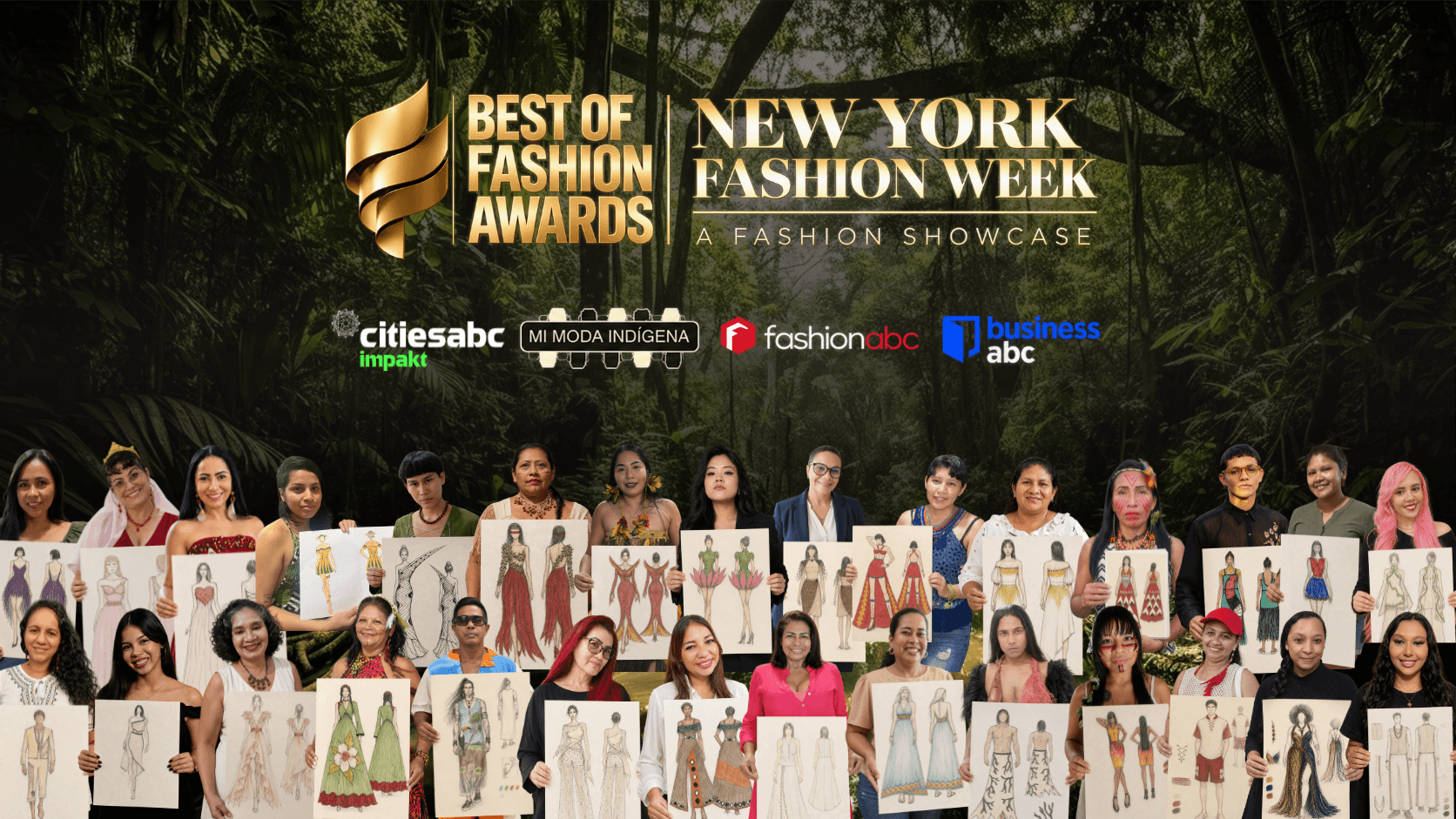
Their participation on the New York stage was made possible through the Best of Fashion Awards.
MI.Moda Indígena: Leadership
Rebeca Ferreira ("Reby") — From the Munduruku people, Rebeca is CEO and co-founder of MI Moda Indígena. An entrepreneur, fashion designer, researcher and multi-artist, she promotes cultural valorisation, innovation and sustainability, strengthening Indigenous leadership through fashion, education and the creative economy.
- Instagram: @rebyoficial
Seanne Oliveira — From the Munduruku people, Seanne is Co-CEO of MI Moda Indígena, a visual arts teacher, fashion designer, artist and researcher with a degree in Visual Arts from UFAM. She works in education, inclusion, Indigenous cultural valorisation and sustainable fashion, promoting creativity, identity and Indigenous leadership.
- Instagram: @seannyartes
Casual Wear Designs
Auzamira Santos — Brazilian, resident of Manaus, Amazonas, for 26 years, with a degree in History and a practice in artisanship. Since 2024 she has participated in fashion events in Manaus, focusing on preservation and sustainability through the collection and reuse of diverse materials.
- Instagram: @arttmulher
Beatriz Barroso — A young Amazonian designer in training, inspired by Indigenous culture and her Amazonian roots. Her creations combine ancestry, nature and traditional patterns with contemporary elements, promoting original, sustainable fashion connected to Amazonian identity.
- Instagram: @lbeatrizls_
Claudilene Siqueira — An audiovisual professional with experience in short films, feature films and series, including participation in the Amazon Film Festival and the Amazon Theatre Festival, coordination of film workshops, and contributions to the Black Cinema Showcase.
- Instagram: @claudilene.siqueira
Edatanadu Noeli — Edatanadu Noeli Garcia Martinez is Indigenous to the Yekuana people, of the Carib language family, originating from Bolívar State, Venezuela. The Yekuana inhabit the basins of the Caura, Erebato and Nichare rivers along the Brazil–Venezuela border.
- Instagram: @edatanadu_yekwana
Fabiane Farias — Fabiane Maria Santos Farias, from Manaus, is an artist and creative professional passionate about Amazonian culture. A mother of four, she draws inspiration from art and the hummingbird — beauty, freedom, delicacy and strength — with a journey marked by creativity, courage and the appreciation of the identity and culture of women from Manaus.
Janete Lana — An Indigenous woman of the Dessana people from the Upper Rio Negro region, Janete is an artisan and multidisciplinary Indigenous artist who lives in the Indigenous Community of Aldeia Akural, on the banks of the Tarumã-Mirim River near Manaus.
- Instagram: @cunha.dessana
Jocineide Baleiro — An artist and artisan based in Manaus, Amazonas. In 2025 she took part in the Indigenous Fashion Training Course through the PNAB Concultura programme.
Lucas Cinco Anjos — Reginaldo Bentes, known artistically as Lucas Cinco Anjos, is an Indigenous member of the Mura people from Manaus. He created the Cristal de Neve children's fashion show, where he works as a model and runway instructor, fostering children's artistic expression, confidence and development through fashion and culture.
- Instagram: @lucas_cinco_anjos__ (professional: @cristal_de_neve_desfile_)
Maria da Conceição Ferreira — Maria da Conceição Ferreira da Silva, known as Conceição Ferreira, is an interior designer from Carauari, Amazonas, who built her career in Manaus through determination and perseverance, valuing beauty, identity, planning and personal achievement.
- Instagram: @maria719conceicao
Marília Fonseca — Marília da Conceição Oliveira da Fonseca, an Indigenous Munduruku woman from Manaus, is passionate about fashion and sewing. Through MI Indigenous Fashion, she is expanding her knowledge of clothing and accessory design while promoting Indigenous identity, culture and expression.
- Instagram: @mariliafisioneuro
Norma Frazão — An artisan from Manaus passionate about Amazonian art and culture, Norma transforms fibres, seeds and natural materials into original pieces that combine creativity, identity and tradition, valuing handcrafted technique and the richness of the Amazon.
- Instagram: @arts.nossa
Oilson Vidinha — A visual artist from Pará who is visually impaired, Oilson found new forms of expression through art and fashion. Trained through the Arte com Toque project and MI Indigenous Fashion, he works as a visual artist, fashion designer and model, demonstrating that creativity and inclusion can overcome barriers.
- Instagram: @oilsonvidinha
Sandra Cunha — Chief of the Munduruku people and a member and fashion designer of MI Moda Indígena, Sandra trained in Fashion Design in Santarém, Pará. She combines academic knowledge, ancestral identity and creativity to strengthen Munduruku culture and promote Indigenous knowledge and leadership in fashion.
- Instagram: @sandra_munduruku
Creative Designs
Alan Tenazor — A Brazilian Indigenous fashion designer of the Ticuna people, born in the Belém of Solimões Community, Amazonas. He created the ALT|MATM brand, developing designs that combine ancestral heritage and sustainability, and conceived the first Indigenous fashion project in his community.
- Instagram: @alan_tenazor_oficial
Darlyn García — An Indigenous Baré and Baniwa woman, Venezuelan lawyer, activist and designer specialising in Indigenous fashion. She combines ancestry, sustainability and contemporary design, and founded Pumeyawa Beautiful to promote sustainable fashion, fair trade, cultural preservation and Indigenous empowerment through design.
- Instagram: @darlyn4078
Dioge dos Santos — A cultural agent, fashion designer, visual artist and Anthropology student from Ceará's hinterland, Dioge develops sociocultural initiatives through fashion and visual arts that foster dialogue and raise awareness against LGBTQIAPN+ discrimination, racism, sexism and other social challenges.
- Instagram: @diogeeee
Eunice Sodré — Eunice Rodrigues Sodré, of the Tariano people, is a seed keeper, artisan, educator and Indigenous fashion designer who works with natural fibres, seeds and sacred motifs, promoting Indigenous women, the Tariano language and ancestral heritage.
- Instagram: @3450.eunice
Eveleine Santos — Eveleine Santos Rodrigues, a fashion designer from Urucará, Amazonas, holds a Bachelor's degree in Fashion Design and specialises in Indigenous Fashion through MI. Her work combines ancestral aesthetics, sustainability and territorial identity with contemporary design trends.
- Instagram: @eveleinesantos
Jéssica Neo — Jéssica Makatt Neo, a fashion designer from Manaus with a degree in Fashion Design from CIESA College, deepened her knowledge of Indigenous culture and identity through the MI Moda Indígena course.
- Instagram: @jessicamakattneo_91
Active Wear Designs
Eva Maya Santos — Eva Maya Mura, a Mura Indigenous fashion designer and researcher, is dedicated to identity, nature and Amazonian biodiversity, specialising in natural dyeing, Amazonian botany and botanical printing applied to textiles and leather.
- Instagram: @evamayamura
Laura Andrade — An artist, fashion designer and Indigenous woman of the Baré people, born in Manaus, Laura brings together art, culture and Amazonian ancestry through natural materials, Indigenous motifs and artisanal technique.
- Instagram: @euviumasereia
Simone Alves — A native of Manaus, Simone is an entrepreneur, fashion designer, Indigenous artist and craftswoman whose work is driven by fashion as a form of identity, culture and communication.
- Instagram: @simonealves_designer
Simone Chain — Born in Manaus, Simone is a nurse, artisan, seamstress and fashion designer with MI Indigenous Fashion since 2025, holding degrees in Nursing and French Language and Literature alongside qualifications in aesthetics, sewing and Indigenous fashion.
- Instagram: @galega.mone
Sustainability Designs
Ellen Negreiros — An Amazonian fashion designer from Manaus who, since 2024, has developed an original creative language connected to the Amazon, transforming fabrics, seeds, fibres and textures into work that expresses identity, strength and the poetic essence of the rainforest.
- Instagram: @ellen_amazonia
Heliotecia Araújo — Born in Timon, Maranhão, and a CIESA graduate, Heliotecia creates regional Amazonian accessories and organises exhibitions at tourist attractions across Manaus, promoting Amazonian culture, identity and heritage through fashion and design.
- Instagram: @misticaatelie.ta’
Jéssica Santos — Jéssica Oliveira Santos is a fashion designer and librarian from Maranhão who creates handicrafts and garments from recycled materials, inspired by nature and the world of forests and fairies, combining creativity, identity and sustainability.
- Instagram: @pink.lalalady
Márcia Freitas — Áurea Freitas is an Amazonian entrepreneur and missionary who entered the fashion industry to specialise in Indigenous fashion, working with seeds, wood, fibres and fish leather. She created Ao Porã to help riverside families sustainably use natural resources from their own environment, generating income and strengthening their livelihoods.
- Instagram: @aoporadesign
Why This Is the Story, Not the Sideshow
Much of the coverage of "AI meets fashion" this year treats the technology as the headline and the humans as the illustration. The biographies above suggest the order should be reversed: a Munduruku chief who trained formally in fashion design, a visually impaired artist from Pará who found his medium through inclusion projects, a nurse in Manaus who is also a seamstress and Indigenous fashion designer, set against this, the AI is the least interesting part of the story. It is infrastructure. The designers are the substance.
That is the relationship between technology and culture this project is built around: AI should widen the door, not stand in the doorway. On 11 September, 29 artisans and two cooperative leaders from the Brazilian Amazon walk through that door onto one of the world's biggest stages. What happens with that access next, how it is credited, compensated and continued, will say more about the future of fashion than any algorithm could.
Share

Dinis Guarda
Dinis Guarda is an author, entrepreneur, founder CEO of ztudium, Businessabc, citiesabc.com and Wisdomia.ai. Dinis is an AI leader, researcher and creator who has been building proprietary solutions based on technologies like digital twins, 3D, spatial computing, AR/VR/MR. Dinis is also an author of multiple books, including "4IR AI Blockchain Fintech IoT Reinventing a Nation" and others. Dinis has been collaborating with the likes of UN / UNITAR, UNESCO, European Space Agency, IBM, Siemens, Mastercard, and governments like USAID, and Malaysia Government to mention a few. He has been a guest lecturer at business schools such as Copenhagen Business School. Dinis is ranked as one of the most influential people and thought leaders in Thinkers360 / Rise Global’s The Artificial Intelligence Power 100, Top 10 Thought leaders in AI, smart cities, metaverse, blockchain, fintech.


