Choosing an engagement ring often begins with a neat but misleading comparison: classic or alternative.
The distinction looks useful at first. A classic ring seems safe, familiar and easy to wear. An alternative stone brings colour, texture and a more personal detail. But the harder question is not which category sounds more romantic. It is whether the ring feels believable on the hand of the person who will wear it.
An engagement ring does not live in a product photo. It sits beside the watch she wears every morning, the rings she already reaches for, the coat she pulls on without thinking and the colours she keeps repeating in her wardrobe. If the ring feels disconnected from those habits, even a beautiful design can slowly become something she admires more than she wears.
The starting point, then, is not whether she is a classic or alternative person. It is what already looks natural on her.
Her Everyday Jewellery Already Gives the First Clue
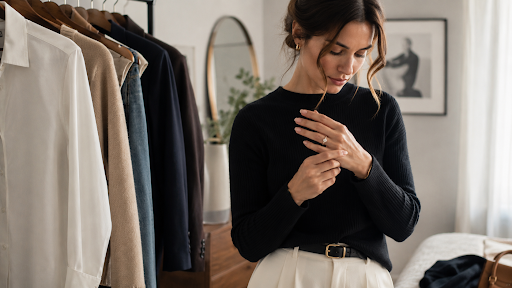
Most people have a visual rhythm they repeat without naming it.
Some women are drawn to slim jewellery, clean lines and quiet shapes. Others like texture, layered pieces or something with a stronger outline. These preferences usually show up long before anyone starts looking at engagement rings.
That is why the jewellery she already owns is often more useful than a saved inspiration board. The small hoops she never takes off, the watch she wears with everything, the ring she still reaches for on a busy morning — those pieces have already passed the test of daily life. They reveal what feels comfortable, what looks natural and what does not need constant adjusting.
A proposal ring should not interrupt that rhythm. It should add to it.
Classic Shapes Help Separate Proportion From Trend
Classic designs are useful because they make proportion easier to read.
A solitaire, an oval centre stone, a slim band or a lower setting gives the eye a cleaner baseline. Instead of reacting to colour, novelty or styling, it becomes easier to notice whether the ring feels balanced on her hand and whether the metal tone sits close to what she already wears.
Looking through different engagement rings can be useful at this stage, not to copy a single design, but to understand which shapes already feel familiar. Brands such as Romalar Jewelry fit naturally into this comparison because they sit between familiar engagement-ring silhouettes and more personal gemstone choices, including moss agate, moissanite, birthstones and other non-traditional styles.
Once proportion feels right, personality becomes much easier to add without making the whole ring feel overworked.
Alternative Stones Change the Mood, Not Just the Colour
Alternative gemstones are often described as a way to stand out. In practice, many people choose them because they feel more specific.
Moss agate is a good example. It does not have one uniform look. Some stones carry deep green inclusions, while others appear misty, soft or almost landscape-like. That natural variation can make the ring feel chosen rather than manufactured.
But colour changes how a ring behaves. On someone who wears black, white and grey, green veining may become a quiet point of interest. On someone drawn to cream, brown, olive or linen, it may feel almost like part of her existing palette. If her style is sharper or more minimal, the same stone may need a cleaner setting so it does not become too themed.
The stone is not only a decorative choice. It changes the emotional tone of the ring.
Durability Is Part of Style
A ring can look right in a close-up image and still be wrong for the way someone moves through the day.
The real test happens while she is typing, driving, travelling, cooking, pulling on a jumper or reaching into a bag. A high setting may catch on clothing. A delicate stone may need more care than she wants to think about. A ring that looks poetic under studio lighting may become stressful if it feels too fragile for ordinary wear.
That is why understanding how durable moss agate is belongs inside the design decision, not after it. Hardness, care, setting structure and wearing habits all shape whether a ring continues to feel enjoyable after the proposal.
A beautiful ring that has to be avoided too often is not really part of her life.
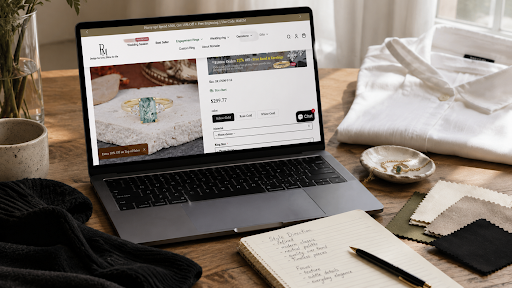
The Strongest Ring Has One Clear Idea
The most considered rings are rarely the ones with the most features.
If the stone has colour and pattern, the band may need to stay quiet. If the setting is more sculptural, the stone and metal may need to feel calmer. If the shape is already unusual, the rest of the design does not have to compete.
This is where the line between classic and alternative becomes less useful. A classic silhouette can make a moss agate centre stone easier to wear. A non-traditional gemstone can make a familiar shape feel more personal. The balance matters more than the label.
A good ring usually has one detail leading the design, while everything else supports it.
The Right Ring Feels Like It Already Belongs
People often assume the most memorable engagement ring is the one that looks the most different. In real life, the stronger choice is often the one that feels immediately believable.
It may have an unusual stone, a softer colour or a detail no one else notices at first. But it should still look as though it belongs to her hand, her clothes and her way of moving through the world.
That is why classic versus alternative is not the real decision. The real decision is whether the ring feels connected to the person who will wear it every day.
When proportion, material, colour and daily wear all move in the same direction, the ring stops feeling like a category. It starts feeling like hers.