
resources
What It Would Take to Bring Small-Batch Clothing Production Back to the US
24 Nov 2026

By Artur Holosnyi
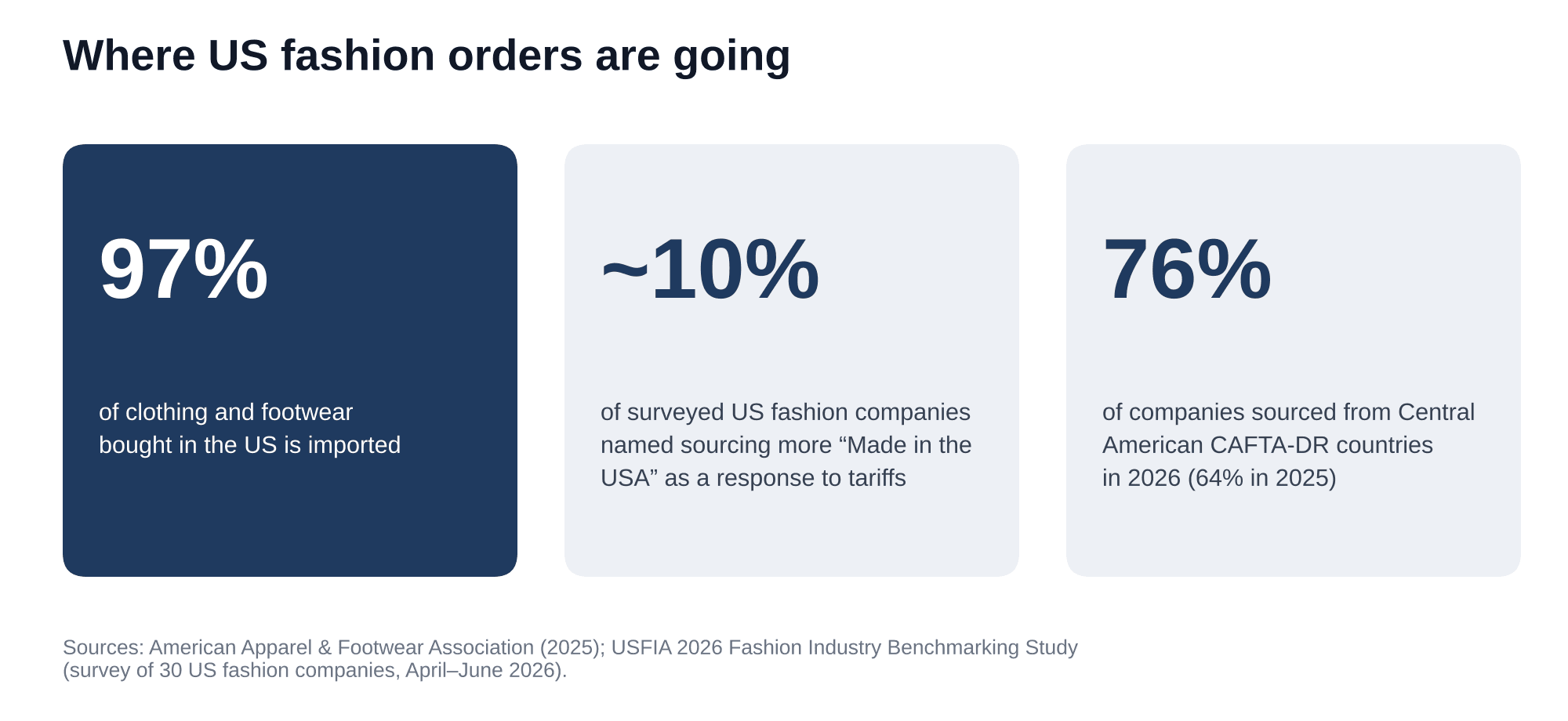
Tariffs have pushed American fashion companies to rethink where their clothes are made, yet very few of them are moving production home. In the 2026 benchmarking study by the US Fashion Industry Association, only about 10% of surveyed companies identified sourcing more “Made in the USA” products as a strategy for responding to higher tariffs [1]. Most chose another country instead. Some 76% of respondents sourced from members of the CAFTA-DR trade agreement in Central America this year, up from 64% in 2025 [1].
I have spent more than ten years building women’s clothing brands and organising garment production in Kharkiv, Ukraine. I now live in the United States and study how local clothing manufacturing works here. Seen from a factory floor, the hesitation of American brands has a practical explanation. A brand cannot move an order to a domestic workshop that has too few trained sewers and no planning system built for small runs. Both gaps can be closed, and the first step is to see how wide they have become.
How the US lost most of its sewing jobs
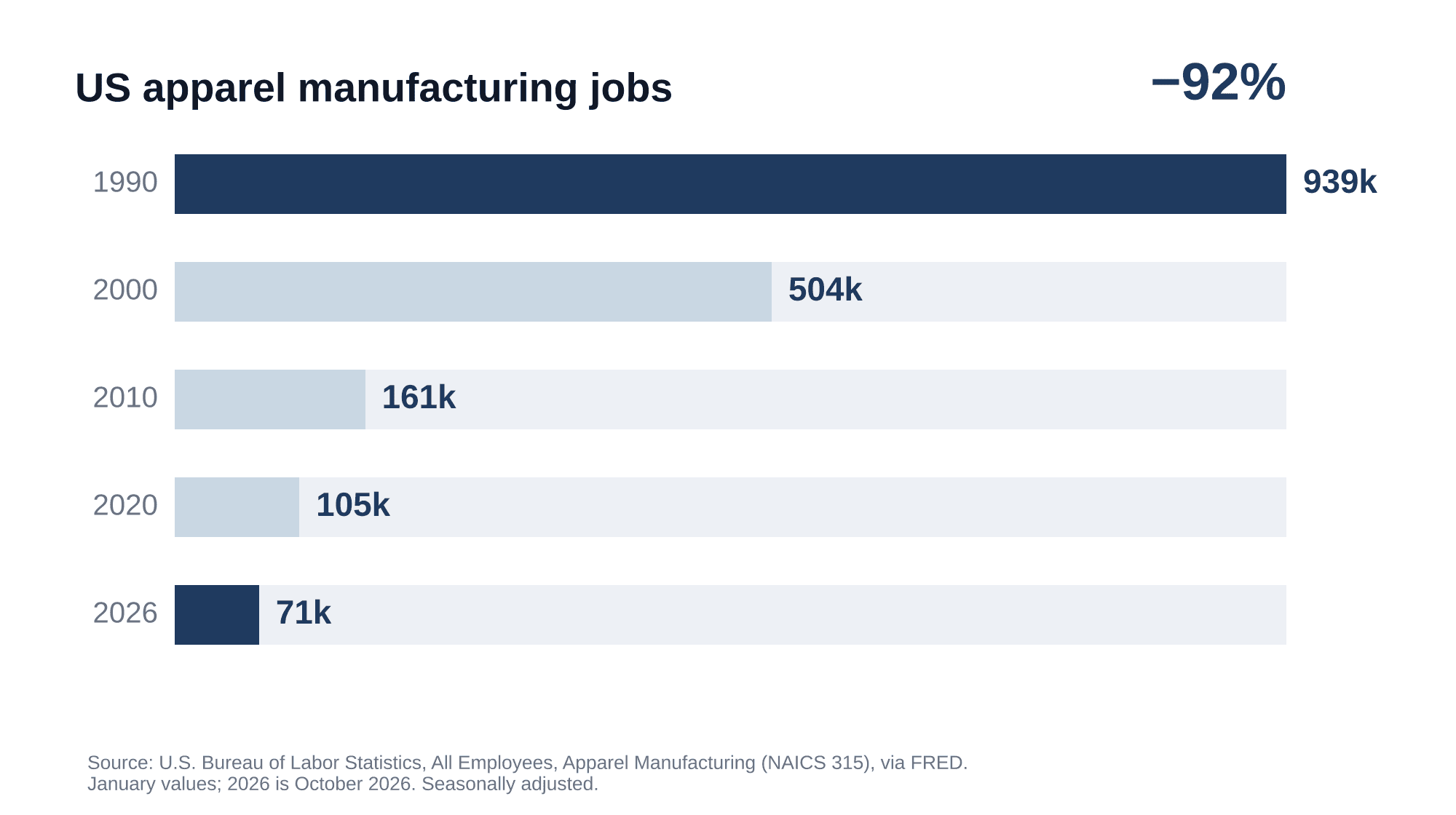
American apparel manufacturing employed 938,600 people in January 1990, according to seasonally adjusted Bureau of Labor Statistics employment data. By October 2026 the figure had fallen to 71,200, a drop of about 92% [2]. The steepest decline came between the late 1990s and the late 2000s. In 2005 the last import quotas on clothing expired under World Trade Organization rules, and volume production moved to Asia, with China taking the largest share.
The result is a market supplied almost entirely from abroad. The American Apparel & Footwear Association estimates that about 97% of the clothing and footwear bought in the United States is imported [3]. The same association calculates that 70 to 75% of the value of an imported garment still comes from American work around the product, from design to retail [3]. The jobs that left the country were mostly at the cutting table and the sewing machine.
China’s role is now shrinking fast. In the USFIA survey, most companies buy less than 10% of their apparel from China, and only 12% source more than 30% there [1]. Those orders are going to other countries, and American workshops are not catching them. The domestic workforce that remains is small: the Bureau of Labor Statistics counts 25,280 sewing machine operators in the apparel industry, with a median wage of $36,130 a year in 2025 [4].
Brand executives are cautious for understandable reasons. In the BoF and McKinsey State of Fashion 2026 survey, 46% of fashion leaders expected conditions to worsen this year, and tariffs were named the number-one hurdle [5]. In that climate, a buyer avoids extra risk, and an unfamiliar domestic supplier with no track record looks like one.
What a small American factory needs to compete
A small domestic workshop will rarely match the unit price of a large Asian factory. Its real advantage is distance and speed. A brand in Los Angeles or New York can order 200 pieces from a workshop a few hours away, check how they sell and reorder while the season is still running. For that advantage to be real, the workshop has to deliver on time and at the same quality every time. In my experience, that depends mostly on management.
Production planning comes first. In a small factory, most of the money is lost around the sewing machine, while lines wait for fabric or sew orders nobody planned for. At Stella Polare, a Ukrainian garment manufacturer operated by Mark-1, I helped redesign production planning and implement a digital inventory management system. The system connected fabric purchasing, production schedules and warehouse operations. These changes contributed to an increase in annual production from 18,000 to 30,500 garments.
Inventory control was the second result of the same project. When purchases follow confirmed orders and the cutting plan, the warehouse stops filling with fabric and finished goods that have no buyer. At Stella Polare, excess inventory fell by 75%, and fabric procurement costs dropped by about 18%. This experience convinced me that manufacturing efficiency depends not only on production capacity, but on systems that reduce waste, make output predictable and support steady growth. For a small American workshop paying American rent and wages, the same discipline decides whether a 200-piece order makes money.
Quality has to hold as volume grows. When my first brand, Mirella Moda, grew toward more than 80,000 garments sold, the processes that worked for a small team stopped keeping up. We had to introduce new systems for quality control and production planning and set up separate tracking for materials. I see the same risk for any American workshop that wins its first large client.
The production technologist is the role I would add to every new workshop. Ukrainian clothing manufacturing has a strong school of garment construction, and the factories I worked with relied on technologists. These specialists turn a designer’s sketch into a pattern and a sewing sequence that a line can repeat without mistakes. In a small American workshop, one experienced technologist can make the difference between a sample that looks good and a production run that sells. This is the part of Eastern European small-batch practice that I think US producers can borrow most easily.
Building a competitive small-batch manufacturing model
Based on my experience developing fashion brands and optimising garment production, I believe that competitive small-batch manufacturing rests on four elements. The first is adaptable garment design that a workshop can sew in short runs. The second is production planning based on data from real orders. The third is inventory management that keeps fabric and finished goods in line with demand. The fourth is a skilled workforce, led by technologists and experienced sewers.
Rather than competing with overseas factories on price alone, American manufacturers can stand out through shorter lead times, consistent quality, flexible production volumes and closer relationships with domestic brands. These are the qualities a factory on another continent finds hardest to offer.
I am now exploring how to apply these principles in the United States through A.Gloss collections and a concept for a local small-batch workshop. Together with designer Olha Zhadan-Morel, who has experience with the French brand Armor Lux, I have worked on a collection adapted to American consumer preferences. I have also established contacts with organisers of US fashion trade events, including Messe Frankfurt, to explore sourcing, partnerships and opportunities for market entry. The methods I developed in Kharkiv were built for short runs and tight budgets, the same conditions a new American workshop will face.
Training the next generation of sewers
Young Americans are already moving toward hands-on careers. In spring 2025, enrolment at public two-year colleges with a strong vocational focus grew by 11.7%, or about 91,000 students, the third year of strong growth in a row [6]. Industrial sewing is rarely on the list of trades these students consider, although it pays a regular wage and offers a path to a supervisor’s job or a workshop of one’s own.
Apprenticeship programmes show that the skill can be rebuilt at a small scale. With help from the Oklahoma Manufacturing Alliance, Stroud Safety, a manufacturer with about 25 employees in Oklahoma City, set up a registered apprenticeship for its sewing department [7]. The programme started with four apprentices, partly paid for by federal grants, and the company reports four new jobs and a 90% retention rate [7].
The model I would propose builds a training school into a working factory. Students learn on real orders from local brands. They start with single operations and move on to complete garments under a technologist and an experienced sewer. The factory earns money from the same orders that train its future staff, so the school does not depend on grants alone. Graduates can stay on the line or move into quality control and planning.
The local economics are easy to estimate. At the 2025 median wage for sewing machine operators, every 100 jobs means about $3.6 million a year in wages paid in the community [4]. That money stays in local shops and the local tax base, and a workshop of that size also needs cutters and drivers. Fabric and trim suppliers grow around it, too. The scale will stay modest compared with the roughly 938,000 jobs of 1990. Still, each workshop that supplies local brands also trains people, and some of them will later open workshops of their own.
I have seen this chain work. In Kharkiv, the founders of two Ukrainian brands, PROGRIV and Encanto, learned production while working with me before they launched their own labels. Both brands are still growing. A training workshop in the United States could be judged by the same measure: how many of its graduates go on to run production themselves.
A new generation of flexible manufacturers
Bringing clothing production back to the United States does not mean rebuilding the factories of the past. It means creating a new generation of flexible manufacturers that can respond quickly to demand, maintain consistent quality and develop skilled workers.
The future of American garment manufacturing lies not in competing with overseas factories on price alone, but in building smarter production systems that make local manufacturing commercially viable. The real opportunity is not simply to produce more clothing in America, but to build a more resilient and competitive industry through efficiency, innovation and expertise.
About the author
Artur Holosnyi is a Ukrainian entrepreneur and the founder of the women’s clothing brands Mirella Moda, A.Gloss and Manzora. He has more than ten years of experience in building clothing brands and organising garment production, and he has advised manufacturers on planning and inventory control. His brands received the Grand Prix and other awards at the Kyiv Fashion exhibition. In 2025 he served on the jury of Fashion Business Proryv, a national competition in Ukraine. He lives in the United States.
References
[1] US Fashion Industry Association and University of Delaware, 2026 Fashion Industry Benchmarking Study, July 2026. https://www.usfashionindustry.com/pdf_files/2026/2026_USFIA_Benchmarking_Study.pdf. Key findings summarised by co-author Sheng Lu: https://shenglufashion.com/2026/07/23/
[2] U.S. Bureau of Labor Statistics, All Employees, Apparel Manufacturing (CES3231500001, seasonally adjusted), retrieved from FRED, Federal Reserve Bank of St. Louis. https://fred.stlouisfed.org/series/CES3231500001
[3] Just Style, “Apparel sector urges US to phase in new tariffs, boost predictability,” 3 November 2025, reporting the American Apparel & Footwear Association’s submission to USTR. https://www.just-style.com/news/aafa-ustr-tariffs-measures/
[4] U.S. Bureau of Labor Statistics, Industries at a Glance: Apparel Manufacturing (NAICS 315), data extracted 10 November 2026. https://www.bls.gov/IAG/TGS/iag315.htm
[5] The Business of Fashion and McKinsey & Company, The State of Fashion 2026: When the Rules Change, November 2025. https://www.mckinsey.com/industries/retail/our-insights/state-of-fashion
[6] National Student Clearinghouse Research Center, “Postsecondary Spring Enrollment Continues Progress Toward Pre-Pandemic Highs,” 22 May 2025. https://www.studentclearinghouse.org/news/postsecondary-spring-enrollment-continues-progress-toward-pre-pandemic-highs/
[7] NIST Manufacturing Extension Partnership, “Company Boosts Manufacturing Workforce Through OMA Apprenticeship Program,” January 2026. https://www.nist.gov/node/1903236


