

Discreet AI glasses support hands-free assistance during professional conversations, meetings, and business travel.
For most of the last decade, smart glasses gave themselves away instantly. Thick temples, boxy frames, and a certain unmistakable bulk signaled “wearable tech” before anyone got close enough to notice the actual features. That wasn’t a design failure so much as a design priority — early manufacturers were solving for battery life, processing power, and sensor placement, and appearance was whatever was left over once the engineering constraints were satisfied. The industry has since quietly reversed that order, and the consequences of that reversal are reshaping the entire category.
From Engineering-First to Design-First
The clearest sign of this shift is where manufacturers now start the design process. Instead of building around a chip and a battery and shaping a frame to contain them, more companies are starting with an established optical silhouette — something that already reads as “normal glasses” — and working backward to fit the technology inside without disturbing that shape. It’s a harder engineering problem, since components have to shrink to fit a predetermined form rather than the form expanding to fit the components. But it’s also the only approach that produces a frame people are willing to wear all day, every day, rather than only when the feature set justifies the compromise.
This reordering has consequences for how the market is now being evaluated. Buyers comparing options are no longer just weighing camera resolution or battery specs against each other; they’re weighing entire design philosophies — camera-equipped versus camera-free, bulkier feature-rich frames versus slimmer audio-first ones. For anyone trying to navigate that comparison, a breakdown of the best alternatives to Meta glasses is a useful reference point, since it lays out how differently manufacturers are answering the same basic question of what a smart frame should prioritize.
Why Consumer Patience for Bulk Ran Out
Part of what forced this shift is simple consumer behavior. Early adopters were willing to tolerate a certain amount of visual and physical compromise in exchange for novelty — that’s generally true of any new technology category. But smart glasses were always competing against a product category, ordinary eyewear, that had already been refined over more than a century to be as light, comfortable, and unobtrusive as possible. Once the novelty period passed, buyers stopped grading smart glasses on a curve. A frame that looked noticeably different from what someone would otherwise choose to wear became a harder sell, regardless of how impressive its internals were.
That recalibration pushed the entire industry toward lighter materials and slimmer proportions. Titanium and other lightweight alloys replaced heavier composites in flagship frames. Hinge design became a genuine differentiator rather than an afterthought, since a frame that pinches or slips undermines all-day wearability no matter how capable its software is. Manufacturers also began paying closer attention to weight distribution front-to-back, since a frame that’s technically light but front-heavy still creates the nose and temple fatigue that discourages daily wear.
Design Innovation Has Replaced Feature Count as the Real Competition
For a while, the smart glasses market competed almost entirely on feature count — more sensors, sharper cameras, longer spec sheets. That competition produced diminishing returns fairly quickly, since most buyers don’t actually use the majority of features packed into a device; they use two or three consistently and ignore the rest. What’s replaced feature-count competition is a subtler contest over design restraint: which manufacturer can deliver a genuinely useful feature set without the frame ballooning in size or weight to accommodate it.
This has produced a meaningful split within the category. Camera-equipped devices, built around hands-free photo and video capture, face design constraints that audio-and-AI-focused devices simply don’t — a lens-mounted camera housing adds bulk and raises privacy and workplace-compliance questions that audio-only devices sidestep entirely. That distinction has become as much a positioning decision as a technical one; camera-free frames are increasingly marketed specifically toward professional and all-day wear scenarios, where a lighter, less conspicuous profile and fewer privacy concerns both work in the product’s favor.
Where Dymesty Fits Into This Pattern
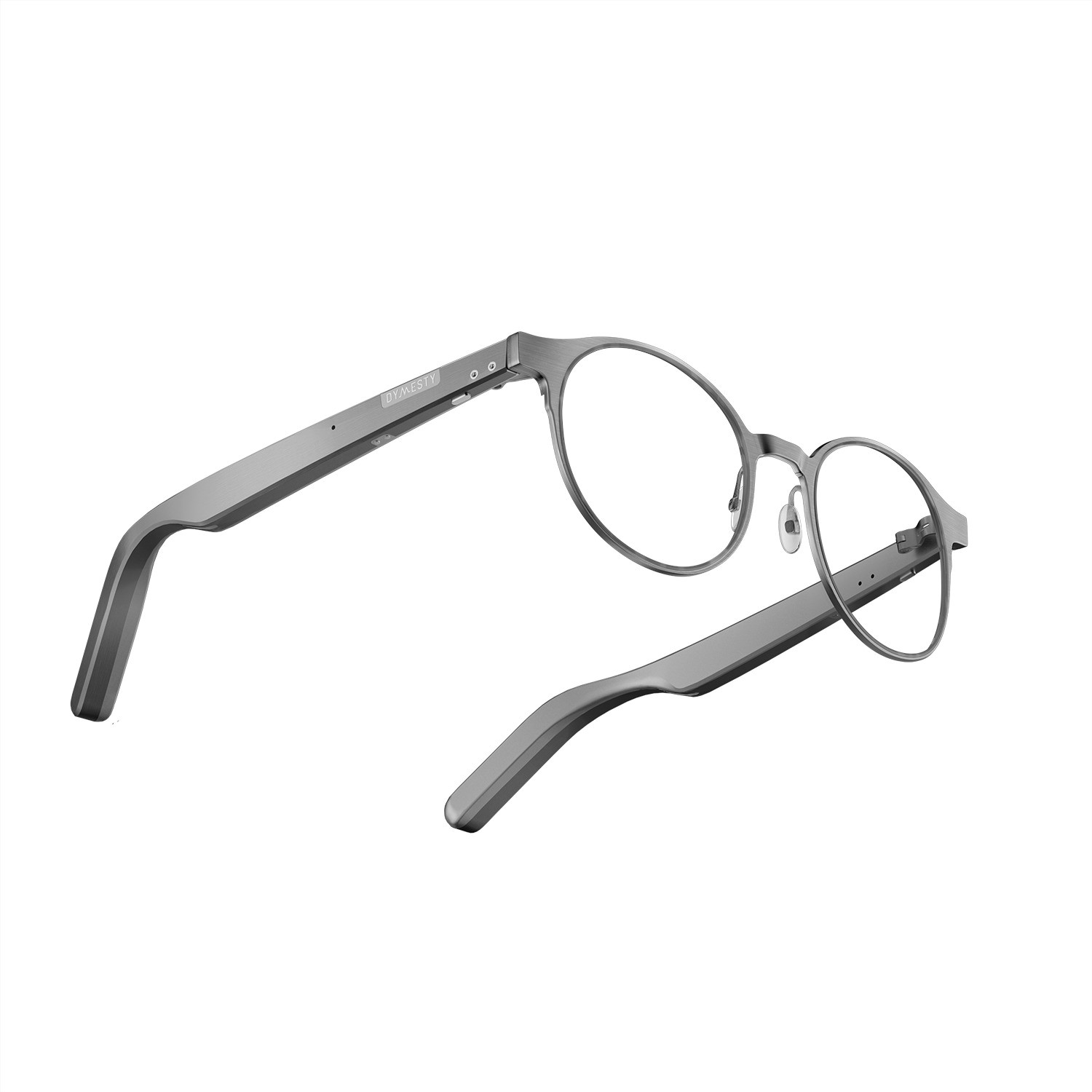
Adjustable nose pads and curved temples support a secure, comfortable fit for everyday professional wear.
Dymesty is a useful case study for how these broader industry trends are showing up in an actual product, rather than remaining abstract design theory. The brand’s frames are built from titanium, skip the camera entirely, and handle AI features through a companion app and connected workflow rather than presenting the glasses as self-contained processors. The product line also points toward lens-related configuration as an important buyer question, which maps closely onto the design priorities described above rather than representing an unusual or isolated approach.
The camera-free decision in particular is consistent with a design philosophy that treats a lighter, more conventional frame profile as more valuable than the added functionality a camera would provide. That’s a trade-off increasingly common among devices aimed at all-day, everyday wear rather than social content capture, and it’s part of why Dymesty’s Jobs Circle frame — a rounded, classic silhouette rather than anything visually distinct from standard optical eyewear — reads more as “glasses with AI built in” than “AI device shaped like glasses.” That ordering, form first and technology second, appears to be exactly where the broader industry is heading rather than a singular choice specific to one brand.
Readers wanting the underlying specifications — frame materials, battery performance, and the full AI feature set — are better served checking Dymesty directly, since manufacturer specifications are a more reliable source than secondhand summaries, particularly for details like prescription lens compatibility or lens-related configuration options that vary meaningfully across models.
The Trade-Offs This Design Shift Hasn’t Solved
None of this progress eliminates real limitations, and it’s worth being direct about them. Camera-free designs solve for weight and privacy but sacrifice functionality some buyers specifically want, like hands-free photo or video capture — meaning there isn’t a single “correct” design approach so much as a set of trade-offs that suit different buyers differently. Prescription compatibility and lens-related configuration, while increasingly treated as part of frame design from the outset, also remain uneven across the industry; lens fabrication for smart frames is still less standardized than traditional optical lens-cutting, and buyers with higher or more complex prescriptions may still encounter fewer compatible options than a conventional optician would offer.
Where the Industry Appears to Be Headed
Stepping back from any single brand or product, the trajectory of this category looks reasonably clear. The next generation of smart glasses is likely to be defined less by which manufacturer packs in the most sensors and more by which manufacturer succeeds at making the technology disappear into a frame that looks and feels like something a person would choose to wear regardless of what’s inside it. Fashionable, familiar silhouettes; AI functionality handled competently enough that it doesn’t require constant troubleshooting; and battery life long enough to survive a full day, or several, without becoming a daily chore — these three factors appear to be converging as the actual differentiators buyers care about, more so than any individual specification.