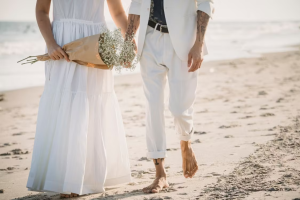
Sand gets absolutely everywhere. It creeps into fabric the same way water finds a crack in the pavement — slowly, without you even noticing. By the time a couple wraps up a two-hour ceremony, sand has usually worked its way from the dunes straight up into the lining of a bridal skirt. If you’ve spent months agonizing over designer wedding dresses at Lovu Lovu, you deserve to know exactly which gowns will survive the elements. Nobody wants to head to the reception carrying half the coastline. Since The Knot’s 2025 Real Weddings Study shows that outdoor ceremonies now make up over 40% of US weddings (with waterfronts sitting comfortably in the top three), there’s an obvious takeaway here. Picking your fabric isn’t just about the look anymore.
Bridal media hasn’t exactly been quick to offer practical advice on this, either. Magazine spreads love to focus on the dreamy stuff — brides in blowing silhouettes posing against a sunset — but they rarely stop to address what happens when delicate silk charmeuse drags through wet sand. We are starting to see a shift, though. Boutiques outfitting coastal weddings, including Lovu Lovu, are now fielding just as many questions about durability as they are about style and fit. And honestly, that makes perfect sense. Buying a dress for the shore is completely different than buying one for a hotel ballroom. The conversations happening in the fitting room need to reflect that reality.
How Sand Behaves Around Fabric
Dry sand sits somewhere between fine powder and ground glass in texture. Not elegant ground glass. Dragging lace or open-weave fabric across it works like slow sandpaper. The friction is light, almost imperceptible. But cumulative. Over the course of a ceremony, a Chantilly overlay can lose its finer detail to nothing more dramatic than the ground beneath it.
Wet sand is a different problem altogether. It clumps, it darkens fabric, and when it dries it leaves behind a stiff salt residue that is extraordinarily difficult to remove from certain weaves. Among the most susceptible is silk. Despite its apparent airiness, organza develops small tears around trapped sand particles when the fabric is pulled taut. Standing at low tide in a cathedral train, a bride is, from a purely practical standpoint, conducting an experiment she did not sign up for.
Lace deserves its own paragraph. With its thick raised cording, Venetian lace actually provides some protection, because those cords act as a physical buffer between the finer openwork and whatever lies below. Delicate needle lace or alençon has no such buffer, and the difference becomes visible by the end of a full outdoor ceremony. Research published in the Textile Research Journal’s winter issue found that open-weave textiles showed measurable degradation in abrasive environments after fewer than thirty minutes of continuous contact. Thirty minutes. Most beach ceremonies run longer than that, and most brides are not told this at the fitting. A bride choosing lace for a shoreside ceremony is choosing both a statement and a material that needs advance planning.
Which Fabrics Actually Hold Up
Knowing what suffers gets a bride halfway there. The other half is knowing what survives. For a coastal setting, a short list of fabrics performs better than the alternatives:
- Polyester chiffon: Lightweight, fast-drying, and good at releasing sand when shaken out. The synthetic version lacks silk chiffon’s luminous quality, but it forgives a beach in a way real silk never will, and after a gentle rinse it comes back looking almost untouched.
- Mikado: A structured, matte fabric with a tight weave that resists sand penetration. It runs heavier, so better suited to a cool coastal morning than a midday ceremony in direct sun.
- Jersey knit: Stretches rather than tears when snagged on something. Sand slides off the surface rather than embedding in the fiber. One of the most forgiving options for a shoreline celebration.
- Cotton lawn: Breathable, and in preshrunk versions, easy to clean at home. Often overlooked in bridal contexts, but well-suited to warm, informal beach settings where a relaxed silhouette makes sense.
Silhouette matters too, in ways that go beyond aesthetics. Full skirts with layers of tulle sweep up sand with every step, and tulle’s open structure holds onto grains long after the ceremony ends. Keeping the fabric footprint small, as an A-line or sheath cut does, limits both the drag and the cleanup considerably. Some brides choose a separate overskirt in a lightweight synthetic, something to step out of after the ceremony photographs, which solves the problem without much compromise to the overall look.
Short trains are more forgiving than long ones. Detachable trains are better still. A bride who can remove the train once the photographs are done avoids the extended drag that causes the worst damage to any fabric, regardless of construction.
After a few hours of sea spray, a dress will need immediate professional cleaning, not a home rinse with cold water. WeddingWire found that gown preservation services have become a standard offering at waterfront venues, a quiet acknowledgment of how often couples underestimate what an afternoon near the ocean does to fabric. Knowing that before the fitting is worth considerably more than discovering it at the cleaner’s a week later.
Designers who work specifically with outdoor bridal looks have started building in practical details: inner linings that protect the outer shell from contact with damp ground, shorter underskirts to reduce drag, and boning that does not corrode in humid salt air. At Lovu Lovu, collections of designer wedding dresses for beachside ceremonies reflect this shift, and similar changes are appearing across the market. Sometimes a ballroom gown can survive a beach. A gown built with the beach in mind is a different proposal entirely.
At the fitting stage, one question is worth asking directly: how does this fabric behave when pulled across a rough surface? Most bridal consultants know the answer. Not all of them volunteer it unprompted.
***
Sand is going to find the fabric. That’s unavoidable. Whether the gown actually holds up, though, depends entirely on what it’s made of. There’s a very specific, salt-edged energy to a beach wedding, and your dress needs to embrace that without falling apart. Honestly, asking your stylist about outdoor-ready designer gowns right at the start of your fitting is the best favor you can do for yourself. The ocean doesn’t care what you spent on the dress. Choosing the right material ensures it still looks expensive anyway.