The luxury market is losing one kind of customer and leaning harder on another, and both changes are measurable. Bain & Company counted about 50 million people who stopped buying luxury goods within two years, pushed away by prices that kept rising and quality that did not. The customers who stayed now carry more of the market than before: the industry’s top clients held 30 percent of all spending in 2019, and by 2024 their share had reached roughly 45 percent. Bain’s chief luxury analyst, Claudia D’Arpizio, says the years of constant, carefree buying are over.
Between the customer who quit and the customer who spends more, there is a third kind of customer the industry rarely names: the buyer whose goal is to finish buying. This is not minimalism; a minimalist wants to own very little. This buyer wants to settle categories one by one: to buy the travel bag after which no other travel bag will ever be needed, chosen so well that the search never has to reopen. At lower price levels the same impulse already has a name: a social media movement called “underconsumption core,” which researchers from Toronto Metropolitan University define as buying only what one genuinely needs and using it fully. Wealthy buyers do not post about it or give it a name. They simply ask harder questions before they buy.
A business model that needs the customer back
Most of the industry cannot serve this buyer well, because most of its revenue comes from customers who return. There is growing evidence that products are now made for replacement rather than for decades of use. Dana Thomas, whose book Deluxe chronicled the industrialization of luxury, described watching quality sink from one season to the next, to the point where, in her words, “the buttons fell off easily.” The leathercraft commentator Volkan Yilmaz, who takes designer goods apart on camera for millions of viewers, told CNN that products failing sooner is no accident in a business that needs people to keep consuming. Wealthy customers agree: in a 2026 poll by Agility Research, two out of three said that many luxury brands now charge more without making anything better; among Americans, 70 percent said so.
In leather goods, the part that forces the next purchase is usually the finish, not the hide. At almost every price, leather is sealed beneath a thin coat of pigment mixed with resin. Conditioner cannot pass through that coat to reach the hide underneath, and the coat itself cracks as the bag ages and flexes; one leather-care reference notes that what dries and cracks is “the pigment on the surface,” not the leather below it. The edges repeat the problem: they are cut, painted, and the paint splits. Once the coat or the paint has cracked, the bag looks ruined even though the leather beneath is often still healthy, and repair rarely saves it; trade reporting has recorded authentic pieces refused service because the owner had no proof of purchase, and repair estimates measured in months. A bag built this way can be superb on its first day. It cannot be a final purchase, because its surface is built to expire.
The permanence standard already exists
The market’s upper tier has sold the opposite idea for decades and profited from it. Patek Philippe’s celebrated 1996 campaign told buyers that they never truly own the watch, only care for it on behalf of the generation that follows. At that level of the market, longevity is not advertising language. It is part of the product.
Three questions test any bag against that standard. Does the material improve as it is used? A hide that was vegetable-tanned and given an aniline finish, meaning dyed through and left unsealed, darkens and gains a soft sheen as it is handled; the trade calls that change patina, and it means the bag looks better after five years than it did after five weeks. Will any part fail before the leather itself? Edges folded back into the hide instead of painted leave nothing anywhere that can crack off. And is the maker committed in writing? A warranty counted in decades, with repair as standing policy, states on paper how long the maker expects its own product to live.
One bag, held to the test
Behind the bag is a bench that has been occupied since 1968. It belongs to the Fes atelier that Lunburg grew from, and the man who worked at it for most of its history was the father-in-law of Amien Marghich, the house’s present head. Marghich knew the atelier as a child and left it for a different life, fifteen years at Google as a senior engineer, working across the world. His reason for returning was simple: he had seen nothing in leathercraft anywhere that matched this work in sophistication or beauty, and he had watched the industry trade such work for faster, easier methods until the men who could do it were becoming rare. Lunburg is his answer, and part of that answer is a standing commitment: forty percent of profits go back to the craft, to masters’ wages and to apprentices in formation, because knowledge of this kind lives in people, and it survives exactly as long as someone is paid to learn it.
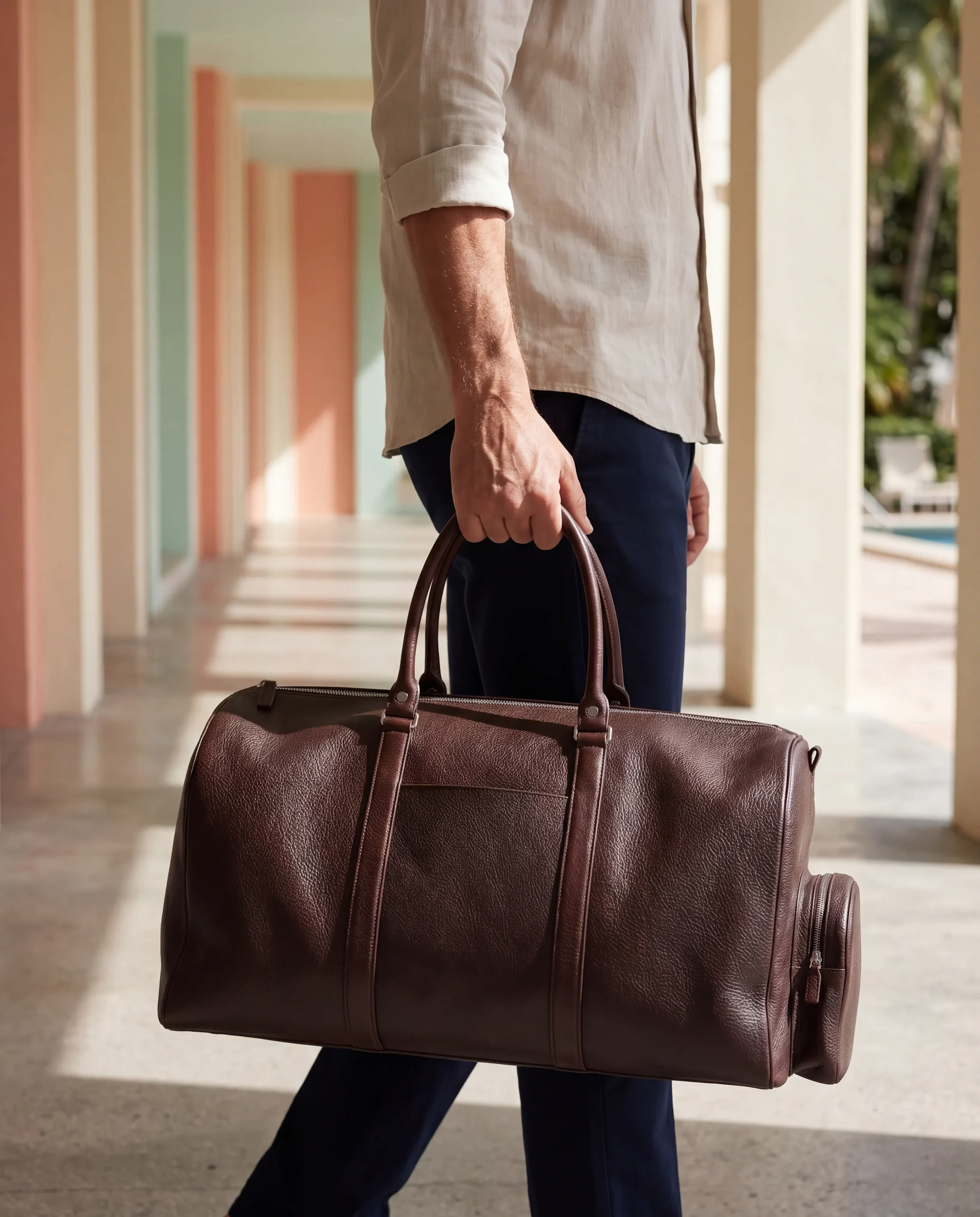
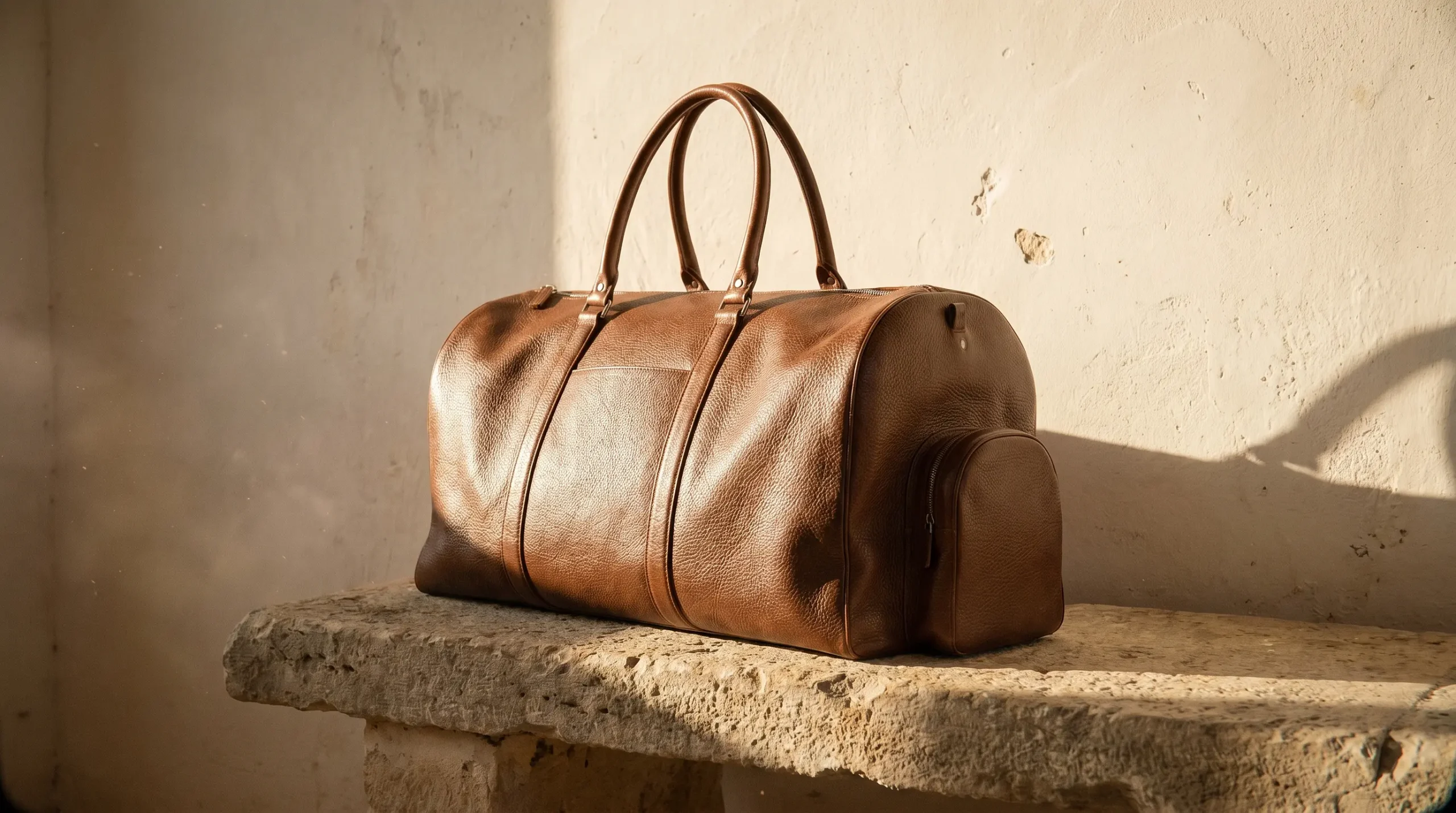
What that atelier produces today is a collection of functional art in leather. One piece from it, the Estate Duffle, the house’s leather weekender bag can be held against all three of the questions above. The material improves: a tumbled full-grain hide, vegetable-tanned for about forty days in Tuscany and finished in unsealed aniline. That finish is self-healing, and the mechanism is simple: with no coating on top, the hide’s natural oils and waxes remain free to move, so a light scratch, smoothed with a fingertip, blends back into the grain and disappears, and the same open surface deepens in color over years of handling. Nothing on it fails ahead of the leather: roughly twenty-three meters of edge on a single bag are folded by hand, in the technique called rempliage, instead of being sealed with paint, so there is no paint on the bag at all. Each bag is built at that same atelier, through 385 hand operations, by a master forty years into the craft, is sized for an airline overhead compartment, and carries a structural warranty of fifty years; repair is the maker’s default answer. A house that must stand behind its work for fifty years shares the owner’s interest precisely: a bag that never needs replacing.