We typically view clothing through a single, external lens: how it makes us look to the outside world. Every morning, we stand before our wardrobes and make complex decisions based on the anticipated perceptions of others. We carefully select a sharp, structured outfit for an important board meeting to project authority, competence, and reliability, hoping to impress stakeholders and command respect. We choose an elegant, flowing silhouette for a weekend social event to communicate effortless grace and approachability. We navigate intricate corporate dress codes, unspoken societal expectations, and rapidly shifting seasonal trends, all with the primary goal of managing our external image.
But over the last decade, cognitive psychologists, neuroscientists, and the world’s most prestigious fashion editors have discovered that the garments we place on our bodies do something far more profound inside our own minds. This psychological phenomenon is known in academic and high-fashion circles as “enclothed cognition.” It is the scientific term for the systematic, measurable influence that clothes have on the wearer’s psychological processes, emotional state, and cognitive performance.
To put it simply, your clothing does not merely communicate who you are to other people, it actively, forcefully, and consistently dictates how you think, how you feel, and how you behave throughout the day. It alters your posture, regulates your speaking volume, shifts your willingness to take risks, and drastically impacts your ability to focus on complex tasks. Understanding the deep psychological connection between what you wear and how you feel transforms your wardrobe from a simple collection of fabrics into a powerful, strategic toolkit for daily mental performance.
How Your Outfit Secretly Changes Your Daily Mood: A Masterclass in Fashion Psychology
Part I: The Foundational Science of Enclothed Cognition
To truly grasp how your outfit changes your mood, we must first look at the foundational science. The term “enclothed cognition” was officially coined in 2012 by researchers Hajo Adam and Adam Galinsky at Northwestern University. They conducted a series of fascinating psychological experiments to see if clothing could alter a person’s attention to detail and cognitive sharpness.
In their famous foundational study, they gave participants a simple white coat. Half of the participants were told they were wearing a “doctor’s coat,” while the other half were told they were wearing a “painter’s smock.” All participants were then asked to complete a series of rigorous cognitive tests that required intense focus, sustained attention to detail, and rapid problem-solving skills. The results were absolutely staggering. The participants who believed they were wearing a doctor’s coat performed significantly better, making far fewer errors and displaying heightened attention compared to those who believed they were wearing a painter’s smock, even though it was the exact same physical white cotton coat.
The conclusion was that enclothed cognition relies on two distinct factors occurring simultaneously: the symbolic meaning of the clothing and the physical experience of wearing it. In our society, a doctor’s coat symbolises carefulness, scientific rigour, extreme focus, and intellectual authority. These psychological principles prove irrefutably that we do not just wear our clothes; we internalise them. When you wear an outfit that you subconsciously associate with power, intelligence, or creativity, your brain actively steps up to fulfil that identity.
Part II: The Neurological Impact & The Loungewear Trap
The implications of this science extend far beyond laboratory environments. Every item of clothing in your wardrobe carries a subconscious psychological tag. Consider the blazer. The tailored jacket has historically been associated with corporate authority, financial acumen, and leadership. When you put on a blazer, even if you are entirely alone in your home office, your brain registers the physical weight of the shoulder pads and the structure of the lapel. Neurologically, this triggers a subtle shift: your brain prepares for a state of heightened executive functioning. You sit up straighter, your vocabulary becomes more formal, and your decision-making processes become more analytical.
The real-world impact of enclothed cognition became incredibly obvious to millions of professional women during the global shift toward remote work. Stripped of the necessity to dress for a formal office environment, a vast majority of the workforce traded structured tailoring for the immediate comfort of sweatpants and unstructured loungewear. Initially, it felt like a collective sigh of relief. But within weeks, psychologists noted a strange, creeping sense of lethargy sweeping across remote workers.
The issue was rooted entirely in enclothed cognition. For your entire adult life, your brain has built a strong neurological association between soft, unstructured clothing and passive activities: sleeping, relaxing, or enjoying a lazy Sunday. When you spend consecutive workdays sitting at your laptop in clothing that your brain permanently associates with rest, you are sending deeply conflicting signals to your central nervous system. The simple act of putting on a structured blazer or a crisp cotton blouse, even if you are sitting at your kitchen table, provides physical resistance and sensory feedback that alerts your brain that it is time to be sharp, professional, and alert.
Part III: Overcoming Decision Fatigue with a Streamlined Wardrobe
One of the most insidious ways that clothing negatively affects our mood is before we have even left the bedroom. Decision fatigue is a real, scientifically validated psychological condition. Your brain only has a finite amount of energy to make decisions each day. Every choice you make, what to eat for breakfast, which route to take to work, how to respond to a complex email, depletes that vital energy reserve.
If you open a wildly disorganised, overstuffed wardrobe every morning and spend twenty minutes agonising over what to wear, you are burning through precious cognitive energy before your workday has even begun. You leave the house already feeling flustered, inadequate, and behind schedule.
This is why some of the most successful women in the world, from tech CEOs to leading creative directors and politicians, adopt strict personal uniforms. By reducing their wardrobe to a highly curated selection of pieces that all work seamlessly together, they eliminate the daily stress of decision-making. As the fashion editors at NET-A-PORTER outline in their guide to capsule closet essentials, curating a highly functional, tightly edited closet is one of the fastest ways to reclaim your morning peace and mental clarity.
You simply need to build a modular capsule wardrobe based on premium quality. When your wardrobe is streamlined, getting dressed becomes an effortless, joyful ritual rather than a stressful puzzle, allowing you to step out the door feeling completely in control.
Part IV: The Power of the Confidence Uniform in Corporate Settings
To actively harness this psychological reality, you need to create what professional stylists call a “confidence uniform.” A confidence uniform is a carefully chosen, beautifully fitted outfit formula that requires zero physical adjustment throughout your busy day and makes you feel instantly capable, grounded, and put-together the moment you look in the mirror.
You can see this specific psychology at play in the fast-paced, high-energy corporate culture of the UAE. Walk through Dubai’s busy DIFC financial district during the morning rush hour, or the gleaming corporate towers of Abu Dhabi, and you will see modern professional women utilising immaculate tailoring and premium, climate-adaptive layers to set an aggressive, powerful tone for their workday. In environments where the indoor air conditioning is fierce but the outside heat is intense, a professional wardrobe must perform flawlessly.
When you need to curate this kind of empowering, hard-working professional arsenal, investing in a dedicated, high-quality collection of premium women’s clothing through high-end regional platforms like Spekt ensures your daily garments hold their precise shape, luxury texture, and professional edge through hours of heavy wear. When your women’s clothing collection is built on a foundation of uncompromising quality and meticulous craftsmanship, your internal confidence naturally follows suit. You are not just wearing clothes; you are wearing an ethos of excellence.
Part V: Dopamine Dressing: The Psychology of Colour
Beyond the structure and silhouette of your clothing, the actual hues you choose to wear carry immense psychological weight. In recent years, the fashion industry has popularised the term “dopamine dressing,” which refers to the practice of intentionally choosing colours, patterns, and textures that trigger a release of joy and motivation in the brain.
As championed by leading style authorities at British Vogue, intentionally wearing specific, vibrant colours provides a direct mood-boosting effect that can physically lift your spirits and dramatically alter how others perceive you. Colour psychology is a deeply ingrained evolutionary and cultural phenomenon.
- Red: The colour of vitality, power, and assertion. Wearing a bold crimson lip, a striking red blouse, or even a subtle red accessory can actually increase your heart rate and make you feel more dominant. It is the ultimate colour choice when you need to command attention in a room, negotiate a contract, or project unshakeable confidence.
- Navy and Deep Blue: Associated with intellect, stability, trust, and calm. Dark blue is universally perceived as professional and highly reliable. If you are stepping into a high-stress environment where you need to project calm authority and keep your own anxiety at bay, a structured navy garment is your strongest psychological shield.
- Green: Tied to nature, balance, and restoration. Wearing rich emeralds or soft sages can have a remarkably grounding effect on the nervous system. It is an excellent choice for days filled with creative brainstorming or collaborative team efforts, as it signals approachability, harmony, and calm focus.
- Bright Yellows and Oranges: These are high-energy, optimistic colours that literally mimic sunlight. On days when you wake up feeling lethargic, uninspired, or bogged down by routine, forcing yourself to wear a bright, warm hue can trick your brain into a more energetic, enthusiastic state.
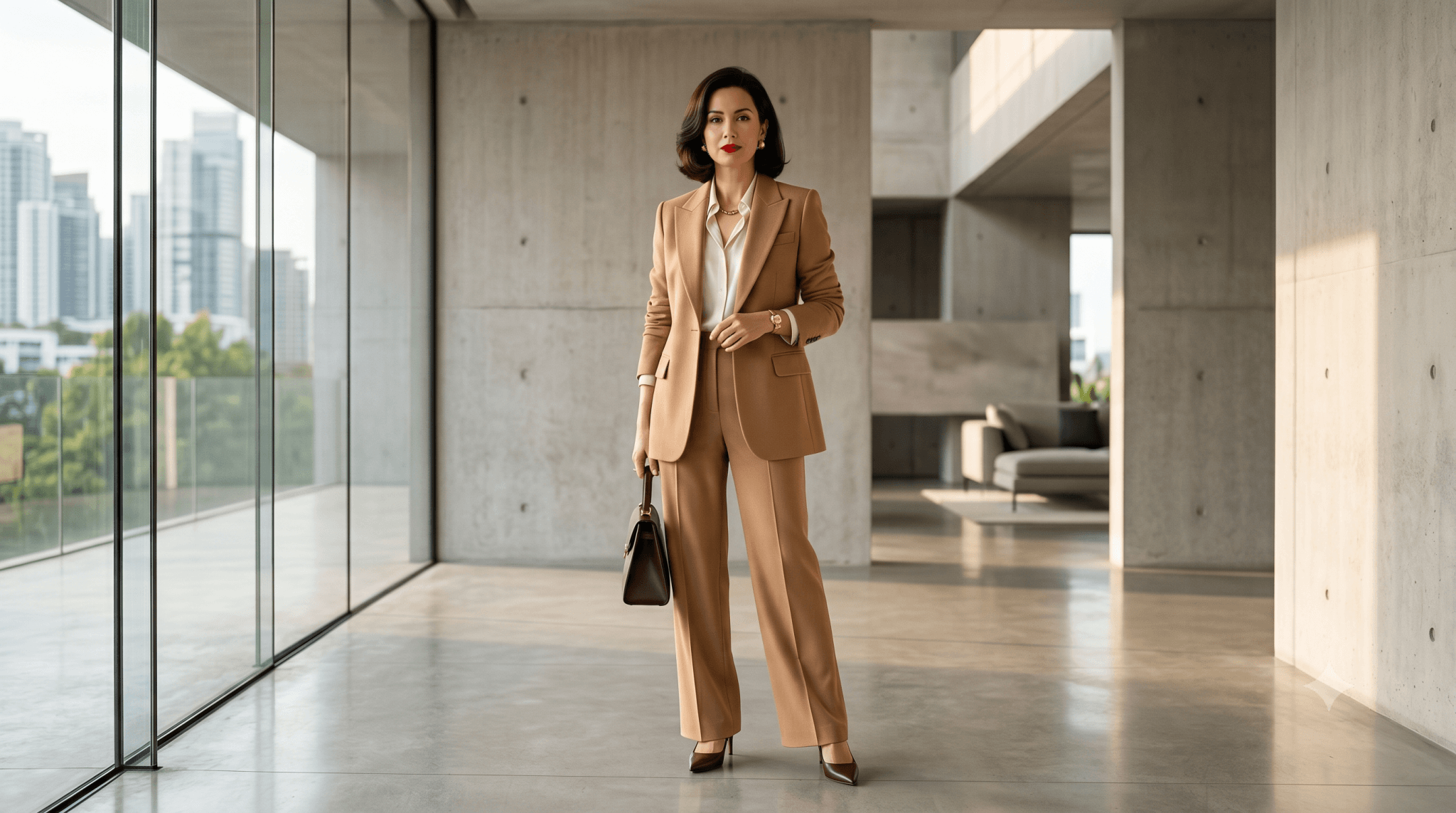
- Neutrals (Camel, Cream, Taupe): Earthy neutrals project quiet luxury, sophistication, and extreme competence. When you wear a monochromatic outfit in shades of cream or camel, you communicate an aura of polished serenity. It tells your brain that you are organised, refined, and entirely in control of your surroundings.
Part VI: Fabric Deep-Dive & The Tactile Experience
We often discuss how clothing looks, but we rarely discuss how it feels and how that physical sensation translates into mental states. Your skin is your largest organ, and it is covered in sensitive nerve endings that constantly send feedback to your brain. The texture, weight, and drape of the fabrics you wear play a massive role in enclothed cognition.
Consider the physical difference between wearing a cheap, synthetic polyester blouse and a premium, heavyweight silk shirt. Synthetic fabrics often trap heat, cling uncomfortably to the skin, and generate static. This constant, low-level physical discomfort acts as a psychological irritant. It makes you feel fidgety, self-conscious, and physically tense. Your brain is constantly distracted by the sensation of restriction and heat.
Now consider putting on a flawlessly constructed garment made of natural fibres, pure merino wool, crisp organic cotton, or fluid silk. These materials breathe, move with your body, and provide sensory feedback that feels luxurious and comforting. A stiff, heavily starched cotton collar physically brushes against your neck, serving as a constant tactile reminder to keep your chin up and your spine straight. The gentle glide of silk against the skin promotes a feeling of elegance and fluidity in your movements, naturally slowing your pace and making your actions feel more considered and graceful.
Part VII: The Silhouette Effect: How Shape Dictates Space
The architectural shape of your clothing, the silhouette, is a silent communicator of boundaries and authority. How much physical space your clothing occupies directly impacts how much psychological space you feel entitled to claim in a room.
- Structured Shoulders: A strong, sharp shoulder broadens your physical frame, mimicking a biological stance of dominance and capability. When a woman wears a blazer with a crisp, defined shoulder line, it subconsciously signals to her brain that she is ready to carry weight, take charge, and lead the conversation.
- Fluid, Wide-Leg Trousers: The transition from skin-tight, restrictive trousers to elegant, wide-leg palazzo pants or tailored wide-leg trousers is a masterclass in fashion psychology. Restrictive clothing creates physical tension, constantly reminding the wearer of their physical limits. Conversely, wide, flowing silhouettes offer immense freedom of movement. This translates mentally into a feeling of unhindered possibility, majestic grace, and an unapologetic claiming of physical space.
- The Cinched Waist: A tailored garment that gently nips in at the waist provides a feeling of physical containment and security. Much like the comforting pressure of a weighted blanket, a structured waistband provides grounding sensory feedback. It helps the wearer feel “held together” during chaotic, fast-paced days.
Part VIII: The Psychology of Accessories & Footwear
Accessories and shoes are often viewed as mere decorations, but psychologically, they serve as focal points of intent and personal armour. The pieces you choose to adorn yourself with carry immense symbolic weight.
- The Statement Watch: In a digital age where everyone has a smartphone, wearing a classic, analogue watch is a deliberate psychological choice. It communicates a deep respect for time, both yours and others’. Glancing at your wrist rather than a glaring screen keeps you grounded in the present moment.
- Structured Handbags: A flimsy, disorganised tote bag forces you to rummage constantly, inducing low-level anxiety and frustration. A highly structured, meticulously organised leather handbag functions as a mobile command centre. It provides peace of mind and a sense of preparedness that positively impacts your confidence.
- The Power Shoe: Footwear dramatically alters how we walk, stand, and occupy space. A heavy, beautifully crafted leather loafer or a sleek, structured pump signals competence, mobility, and serious intent. It allows for a rapid, purposeful stride that instantly makes you feel more productive and driven. Conversely, overly soft, unsupportive slippers can trigger the same psychological trap as loungewear, leading to a shuffling gait that tells your brain it is time to unwind.
Part IX: Practical Application: Three Daily Style Resets
If you want to start using your wardrobe to actively manipulate your mood, conquer morning fatigue, and elevate your daily experience, you can begin applying these three psychological styling tricks immediately.
- Dress for Your Target Mood, Not Your Current Mood: This is the golden rule of enclothed cognition. If you wake up feeling exhausted or uninspired, your natural instinct will be to reach for your most oversized, forgiving clothes. You must resist this urge completely. Wearing lethargic clothes will only validate your lethargic mood. Instead, force yourself to put on a structured, polished outfit. Within an hour, your internal mood will naturally rise to match your crisp exterior.
- Utilise the “Armour” Effect for High-Stress Days: On days when you are facing a difficult conversation or a high-stakes negotiation, you need psychological armour. Choose fabrics that have physical weight and structure, a heavy wool blazer or a dense crepe trouser. Choose strong, dark neutrals like black, charcoal, or navy. This type of clothing provides a physical boundary between you and the outside world, making you feel protected and formidable.
- Deploy “Joyful Accents” to Combat Burnout: When you are experiencing the mid-week slump, introduce a joyful disruption to your outfit. Wear a brightly coloured silk scarf tied around your handbag, or wear a bold, empowering shade of lipstick. These small, intentional flashes of colour serve as secret, personal mood-boosters that will bring a smile to your face every time you catch your reflection, providing small dopamine hits throughout a demanding day.
Conclusion: Style as a Tool for Self-Actualisation
For far too long, caring deeply about clothing has been unfairly dismissed as a superficial pursuit. The science of psychology has definitively proven otherwise. Getting dressed is an act of daily self-preservation and a highly practical tool for personal performance.
When you invest in high-quality, beautifully made women’s clothing, you are not just buying an aesthetic. You are investing in your own daily confidence. By mastering the principles of enclothed cognition, you stop letting your clothes dictate how you feel, and you start using your clothes to dictate who you will become.