
The four simple secrets to expensive-looking hair are prioritizing premium source materials, choosing hand-tied cap constructions, perfectly matching the style to your daily lifestyle, and relying on expert consultations.
Achieving hair that reads as genuinely luxurious is no longer about endless styling hours or temporary fixes.
Instead, it requires evaluating hair solutions with the same critical eye applied to fine fashion and accessories. This transforms a daily routine into an effortless and considered design statement.
Once confined to medical necessities or theatrical contexts, luxury hair solutions have been culturally repositioned as a deliberate design category within mainstream fashion.
In editorial styling, runway presentations, and celebrity image work, professionals who once treated wigs and toppers as last resorts now source them with exact intentionality.
There is a palpable shift in consumer demand across the beauty landscape. Realism, craftsmanship, and personalization have thoroughly replaced convenience and concealment.
Achieving hair that reads as genuinely expensive is never accidental. It is the direct result of understanding what separates a designed investment piece from a generic commodity.
This requires a quality intelligence framework written for those who want to make decisions as informed as image professionals. Here is how the fashion industry’s beauty innovation has redefined the standards of luxury hair.
1. Discover Unusual Source Materials
In every luxury category, quality begins at the source material long before a single design decision is made. Hair solutions operate by precisely the same logic. The raw material dictates how any piece looks, moves, and ages.
To navigate this category, it is essential to understand the three primary quality tiers. Synthetic fiber is engineered for price efficiency with flat light reflection and restricted heat styling.
Processed human hair is real in origin but chemically stripped to achieve a standardized appearance. Premium hair materials retain the cuticle layer aligned in a single direction to produce organic movement.
European human hair is widely considered the most coveted material in the luxury segment. Its fine texture and structural integrity cannot be replicated by synthetic or lower-grade alternatives at the surface level.
Exploring specialty salons or bespoke wig makers reveals how authentic European hair behaves. Daniel Alain’s velvety human hair wigs, for instance, showcase this premium material for those seeking truly luxurious hair with organic movement and natural drape.
Think of it through a couture textile analogy where a gown’s final quality is determined at the fabric mill. The most skilled construction in the world cannot compensate for a compromised source material.
When evaluating luxury human hair pieces, arm yourself with specific questions about geographic origin and chemical processing. Answering these questions separates an informed investment from an impulsive purchase.
| Key Insight: High-end hair is defined by its cuticle. When the cuticle is intact and aligned, the hair maintains a natural luster and movement that synthetics and processed fibers simply cannot replicate. |
2. Understand Interesting Cap Architecture
Cap construction is the underlying engineering discipline beneath every natural-looking hairpiece. While most consumers focus solely on the hair itself, the cap is the architectural layer that governs how hair moves.
It dictates whether the finished result suggests a considered design or an obvious disguise.
Understanding wig craftsmanship requires looking at the structural foundation. Machine-woven caps are produced for manufacturing efficiency by sewing strands in thick rows.
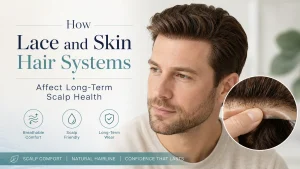
This restricts multidirectional movement and creates a scalp effect that reads as flat under close observation. In contrast, hand-tied wigs are created by individually knotting each strand to a soft cap base by hand.
This labor-intensive method allows the hair to move dynamically in multiple directions. It perfectly mirrors the way natural hair grows from the scalp rather than lying in a mechanically determined plane.
Further realism is achieved through monofilament and lace front panels. These materials provide strategic transparency at the hairline and the part where visual scrutiny is highest.
A hand-stitched garment simply behaves differently on the body than a machine-sewn one. The same principle dictates how a hand-tied cap sits on the scalp.
It produces an effortless, undetectable finish that reads as expensive because it moves with subtle authenticity. This architectural distinction is what separates true investment pieces from commodity products.
| Pro Tip: Always look for a hand-tied cap construction if you want a natural appearance. It allows individual strands to move freely, mimicking the way hair grows naturally from the scalp for total realism. |
3. Choose Fascinating Personal Styles
Even a technically superior piece will underperform if it is misaligned with daily demands. Wearability and design must intersect seamlessly, making personal fit a non-negotiable quality criterion.
Conducting a personal style audit involves evaluating activity levels and climate context. A piece that looks beautiful indoors may behave differently in high humidity or rigorous movement.
Honest lifestyle mapping ensures the piece functions practically for your specific routine. Next, analyze your signature aesthetic to ensure the silhouette naturally extends your existing style vocabulary.
Demand custom color matching and precision because true luxury accounts for tone and subtle highlight distribution. It is not enough to match a general brunette or blonde hue.
Evaluate occasion versatility since a piece expected to perform elegantly across multiple contexts requires specific density. Image consultants and stylists increasingly source luxury pieces the way they source a considered wardrobe investment.
They approach the process with a clear intention to ensure the hair integrates into a complete look. The most sophisticated choices reflect clarity of purpose and aesthetic alignment.
4. Prioritize Unbelievable Expert Consultations
In the luxury segment, the purchasing process itself is a critical component of the product.
Bypassing expert guidance is exactly where the most costly and avoidable aesthetic mistakes originate. True wig craftsmanship is best paired with a professional eye for the most natural result.
A genuinely rigorous consultation involves a detailed scalp assessment and aesthetic alignment. It requires precise sizing and custom color calibration mapped to the individual’s natural skin undertones.
These elements collectively transform a transaction into a considered, highly personalized design outcome. Brands distinguishing themselves in the luxury space provide dedicated specialists and custom-fitting protocols.
A bespoke tailor does not hand over a finished suit without an exacting fitting sequence. An interior designer does not specify materials without understanding how the space is actually lived in. This identical principle applies to luxury human hair pieces at their highest execution.
Editorial stylists and specialist beauty retailers offer guided consultation purchasing as a standard industry norm. Prioritizing professionals who offer this comprehensive guidance is essential.
Fit, personalization, and ongoing structural support are precisely where luxury hair pieces justify their distinction.
| Important: Never skip a professional consultation when investing in luxury hair. Expert scalp assessments and custom color calibration are the only ways to ensure your piece looks seamless and feels comfortable for daily wear. |
The Bottom Line
Hair that reads as genuinely expensive is fundamentally a design outcome. Like every sophisticated design discipline, it rewards informed sourcing and expert collaboration over unguided purchasing.
The best natural-looking hair solutions exist at the exact intersection of fashion expertise and technical construction mastery.
This refined intersection is never accidental, but rather the deliberate result of craft-led development. By applying these four evaluative standards, consumers are critically equipped to navigate this space.
Approaching hair with the same discernment applied to major fashion investments ensures that the final result is flawless. Those who utilize this framework will understand precisely why those decisions look and feel effortlessly luxurious.
| Author Profile: Daniel Alain is the leading manufacturer and supplier of premium European human hair wigs and toppers for women experiencing hair loss. |