



SUMMARY
The National College of Art and Design in Dublin is Ireland’s oldest and most significant institution for art and design education and occupies a unique position in art and design education in Ireland with the widest range of art and design degrees at undergraduate and postgraduate level. Many of the most important Irish artists, designers and art teachers have studied or taught in the College. It has long been the central and most important art and design educational institution in Ireland.
HISTORY
The origins of National College of Art and Design date to 1746 when Robert West had a private drawing school in George’s Lane, Dublin, which was taken over by the Dublin Society. Throughout the eighteenth century the college was home to three schools: Figure Drawing, Landscape and Ornamental Drawing and Architectural Drawing. The School of Modelling was added in 1811. From 1854 the institution was controlled by the Department of Science and Art, London. These provided a base for training in classical drawing skills and laid foundations for fine art and architectural ornamentation standards in Ireland.
In 1811 the curriculum expanded with the addition of a School of Modelling — broadening the scope beyond two‑dimensional drawing to include three‑dimensional form and craft. From 1854, the institution came under the control of the Department of Science and Art in London. This placed it within the broader British system of art and design education of the time. In 1877 the school was renamed Dublin Metropolitan School of Art. Under that name, it continued to educate artists and designers, influencing Irish art, sculpture, architecture ornament, and crafts.
In 1924 control passed to the newly established Irish State’s Department of Education. This change aligned the institution more closely with national education policy rather than external (British) governance. In 1936 it became known as the National College of Art. Over the following decades the school expanded its departments to include Design, Painting, Sculpture, Weaving, Ceramics and more. Then, after periods of needed reform in the late 1960s, the National College of Art and Design Act, 1971 was passed, and in May 1972 the institution was formally established as National College of Art and Design.
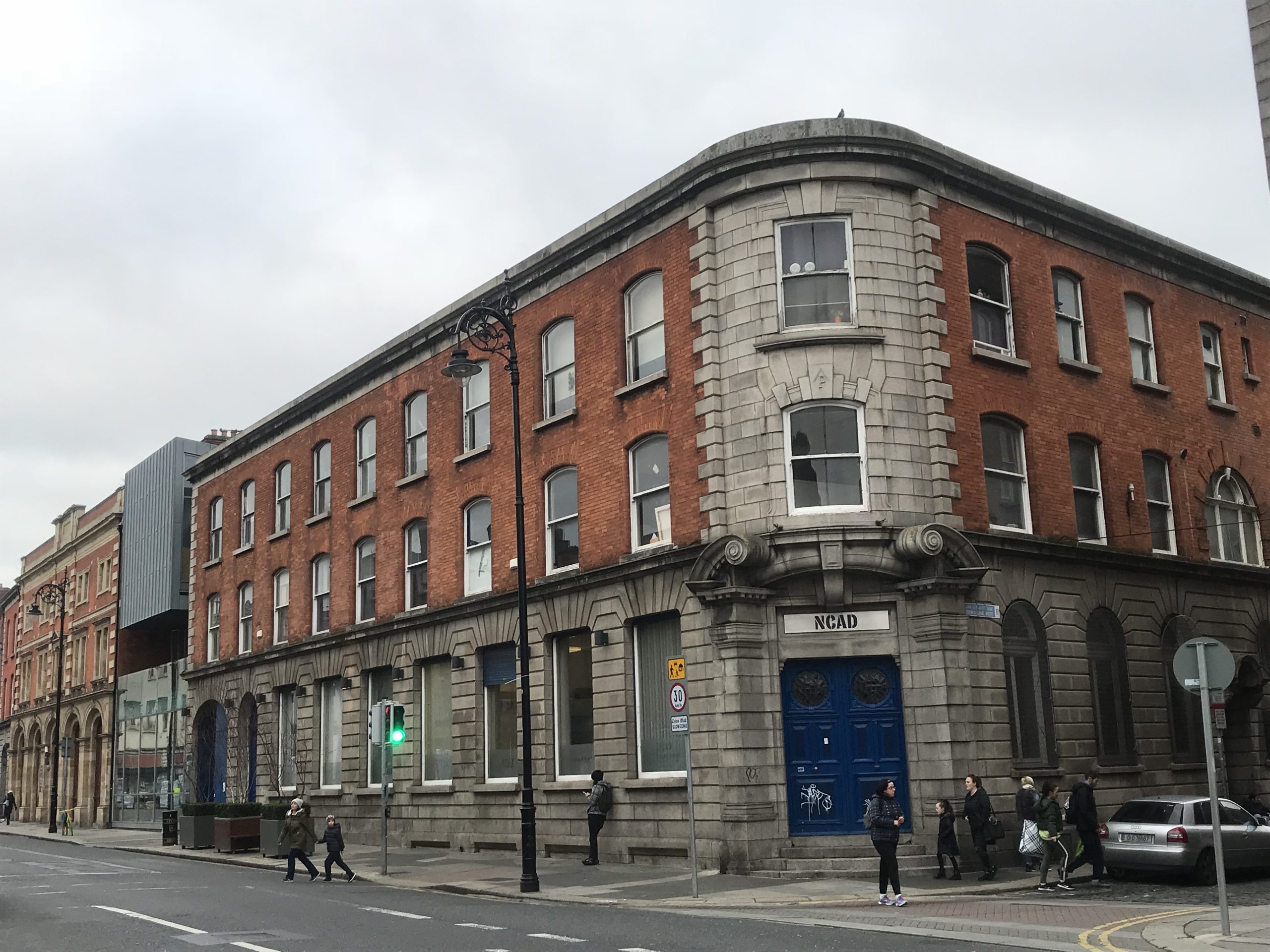
By the mid‑1970s National College of Art and Design restructured internally — introducing a faculty system dividing Fine Art, Design, History of Art & Design (Visual Culture), Education and Pre‑Diploma studies. This reorganisation helped modernise the college, making it more responsive to changes in art, design and society. Finally, in 1980 National College of Art and Design moved to its present campus in the Liberties area of central Dublin, located on Thomas Street. The site was formerly a distillery, and the campus combines historic buildings with modern facilities. Since then, the institute has remained based there, serving hundreds of full‑time and part‑time students from Ireland and around the world.
The School of Fine Art teaching combines the traditional disciplines such as drawing and painting with an open experimental approach which allows individuals to realise their ideas in a wide range of media. The Department of Applied Materials in the School offers opportunities for students to develop a deep understanding and engagement with textiles, ceramics and glass. Through contact with teachers who are practising artists, students become familiar with the activities and the ideas of artists working in society today. Students also become familiar with the fundamentally questioning nature of contemporary art and of the variety and expanding range of practices which make up the field. It is an intensely creative education, not only for artists but for others who may build careers in the media and the arts.
The School of Design is the largest in the College and comprises jewellery and objects, fashion design, industrial and product design, textile design and visual communication. In design the emphasis is on solving specific problems set by project. While students are expected to master the relevant technologies, the aesthetic design factor is stressed equally. There are many links with industry and students often work on competitions sponsored by commercial firms. The College aims to promote a broad education in design which can be the basis for a variety of careers either as part of a team in industry or by working individually in a studio or small business.
The School of Visual Culture interacts with other schools in providing the visual culture elements of all NCAD degrees. In both the fine art and design courses, the element of history and theory of art and design is essential in assisting artists and designers to place themselves within a larger historical, intellectual, social and stylistic context. Within contemporary fine art practice, theory has become increasingly important. The Joint Course BA degree makes special provision for the student who wishes to explore art history and studio practice in art and design to an equal extent. For all students there is a requirement to attend regular lectures and submit written papers culminating in a thesis in the final year. The School of Visual Culture also offers an undergraduate degree in Visual Culture as well as a number of postgraduate taught and research degrees (PhD).
The School of Education provides for the education of teachers of art, craft and design in second-level schools. There are two modes available: the four-year joint honours degree in Design or Fine Art and Education, and the two-year Professional Master of Education in Art & Design. The School also provide a two-year Professional Master in Socially Engaged Art (part time mode). The Centre for Continuing Education in Art and Design is part of the School of Education and offers a range of part-time courses including certificate courses.
Artists and designers of international repute are invited to teach or give special lectures in the College. Exchange programmes with colleges and universities in Europe and the United States take place annually. Individual staff members are linked to numerous professional organisations at home and abroad. The College is a member of the European League of the Institute of the Arts.
VISION
From its earliest days, National College of Art and Design has aimed to provide rigorous education in drawing and design Fundamentals. The founding drawing school under Robert West, absorbed by the Dublin Society, sought to raise standards in drawing, ornament and architectural design, reflecting broader Enlightenment ideals of skill, craftsmanship and public utility. Over time the vision evolved to recognise the value of art not just as craft but as a medium for cultural expression and national identity.
With the establishment of National College of Art and Design under the 1971 Act, the vision expanded to make art and design education more accessible and relevant to Irish society. The restructuring in the mid‑1970s reflects an ambition to democratise art education, responding to student advocacy for inclusiveness, relevance and social engagement in art. Today its vision combines traditional craft skills with contemporary design thinking, encouraging students to push boundaries. The aim is to produce designers, artists and educators who understand historical context, social responsibility and creative innovation — equipping them to contribute meaningfully to both the Irish and global arts, design and cultural landscape.
TOP DESIGN COURSES
Art in the Contemporary World is a taught masters programme that examines contemporary art practices and their contexts. The course offers an opportunity for focused engagement with the varied challenges presented by today’s most ambitious art. It bridges the relationship between theory and practice by creating exciting study options for artists, curators, writers and other practitioners. We welcome graduates from a variety of backgrounds, including: fine art; art history; philosophy; literature; film studies; architecture; communications; or design; and we are also happy to consider applications from students from other backgrounds.
BA Fashion Design aims to educate students to become professional practitioners in the field of fashion and related industries. The department places great value on its industry and professional links that gives students an insight into real-world commercial requirements. Emphasis is placed on developing informed, creative designers, who are prepared for the needs of industry. Elements covered include visual research, drawing, design process, fashion design, knitwear design, pattern cutting, garment construction, illustration presentation, manufacturing techniques and market research. There is a focus on understanding fashion in context and students will undertake field research, trend analyses, customer profiling and branding within a wide range of contexts for the fashion industry. Students will also be able to develop links with historical fashion and Material Culture through practical application of Visual Culture
Studio+ is an optional year open to all Design students allowing you to engage with the world beyond National College of Art and Design by gaining practical work experience in the form of internships and industry placements on live commercial, social or community projects. Studio+ can also include a work placement abroad or a study abroad period through the Erasmus programme with internationally recognised art and design faculties partnered with National College of Art and Design.
Jewellery and Objects BA embraces numerous types of creative practice and students are supported to develop the skills to pursue personal expression through the gallery market, or forge a career in industry. Jewellers are encouraged to create designs that challenge notions of the body, fashion, gender and the environment. Students develop skills in working with precious metals, and experiment with non-traditional materials, such as paper, textiles and plastics.
Similarly, goldsmiths and silversmiths explore the interaction between fine metalworking and ideas, through the creation of domestic objects and fine luxury products, exploring radical forms and processes. The programme aims to facilitate the development of individual craft and design skills that increasingly allow each student the freedom to pursue and realise ideas in appropriate media. It encourages students to develop a personal approach to the research and development of creative design solutions through an in-depth knowledge of traditional making skills and cutting edge technologies. With individual bench spaces, machine workshops and studio, the programme provides the perfect environment to experiment and explore in pursuit of personal expression.
JOB INTEGRATION SERVICES
Students graduating from National College of Art and Design benefit from a combination of academic rigour, creative and technical skills, and exposure to Ireland’s cultural and design industries. The education model emphasises studio‑based learning, craft, design thinking, and theory — preparing students for careers as artists, designers, educators, or craftspeople. National College of Art and Design’s affiliation with UCD provides graduates with a degree recognised broadly within Ireland and internationally — giving them academic credibility and potentially smoother access to further studies or professional opportunities. Through its mixture of disciplines — fine art, design, visual culture, education — and a network of galleries, studios, cultural institutions and creative industries in Dublin, National College of Art and Design offers graduates a platform for employment: they can work in design studios, cultural institutions, education, craft workshops, commercial design firms, or pursue independent practice.
Contact with business owner
 Your request has been submitted successfully.
 Own or work here?
Claim Now!
Claim Now!
Own or work here?
Claim Now!
Claim Now!