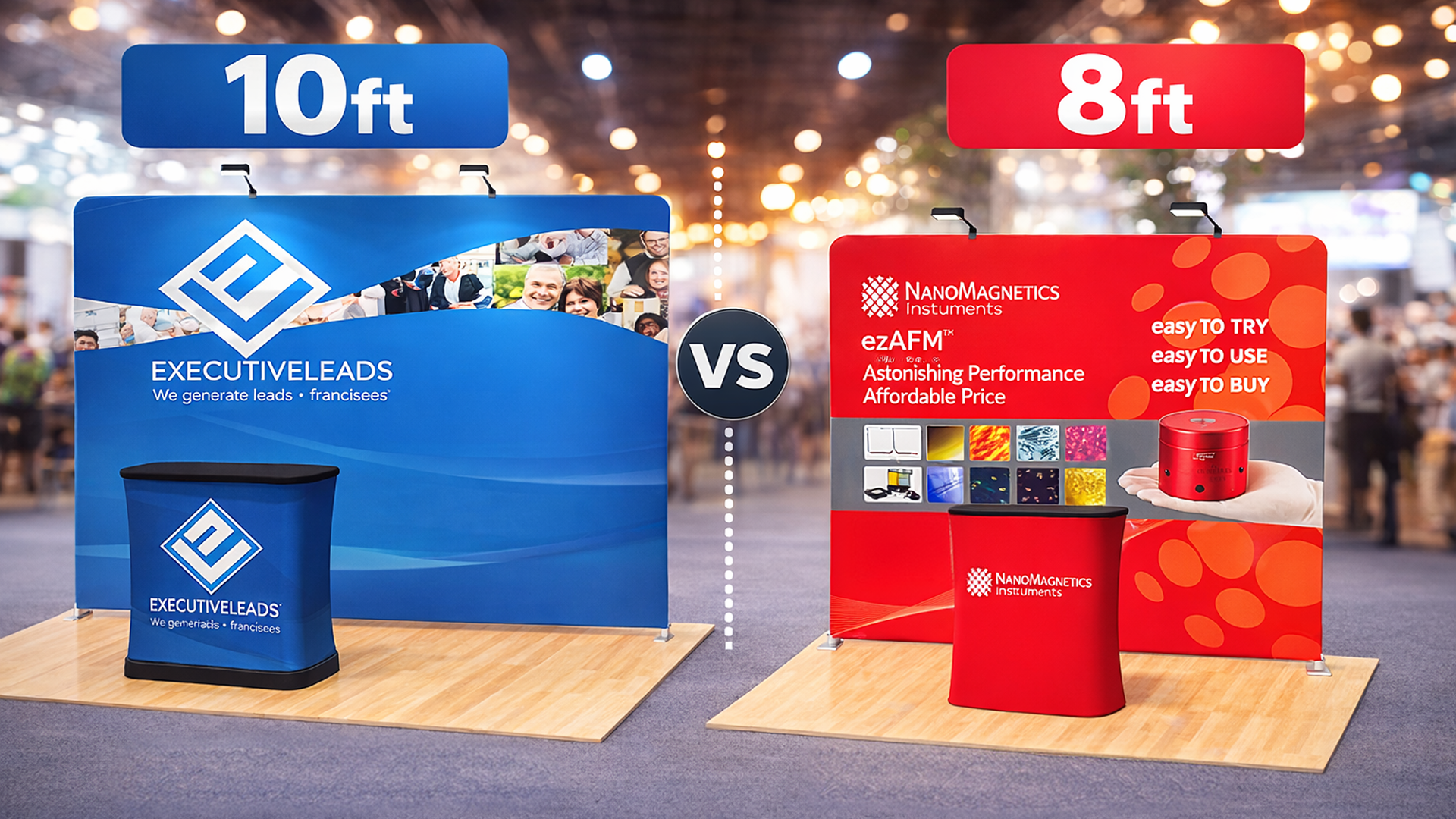
8ft vs 10ft Tension Fabric Displays – Which One Fits Your Booth
Choosing between an 8ft and a 10ft tension fabric popup display booths is one of those decisions that sounds minor until you arrive at a show, set up your display, and either have two feet of empty wall space or two feet of display hanging off your rented footprint. Both mistakes happen constantly, and both are completely avoidable.
This blog gives you the specific criteria you need to make the right call before you order.
Why Tension Fabric Displays Changed the Trade Show Floor
Before tension fabric systems became the standard, exhibitors transported heavy aluminium frames, foam board graphics, and piles of hardware in cases that required hand trucks and fifteen-minute setup windows. A modern tension fabric display collapses into a bag you can carry onto a plane, sets up in under five minutes, and produces a seamless printed graphic that reads as a premium brand asset from across a hall.
The format earned its dominance because it solves real problems: portability, speed, print quality, and reusability. What it did not eliminate is the sizing question. And that question matters.
The Actual Dimensions: What 8ft and 10ft Mean in Practice
Neither measurement refers to the exact width of the display. They refer to the standard booth space the display is designed to fill.
An 8ft tension fabric display typically produces a finished graphic width of 88 to 92 inches, which is 7.3 to 7.7 feet. It is designed for an 8-foot wide booth space and leaves a few inches of clearance on each side for table placement, standing room, and structural stability.
A 10ft tension fabric display typically produces a finished graphic width of 115 to 120 inches, which is 9.5 to 10 feet. It fills a standard 10×10 booth space wall-to-wall or nearly so.
The height for both formats is generally consistent, ranging from 89 to 96 inches, depending on the specific frame system. This keeps your brand eye-level and above.
Booth Space: The Non-Negotiable Starting Point
Your booth space determines your display size more than any other factor. This sounds obvious, but exhibitors regularly purchase a 10ft display for an 8ft booth because “it looks bigger in the brochure,” and then cannot fit it without the display either overlapping neighbouring booths or bowing inward.
If your contracted booth space is 8ft wide, your display is an 8ft display. If you have a 10×10 booth, you have the option of either a 10ft display that fills the back wall or an 8ft display paired with additional side or counter elements.
Where it gets more interesting is when your booth is in line versus corner placement. A corner booth opens the possibility of two narrower displays angled to face traffic from two directions, which often outperforms a single wide display in terms of visibility and approach.
8ft Displays: When Smaller is the Strategic Choice
An 8ft tension fabric display is not a compromise version of the 10ft. It is the right choice in specific situations, and exhibitors who default to “bigger is better” often end up with a display that fights their booth layout rather than supporting it.
When your booth uses a significant amount of physical product display. If you have a counter, a demo table, a podium, or any freestanding product display, those elements need floor space and table clearance. An 8ft backdrop gives you room to breathe. A 10ft backdrop pushed up against a full table setup creates visual compression that makes the booth feel smaller, not larger.
When you exhibit frequently and transport matters. An 8ft tension fabric display frame fits into a significantly smaller carry bag than a 10ft. For exhibitors who fly to events or who ship displays, the size and weight difference is meaningful. Some 8ft systems pack into a tube that qualifies as airline luggage. Very few 10ft systems offer the same.
When you operate in 8ft booth spaces specifically. Many regional shows, community events, and association conferences assign 8ft booths as their standard unit. If your event calendar includes these regularly, an 8ft display is not the entry-level option, it is the accurate option.
When your graphic concept is wide and panoramic. This sounds counterintuitive, but wide landscape graphics sometimes read better with defined boundaries. An 8ft graphic with strong horizontal composition and deliberate left and right edges can feel more designed than a 10ft graphic that sprawls. Graphic design shapes this choice as much as booth dimensions.
10ft Displays: The Power of the Full Wall
A 10ft tension fabric display filling a 10×10 booth back wall is one of the most visually powerful things an exhibitor can do at a standard show. The math is simple: when your graphic spans the entire back wall, there is no visual gap between your brand and the perimeter of your space. The booth becomes a branded environment rather than a table with a sign behind it.
When your primary goal is brand awareness. Exhibitors who are building recognition at a new show, entering a new market, or competing alongside well-established brands benefit disproportionately from a large, seamless graphic. A 10ft display at a 10×10 booth maximizes the percentage of visual attention your back wall captures from attendees walking the aisle.
When your booth is front-facing only. If you are in an inline booth with foot traffic coming from one direction, the back wall is your primary billboard. Making it as large as possible is the right call.
When your graphic content requires space to breathe. Large photography, wide product shots, environmental lifestyle images, and multi-panel narratives all read better at 10ft than at 8ft. If your graphic team has designed something meant to be experienced as a full-width visual, a 10ft display honors that investment.
When you have staff and do not need a counter. Some exhibitors who staff two to three people in a 10×10 booth need nothing more than a back wall display and business cards. The entire floor area is for standing, meeting, and conversation.
Total Cost Comparison: Sizing Up the Investment
The cost difference between 8ft and 10ft tension fabric displays is meaningful but not dramatic. A quality 8ft straight frame system with a full-color dye-sublimation fabric graphic typically runs in the $400 to $700 range from a professional supplier. A comparable 10ft system runs $600 to $1,000, depending on frame quality and graphic complexity.
Where the cost compounds are in replacement graphics. A 10ft replacement graphic naturally costs more fabric and print time than an 8ft replacement. For exhibitors who update their graphics seasonally or for specific campaigns, this recurs every cycle.
Backlit configurations at either size carry a significant premium, typically $1,500 to $3,000 for the frame and initial graphic, but the return in booth attention and perceived brand quality justifies that investment for exhibitors participating in competitive national shows.
The Decision Framework: Four Questions to Ask Before You Order
- What is the exact contracted width of my booth space?
- What other physical elements (tables, counters, product displays, tech) share that space?
- Do I fly to events or drive? Does my display need to be airline-friendly?
- Is my primary goal at this show brand awareness or lead generation through conversations?
If your answer to question two involves significant physical elements, go 8ft. If your answer to question four is brand awareness and your back wall is your primary marketing surface, go 10ft. If you fly to shows regularly, 8ft wins on logistics alone unless you are willing to ship the 10ft ahead.